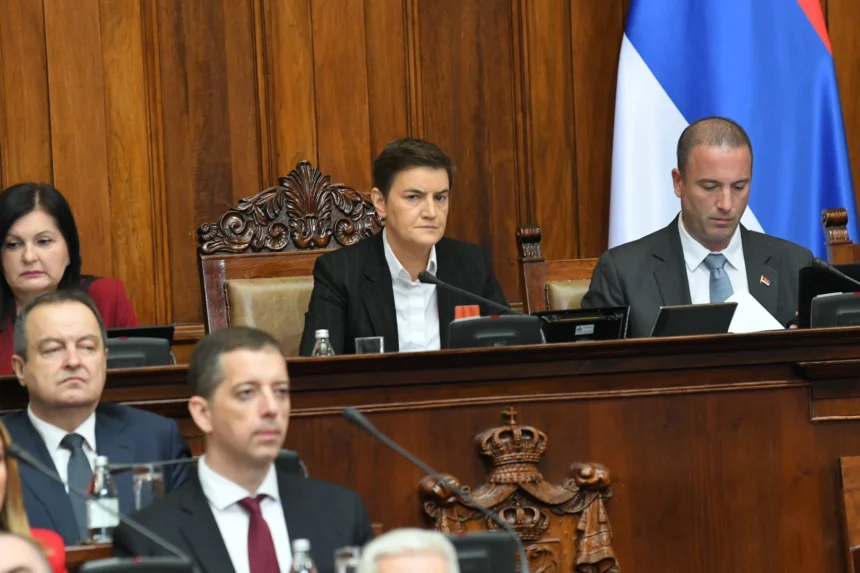
In an analytical piece published for the 118th edition of Politika, Aleksandar Ivković, an associate of the Center for Contemporary Politics and news editor at European Western Balkans, explores how the ruling Serbian Progressive Party (SNS) has systematically eroded parliamentary norms, transforming the country’s legislative body into a mere facade.
Drawing structural parallels to Steven Levitsky and Daniel Ziblatt’s seminal book How Democracies Die, Ivković argues that the collapse of democracy does not always require a violent coup. Instead, it happens through the gradual decay of unwritten democratic norms—specifically, the concept of “institutional forbearance.”
The Decay of Institutional Forbearance
Institutional forbearance dictates that political actors should avoid actions that, while respecting the letter of the law, fundamentally violate its spirit. When this norm is abandoned, political institutions weaponize their technical prerogatives, plunging the system into polarization and dysfunction.
Ivković highlights how the Serbian government has mastered this tactic in 2026 to completely evade executive accountability:
- The Generalštab Obstrucion (February 2026): Following the controversial Generalštab (Military Headquarters) case, opposition MPs utilized Article 130 of the Constitution to submit a formal motion of no confidence against the government.
- The Ghost Parliament: The ruling majority delayed scheduling the mandatory session for two months. When the session was finally called, majority MPs intentionally withheld a quorum, successfully freezing the assembly. Technically, no written law forces MPs to provide a quorum, but the spirit of the Constitution was openly violated.
A History of Strategic Evasion
This pattern of structural obstruction is not an isolated incident. Ivković recalls a nearly identical constitutional crisis that unfolded in November 2024 following the catastrophic Novi Sad railway station canopy collapse.
- The Validation Dispute: After the disaster, the opposition submitted its first motion of no confidence. The Speaker of the National Assembly refused to place it on the agenda, citing a technical dispute over the validity of just two signatures—even though the motion retained far more than the legally required 60 signatures.
- The Pocket Veto: While an appeal was sent to the Constitutional Court, the matter was quietly shelved in a drawer. The Assembly failed to hold a single session from late November 2024 until March 2025—a period marked by the largest wave of civil protests in modern Serbian history.
- Miloš Vučević’s Resignation: The freeze continued until early March 2025, when the government of Miloš Vučević resigned, rendering the opposition’s motion legally moot and allowing the executive to bypass a public, televised grilling.
The Rise of the One-Party Monopoly
Ivković points out a telling metric regarding parliamentary efficiency. Between 2020 and 2022, when the opposition boycotted elections and the parliament was led by Ivica Dačić, the single-party assembly was a model of mechanical efficiency, zaseding for 100 days in 2021 alone.
However, since the opposition returned to the benches in 2022, the ruling party has drastically reduced the parliament’s footprint to prevent it from acting as an oversight body. Between 2022 and 2025, the parliament met for an average of only 36 days a year—nearly three times less.
Parliamentary Session Days Per Year:
2021 (No Opposition):  ██████████████████████████████ 100 Days
2022-2025 (Average):   ██████████ 36 Days
This structural subjugation of the legislative branch began as early as 2017, when the SNS halted assembly sessions entirely during the presidential election to deprive the opposition of a public platform, later sabotaging budget debates with hundreds of meaningless, time-wasting amendments.
Public Apathy and the Illusion of Permanence
The systematic dismantling of parliament has done little to dent the popularity of the SNS. According to an April 2026 Eurobarometer survey, a mere 31% of Serbian citizens express trust in the National Assembly—a figure that has remained virtually unchanged since 2012. While European Union averages are only slightly higher at 37%, the deeper issue in Serbia is an institutionalized “syndrome of lifelong rule.”
The Missing Consensus: Democratic systems rely on the consensus that politics is a game of alternating power—where today’s ruler is tomorrow’s opposition. However, when a single dominant party controls the state for 14 consecutive years, the belief in democratic transition vanishes among the political elite.
Ivković concludes that when a regime convinces itself it will remain in power indefinitely, it loses all incentive to maintain institutional norms. Yet, the very fact that the Vučić administration goes to such extreme lengths to obstruct parliamentary debates proves that the institution of parliament still holds latent power. Even if the legislative body has been turned into a architectural facade, its underlying constitutional standards remain the only viable roadmap for restoring Serbian democracy whenever favorable political conditions return.