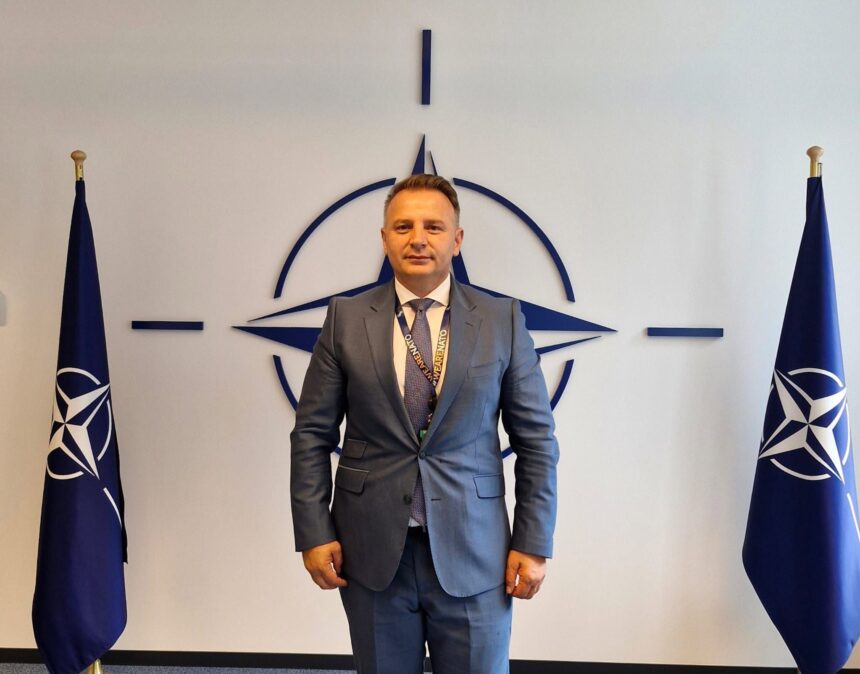
Kosovo’s Ambassador for Relations with NATO, Astrit Zemaj, has responded to what he described as inaccurate and politically motivated interpretations regarding the Republic of Kosovo’s non-participation in the NATO Summit.
In a public statement, Zemaj said that social media posts and some media reports have attempted to create false narratives about Kosovo’s relationship with the Alliance, stressing that NATO summits are well-defined institutional processes and not events that can be interpreted through the lens of domestic political interests.
“Any attempt to portray Kosovo’s absence as a ‘political message’ is unfounded, distorted, and ultimately harmful to understanding the institutional reality,” Zemaj stated.
He recalled NATO’s historic role in 1999, describing the Alliance’s intervention as decisive in stopping the violence, terror, and crimes committed by the former Serbian regime against the people of Kosovo. According to him, that intervention paved the way for peace, freedom, and Kosovo’s state-building process.
Zemaj emphasized that NATO summits are governed by institutional rules based on the status of member states and partner countries, rather than political preferences or media narratives.
He also highlighted that for more than two decades, KFOR has been the main guarantor of security and stability in Kosovo, while NATO’s Advisory and Liaison Team (NALT) continues to play an important role in the country’s institutional and strategic development.
According to Zemaj, Kosovo remains fully committed to its Euro-Atlantic path and its strategic objective of full membership in NATO. He argued that any narrative aimed at undermining Kosovo’s relationship with the Alliance or weakening institutional trust between Kosovo and NATO is both politically harmful and factually inaccurate.
“Kosovo is not diverted by any fabricated narrative. Our path and objective remain clear and unchanged: a deep partnership with NATO and continued integration toward full membership in the Alliance and other Euro-Atlantic structures in the future,” Zemaj concluded.