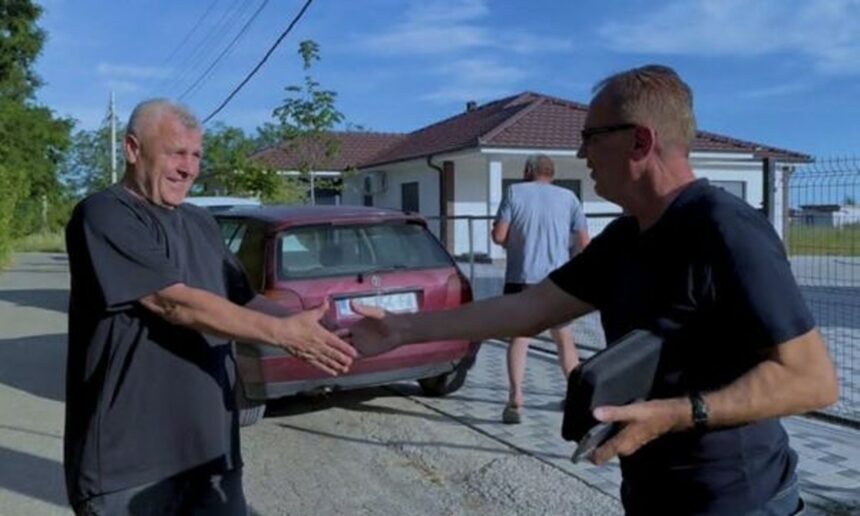
In a small café in the center of Vitomirica, Mehmet Bajraj and Omer Daciq meet almost every afternoon. One is Albanian, the other Bosniak, but for years they have shared the same table as friends. For them, these gatherings have become an inseparable part of daily life and a testament to the fact that communication, respect, and human connection remain essential values in this settlement of the Municipality of Peja.
Mehmet Bajraj says that regular meetings with his friends have become a daily tradition.
“Whenever we have a bit of free time, we call each other to see where we are having coffee. We have a place where we meet regularly and spend time together,” he says.
What unites the residents is not only the years they have spent living side by side, but also the belief that understanding and communication are among the greatest achievements of post-war Kosovo. According to Bajraj, the presence of different communities enriches everyday life and creates opportunities to exchange experiences, cultures, and ideas.
“The more communities that live in one place, the more cultures there are, better ideas emerge, and valuable experiences can be gained from each community,” he says.
Bajraj believes that positive relations among residents have directly contributed to Vitomirica’s development.
“If there had not been good communication among us, Vitomirica would not have been built as beautifully as it is today. Without cooperation at work and in everyday coexistence, it would not be what it is now,” he adds.
The same view is shared by Omer Daciq from the Bosniak community. He says Vitomirica has long been known for strong interethnic relations.
“You have come to a place known for good interethnic and international relations. Vitomirica has always been recognized for this. We socialize, cooperate, and help one another whenever needed,” says Daciq.
His years of experience as a teacher have convinced him that mutual respect has also been cultivated in schools.
“Not only were relations between teachers of different nationalities good, but relations among students were good as well. We almost never had incidents among students because of their ethnic background,” he says.
Daily coexistence is also reflected in the experiences of members of the Egyptian community. Zeqë Beqiraj, who has lived in Vitomirica for several years, says relations with neighbors are based on mutual respect.
“I have lived here for five or six years. I get along well with both Bosniaks and Albanians. We spend time together with our neighbors, eat together, and talk together. We have no problems,” he says.
Harmony among communities is also visible in the local economy. Refko Baliq, a member of the Bosniak community who works in livestock farming, says most of his customers are Albanians and that cooperation is a natural part of daily life.
“Most of my customers are Albanians, and I have excellent relations with them. Things are much better now; there is more freedom and more opportunities for progress,” he says.
For the people of Vitomirica, religious and national holidays are among the moments that bring communities closest together.
“We celebrate Eid together with everyone, and when someone is in need, we help them,” says Refko.
Omer Daciq emphasizes that solidarity extends far beyond holidays.
“When Eid comes, we visit one another. We attend each other’s weddings when invited, and they come to ours as well. During times of mourning, whether we are invited or not, we all go together,” he explains.
As Kosovo marks its Liberation Days, residents say freedom should serve as a point of unity for all citizens.
“Freedom gives you many opportunities. The celebrations of the liberation of municipalities and all of Kosovo are very special and should unite us all. Freedom provides space for life, development, and economic advancement,” says Mehmet Bajraj.
However, one concern shared by nearly all communities is the departure of young people from the country.
“A large number of young people, both from the majority community and minority communities, have gone abroad. This is a great loss for us and for Kosovar society,” says Daciq.
For the residents of Vitomirica, coexistence is not merely a concept or a slogan. It is visible at the tables where coffee is shared, in the holidays celebrated together, in support for families in need, and in the mutual respect among neighbors.
In a multiethnic Kosovo, they believe that freedom and peace are measured not only by anniversaries and ceremonies, but by the ability to live, work, and build a future together.