The European Union has unveiled a historic, fast-tracked economic lifeline for Armenia, deploying an aggressive trade mechanism originally reserved for war-torn Ukraine. The sweeping package is explicitly designed to buffer the South Caucasus nation against intensifying retaliatory trade restrictions from Moscow.
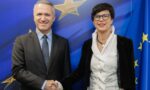
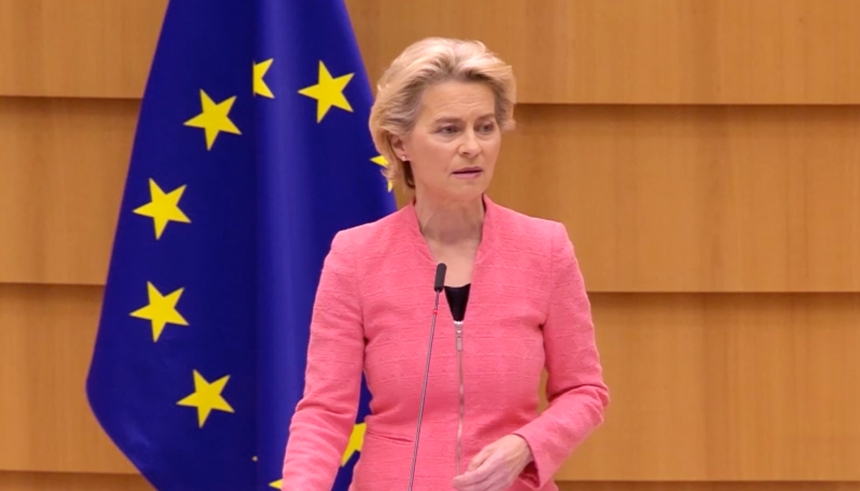
European Commission President Ursula von der Leyen announced the groundbreaking initiative on Thursday, July 2, 2026, during a high-stakes diplomatic visit to Yerevan. Joined by Enlargement Commissioner Marta Kos, von der Leyen met with Armenian Prime Minister Nikol Pashinyan to cement the country’s strategic pivot away from the Kremlin.
The visit carries deep political symbolism, marking the first arrival of a Western head of state since Pashinyan’s pro-European Civil Contract party secured a decisive parliamentary majority in last month’s tightly contested June elections.
The Deal: Tariffs Slashed for 450 Million Consumer Market
At the heart of the package are Autonomous Trade Measures (ATMs)—the exact economic instrument Brussels leveraged to keep Ukraine’s economy afloat. Once formally rubber-stamped by the European Parliament and EU member states, the temporary measures will fundamentally rewrite trade dynamics in the region:
- Mass Market Liberalization: The EU will completely eliminate tariffs and open its single market to roughly 80% of all Armenian exports.
- Targeted Agricultural Safeguards: The emergency rules will immediately remove barriers for 99% of Armenia’s fresh fruits, vegetables, and plant products, alongside more than 91% of its alcoholic beverages and spirits.
- Rapid Deployment Experts: To expedite the trade shift, the European Commission will dispatch dedicated technical teams to Armenia by mid-July 2026. These specialists will work on-the-ground with local farmers and businesses to align export logistics with strict EU sanitary and quality standards.
       [EU-ARMENIA EMERGENCY STABILIZATION PACKAGE]
                            │
       ┌────────────────────┴────────────────────┐
       ▼                                         ▼
 [TRADE LIBERALIZATION]                 [FINANCIAL INJECTIONS]
 ──────────────────────                 ──────────────────────
 • 80% of all exports tariff-free       • €18M immediate release
 • 99% of fresh produce & flowers         (completing €52M June pool)
 • 91% of spirits & beverages           • Part of broader €288M
 • Direct EU expert alignment             long-term support budget
Countering Moscow’s Trade Blockades
The sweeping intervention comes in direct response to an aggressive economic offensive orchestrated by Moscow. In the high-stakes weeks leading up to Armenia’s June election, the Kremlin imposed wide-ranging import bans on Armenian goods under the guise of regulatory non-compliance—most notably blocking imports of Armenian flowers and agricultural products.
The blockade threatened to cripple local producers, given that Russia historically swallowed roughly 35% of Armenia’s foreign trade, compared to the EU’s modest 11%.
“I know Armenia is still facing significant economic pressure from Russia,” von der Leyen stated during a joint press conference in Yerevan. “But rest assured: when pressure mounts on our partners, the EU steps up. The recent elections have shown the strength of Armenia’s democracy. The Armenian people have chosen reform and a closer partnership with our Union. No country should be pressured for a sovereign choice.”
To complement the tariff removals, von der Leyen announced the immediate release of €18 million in direct economic funding, clearing the remaining balance of a €52 million emergency resilience package drafted in early June. The capital injection will fund a brand-new national export promotion agency.
A Regional Shift Toward the West
Prime Minister Pashinyan hailed the development, highlighting that Armenia will become the first nation in EU history to benefit from an ATM package without holding official EU candidate status or a pre-existing comprehensive Free Trade Agreement.
The economic package lands alongside a broader regional €200 million South Caucasus Connectivity Package announced earlier by Brussels, which aims to fund major transport, digital, and green energy infrastructure bridging Armenia, Turkey, and Azerbaijan.
With the trade framework moving toward rapid implementation, Pashinyan reiterated his administration’s next major geopolitical target: achieving a fully functional visa-free travel regime with the European Union by 2029, with assessment missions slated to arrive in Yerevan this autumn.