In a major recalibration of its strategic foreign policy, Ukraine is positioning itself as a global security exporter. Kiev aims to finalize comprehensive defense pacts with at least seven NATO member states by the end of December.
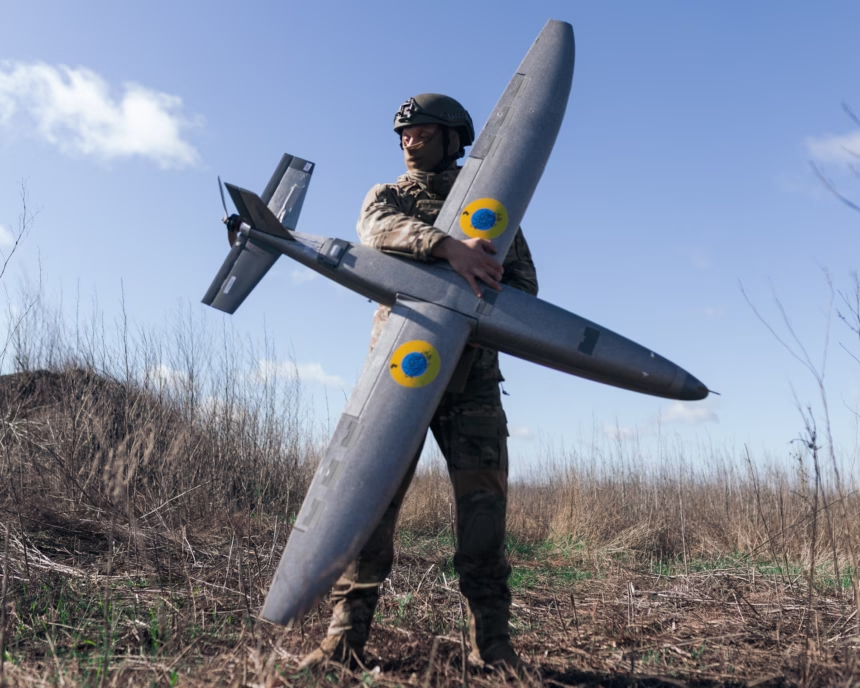
The initiative, colloquially dubbed the “Drone Agreements,” marks a dramatic shift. After four years of relying primarily on Western military aid pipelines, Ukraine is leveraging its unmatched battlefield experience to provide cutting-edge anti-unmanned aerial vehicle (UAV) defensive architecture and operational software to international allies.
                    [THE UKRAINIAN DRONE DIPLOMACY MATRIX]
                                       │
         ┌─────────────────────────────┴─────────────────────────────┐
         ▼                                                           ▼
  [THE ACTORS IN PLAY]                                        [THE STRUCTURAL PACKAGE]
  ────────────────────                                        ────────────────────────
  • SECURED: Latvia, Lithuania, Azerbaijan,                    • Tactical sensor arrays and field radars.
    Saudi Arabia, UAE, and Qatar.                             • Proprietary software for EW interception.
  • TARGETED: Seven additions across Western                  • Strategic audits of urban vulnerability.
    and Northern NATO borders by year-end.                     • Advanced baseline kinetic interceptor drones.
Middle East Expansion Triggers Global Framework
The structural architecture of Kiev’s drone diplomacy matured rapidly following the explosive expansion of the US-Israel conflict with Iran. When Tehran-backed forces deployed waves of long-range Shahed kamikaze drones across the Gulf region, multiple Middle Eastern powers discovered their multi-billion dollar air defense umbrellas were unequipped for asymmetric swarm tactics.
To bridge this tactical gap, three major Gulf states—Saudi Arabia, the United Arab Emirates (UAE), and Qatar—discreetly signed formal security agreements with Kiev.
“An interceptor drone is just a physical piece of hardware; it doesn’t guarantee you can actually down a Shahed,” explained Davyd Aloian, Deputy Secretary of Ukraine’s National Security Council. “You need the physical platform, but you also need subcomponents, advanced sensors, ground control tracking, and, most critically, integrated radar software.“
Exporting an Ecosystem, Not Just Hardware
Because domestic defense factories face strict operational controls to prioritize Ukraine’s active front lines, the treaties do not focus on shipping finished military inventory out of the country immediately. Instead, Ukraine is exporting institutional knowledge and structural ecosystems.
| Phase of Engagement | Technical Execution | Long-Term Strategic Value |
| Phase 1: Tactical Audit | Elite Ukrainian military engineer cells deploy to partner states to map geographic vulnerabilities. | Pinpoints optimal placement for electronic warfare (EW) nodes. |
| Phase 2: Architectural Build | Integrating multi-tiered interceptor grids using Western tech modified by Ukrainian field logic. | Bypasses reliance on scarce, million-dollar Patriot missiles for cheap targets. |
| Phase 3: Industry Priority | Signatories secure priority manufacturing slots for future Ukrainian combat tech as factory lines expand. | Locks in long-term global supply chains centered in Kiev. |
According to Michael Kofman, senior fellow at the Carnegie Endowment for International Peace, Ukraine’s primary value proposition is its ability to build an all-inclusive air defense blueprint. Kiev provides the exact algorithmic integration needed to make disparate interceptor arrays communicate in real time during a saturation strike.
Securing the NATO Flank
As focus shifts to NATO, frontline European states are scrambling to adapt. The urgency was underscored by a massive political crisis in Latvia, where the government collapsed following a severe security lapse when two long-range Ukrainian strike drones—thrown entirely off-course by Russian electronic jammer networks—crashed directly into a domestic oil storage depot.
By fast-tracking agreements with NATO’s eastern corridor, Kiev is achieving a dual objective: fortifying European airspace against shared border threats while ensuring Ukraine remains an indispensable geopolitical anchor on the global security agenda.