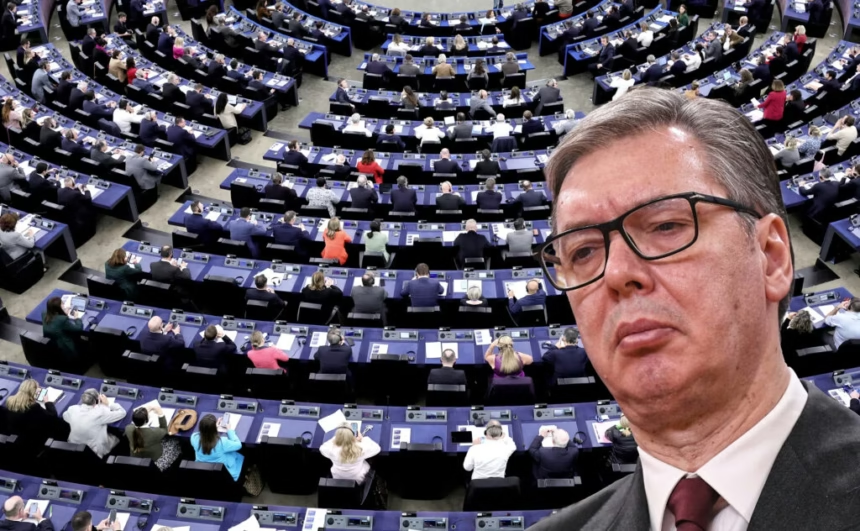
Ahead of a pivotal European Parliament vote scheduled for July 7, 2026, a major political row has erupted over efforts by the European People’s Party (EPP) to bypass floor debates on a highly critical new Resolution on Serbia.
The political maneuvering by the EU’s largest voting bloc—where Serbia’s ruling Serbian Progressive Party (SNS) holds associate membership—has sparked intense scrutiny. Critics suggest the EPP attempted to suppress a public floor debate to shield Serbian President Aleksandar Vučić from sharp, public cross-examination on the European stage.
The Procedural Clash: A Compromised Debate
While annual progress resolutions for all Western Balkan candidate states were adopted collectively on June 17, the European Parliament designated a standalone, separate session for Serbia due to the high volume of critical amendments submitted by lawmakers.
Just four days before the plenary session, EPP representatives lobbied behind closed doors to skip the debate entirely and push the text directly to a vote. Following pushback from rival political groups, a compromise was reached to hold a severely truncated debate, allowing only one representative per political group to speak.
                  [THE STANDALONE SERBIA RESOLUTION PIPELINE]
                                       │
        ┌──────────────────────────────┴──────────────────────────────┐
        ▼                                                             ▼
 [INITIAL PLENARY PLAN]                                        [EPP MANEUVER & COMPROMISE]
 ──────────────────────                                        ───────────────────────────
 • Deep parliamentary scrutiny.                                • EPP lobbied for immediate vote with zero debate.
 • Broad floor participation.                                  • Compromise reached: Strict procedural time limit.
 • High volume of critical amendments.                         • Only one speaker permitted per political group.
“Overt Anxiety in Belgrade”
Members of the European Parliament (MEPs) contend that procedural silencing cannot hide the severe tone of the text, which details democratic stagnation and institutional capture.
“I hope no one is celebrating prematurely, because the core is not the duration of the debate, but the text of the Resolution itself,” Slovenian MEP Irena Joveva told Nova.rs. “The substance represents a realistic reality check, and its tone is quite harsh. It clearly causes a certain level of anxiety among some in Serbia, because it explicitly shows how much progress has been made over the past year—or rather, whether there is any at all.”
Joveva added that despite internal EPP defense mechanisms, the underlying consensus among Liberals, Socialists, and even mainstream EPP lawmakers remains aligned regarding Serbia’s distinct lack of reform.
A Pattern of Executive Backsliding
Austrian MEP Andreas Schieder expressed regret that the EU is sending a weak signal by restricting debate times, emphasizing that recent local clampdowns demand deeper parliamentary exposure.
“It would be of crucial importance to debate the current situation in Serbia in much greater detail, and to look back at the latest developments, such as the direct attacks on media freedom in the country,” Schieder noted.
| Policy Sector | EU Assessment Core | Key Systemic Risks |
| Judicial Independence | Ongoing political interference in high-profile probes. | Weaponization of state prosecutors against civic activists and student protestors. |
| Media Freedom | Tightening state control over the media landscape. | Systematic coordination between law enforcement and pro-government tabloids to leak private interrogation data. |
| Financial Oversight | Increased risk of corruption in major state vanity projects. | Call for EU funding suspensions, specifically targeting EXPO 2027, if structural irregularities persist. |
The Shadow of Previous Sanctions
The friction surrounding this draft follows the landmark resolution adopted in October, which passed by an overwhelming 457 to 103 votes. That resolution condemned the government’s handling of the Novi Sad railway station canopy tragedy and demanded independent investigations under the threat of frozen accession funds.
With Belgrade facing growing pushback from individual EU member states—including recent vetos by countries like the Netherlands over rule-of-law deficits regarding the opening of Cluster 3 negotiations—the EPP’s defensive strategy appears increasingly isolated against a broader European consensus demanding systemic accountability.