
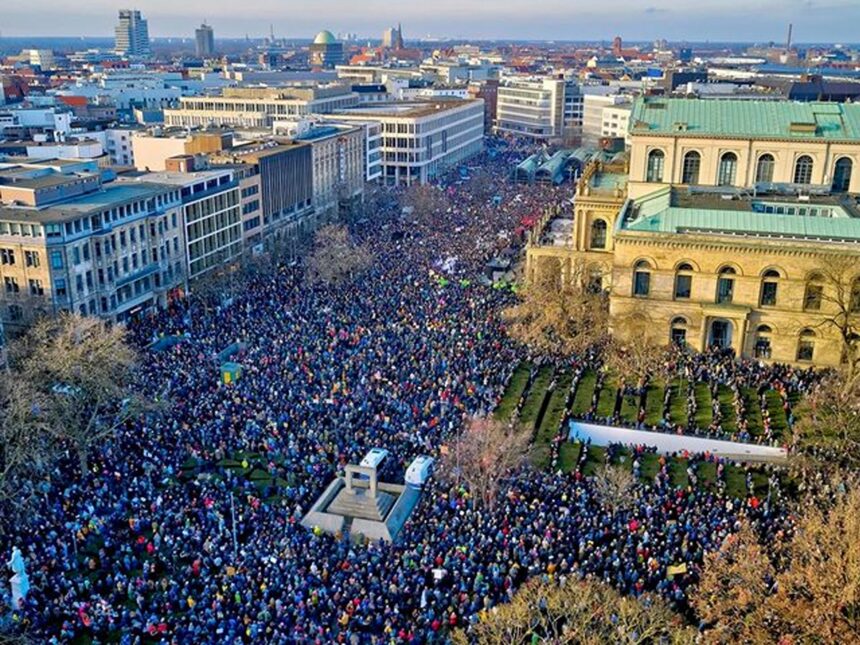
Thousands of people took to the streets in Erfurt on Saturday, blocking roads leading to the Alternative for Germany (AfD) annual party conference ahead of regional elections that could see the far-right party take power at the state level for the first time.
Protesters from trade unions, civil society organizations, and left-wing political parties gathered as a large police presence, reinforced by officers from across Germany, was deployed outside the two-day AfD conference.
Under close police supervision, demonstrators sat across highways and access roads leading to the convention center where the meeting was taking place. Police estimated that around 15,000 people joined protests in and around the eastern German city.
“We want to make it clear that we simply will not tolerate this, that fascism is on the rise here in Germany,” said Georg Becker, spokesperson for Widersetzen, an anti-AfD activist group.
The conference, where co-leaders Alice Weidel and Tino Chrupalla are expected to be re-elected, comes ahead of state elections in Saxony-Anhalt and Mecklenburg-Vorpommern, which the AfD hopes will pave the way for greater success at the national level.
Founded more than a decade ago, the AfD has opened a significant lead over Chancellor Friedrich Merz’s conservative bloc in opinion polls by combining nationalist rhetoric, calls for tougher immigration policies, and appeals to voters frustrated with successive governments and years of economic stagnation.
Critics accuse the AfD of promoting racist policies and views that are incompatible with Germany’s democratic values, arguing that the party poses a threat to the country’s constitutional order.
Germany’s mainstream political parties have ruled out any cooperation with the AfD under the so-called “firewall” strategy, designed to isolate the party and prevent it from entering coalition governments.
AfD leaders reject allegations that they oppose Germany’s democratic foundations. Earlier this year, the party secured a court order requiring Germany’s domestic intelligence service to suspend its previous designation of the AfD as an “extremist” organization.
Recent opinion polls place AfD support at as much as 29%, compared with around 22% for Merz’s CDU/CSU alliance. The party also made significant gains in two regional elections in western Germany earlier this year.
However, its strongest support remains concentrated in the former East Germany, where surveys indicate the highest levels of voter dissatisfaction with the traditional party system.
In Saxony-Anhalt, where the latest poll places the AfD at 41%, well ahead of the Christian Democrats on 23%, the party is aiming for an outright victory. It also hopes to emerge as the largest party in Mecklenburg-Vorpommern.