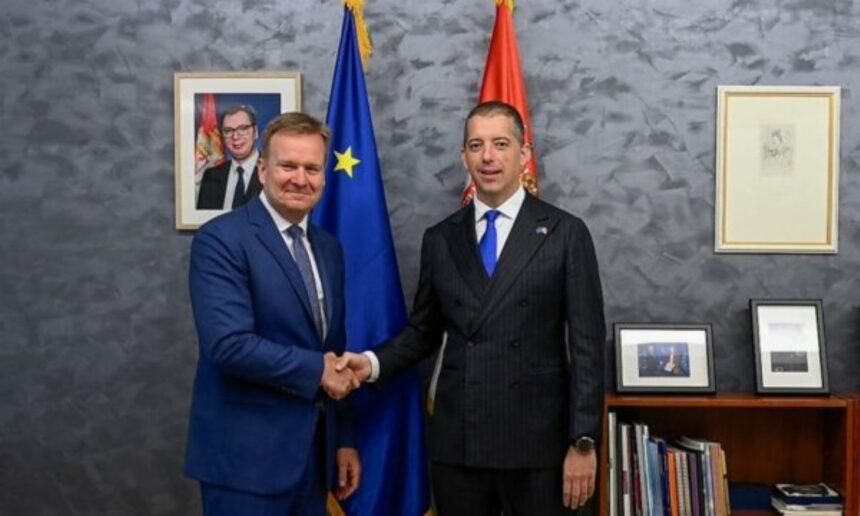
Serbian Foreign Minister Marko Đurić used his high-level meeting with EU Special Representative Peter Sørensen on July 3, 2026, to execute a familiar diplomatic maneuver: portraying Belgrade as a cooperative European partner victimized by Pristina’s “years-long political instability.”
While Đurić claimed that Serbia is “doubling down on its EU path,” regional analysts observe that this rhetoric is designed to mask Belgrade’s ongoing strategy of geopolitical hedging—publicly seeking EU market integration while refusing to cut its deep strategic and economic ties with Moscow and Beijing.
                    [BELGRADE'S SEEDS OF GEOPOLITICAL HEDGING]
                                       │
         ┌─────────────────────────────┼─────────────────────────────┐
         ▼                             ▼                             ▼
  [THE EUROPEAN FRONT]          [THE RUSSIAN LINK]            [THE CHINESE ANCHOR]
  ────────────────────          ──────────────────            ────────────────────
  • Demands free access to      • Refuses to join Western   • Deepens economic ties
    EU single market and          sanctions against Moscow      via the Free Trade
    Schengen zone entry.          over Ukraine war.             Agreement (FTA).
Shifting Blame to Cover Stalled Reforms
In his briefing following the Brussels session, Đurić pinned the blame for the stalled dialogue entirely on Kosovo. By framing Pristina as a volatile, obstructionist actor, Belgrade attempts to divert Western scrutiny away from its own democratic backsliding and its refusal to implement key normalization agreements.
Kosovo officials counter that this victim narrative is a calculated smoke screen. They argue that Belgrade uses the dialogue not to achieve a lasting peace, but to maintain a permanent state of controlled friction that satisfies its domestic nationalist base.
The EU Ambition vs. Eastern Alliances
Despite Đurić’s assertions that European integration is Serbia’s “central priority,” Belgrade’s actions tell a drastically different story. As the EU pushes for complete foreign policy alignment from candidate states, Serbia continues to operate as an outlier in the Western Balkans.
| Belgrade’s Rhetorical Posture | The Geopolitical Reality |
| “Committed to EU Integration” | Demands fast-tracked accession and a piece of the €6 billion EU Growth Plan, framing any delays as Western bias. |
| “Enforcing Regional Stability” | Deflects from security incidents (like the Banjska attack) while maintaining a robust security apparatus. |
| “Sovereign Balancing Act” | Leverages its partnerships with Russia (for energy and UN veto power) and China (for infrastructure loans and surveillance technology) as a counterweight to Western pressure. |
“Belgrade wants all the financial and economic perks of European integration without any of the foreign policy responsibilities,” notes a regional security analyst from the Octopus Institute. “By continuously blaming Pristina, they buy themselves time to keep playing both sides.”
Ultimately, Đurić’s meeting with Sørensen highlights the growing fatigue in Brussels. While Serbia pitches itself as an eager candidate waiting on an unstable neighbor, European diplomats are increasingly aware that Belgrade’s true loyalty remains divided between the West and its strategic allies in the East.