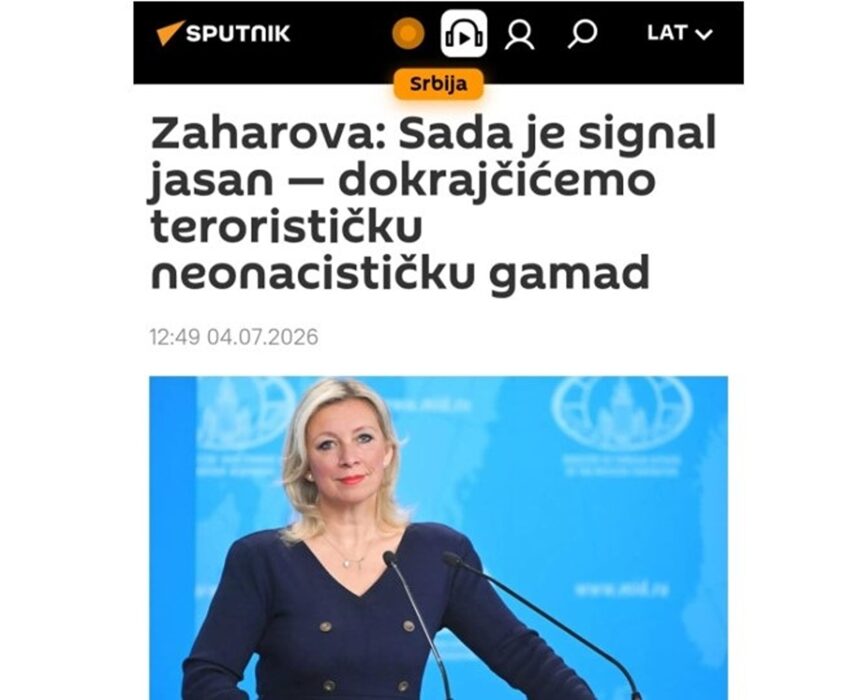
Russian state media outlet Sputnik and several pro-Russian portals in Serbia have published propaganda statements by Russian Foreign Ministry spokeswoman Maria Zakharova, presenting them as factual reporting despite their use of explicit war propaganda.
The reports were prompted by Russian President Vladimir Putin’s appearance in military uniform during a meeting focused on Russia’s military operations in Ukraine.
Zakharova described Putin’s appearance as a “clear signal” that Russia would, in her words, “finally eliminate the neo-Nazi terrorist scum on all fronts,” using rhetoric that collectively demonizes and dehumanizes the Ukrainian side.
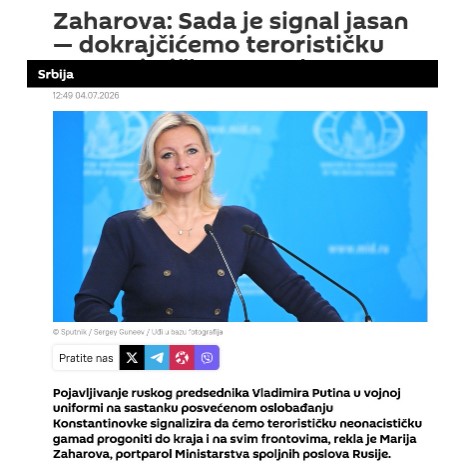
Sputnik and other pro-Russian media outlets in Serbia republished Zakharova’s remarks without editorial distance or critical context. As a result, propaganda messages from Russian officials were presented as news content, contributing to the normalization of hate speech and war rhetoric.
Particularly concerning is that these reports also repeated, without independent verification, claims by the Russian military about the “complete liberation” of Konstantinovka and alleged heavy losses suffered by Ukrainian forces. Such claims originate exclusively from official Russian sources, have not been independently confirmed, and form part of the information war surrounding the conflict in Ukraine.
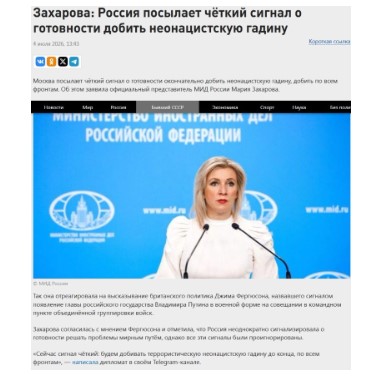
The use of expressions such as “neo-Nazi terrorist scum” is a textbook example of propaganda language. Such rhetoric seeks to justify the continuation of military aggression, portray the war as legitimate, and undermine any possibility of dialogue.
Serbian media amplify war rhetoric without editorial filtering
Media outlets in Serbia, including Sputnik Srbija, B92, and Politika, have continued to circulate these narratives.
B92 published the story under the sensationalist headline: “Fury in Moscow: ‘The Signal Is Clear, We Will Finish This’,” directly repeating statements about the “elimination of neo-Nazi terrorist scum,” thereby lending institutional legitimacy to Moscow’s narrative.
Meanwhile, Serbia’s oldest daily newspaper, Politika, also served as a platform for Russian geopolitical messaging by publishing articles such as: “Zakharova: We Will Continue to Achieve Our Goals Until the End.”
German journalist warns about Kremlin narratives in Serbian media
German journalist and longtime Balkan analyst Thomas Brey publicly warned on X about what he described as a clear example of Kremlin narratives being reproduced in Serbia’s media landscape.
“Pure propaganda: Serbian media reproduce Kremlin narratives one by one, without context or background,” Brey wrote.
He emphasized that content produced by the Russian state outlet Sputnik is often republished almost immediately and without editorial intervention by parts of Serbia’s media, giving Kremlin propaganda broader reach and additional legitimacy.