Until a few days ago, it seemed impossible that someone in Europe could call for ethnic cleansing.
This because it was believed that only no one would do that, but also that it was thought that the actions of the European Union and other states that call for democracy, freedom and human rights would not allow such a thing in any form.
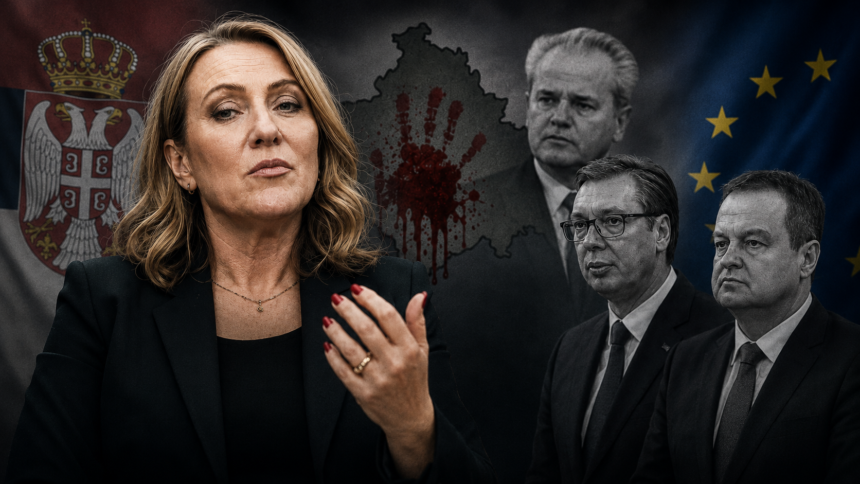
However, this illusion was shattered by Serbian Minister Snežana Paunović, who declared that “if she had been in Slobodan Milošević’s position in 1998, she would have ethnically cleansed Kosovo.”
Even more surprising than such a horrifying statement, and the defense offered to her by Serbian President Aleksandar Vučić and Interior Minister Ivica Dačić, was Europe’s weak response.
For this scandalous statement, made in a region that remains fragile because of Serbian crimes and the genocide committed by Paunović’s idol, Slobodan Milošević, the most European officials and leaders did was describe it as dangerous rhetoric and condemn it.
This weak reaction appears to have surprised Snežana Paunović herself, who not only refused to apologize, but continued to intensify her language toward Kosovo and apparently even mocked the reactions of the international community.
She acknowledged the statement she had made, but mockingly said that she had said it in reference to 1998, while it is now 2026.
“Who is there in Europe who dares to deal with this issue in this way or even worse, not deal with it at all, but instead deal with a minister who said: ‘Ah, in 1998, I would have ethnically cleansed Kosovo…’ Meanwhile, it is now 2026.”
Paunović, refusing to abandon her desire for genocide, described all Kosovo Albanians as terrorists, saying that “I would have ethnically cleansed Kosovo of terrorists,” implying that those whom Snežana calls terrorists belong to a particular ethnicity.
“I would have ethnically cleansed Kosovo of terrorists! Yes, I would have done it—not only Kosovo, but I would cleanse the entire world of terrorists, for the sake of innocent victims, always! What is controversial about that?”
Despite all this, the EU continues to treat Serbia as a candidate for membership, while the country receives more EU funds than any other in the Western Balkans.
Instead of concrete consequences, Belgrade continues to receive political tolerance and the largest financial support in the region, even as a Serbian minister openly defends ethnic cleansing.