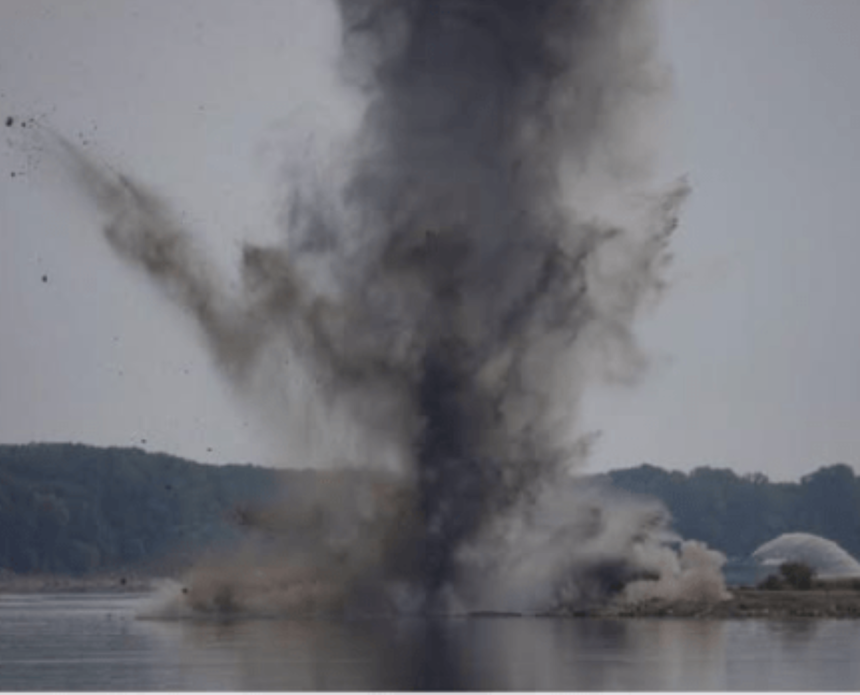
Romanian authorities have carried out a controlled explosion on the Danube in an emergency effort to redirect vital cooling water toward the country’s remaining operational nuclear reactor, as record-low water levels threaten energy supplies across the region.
Romania and neighboring Hungary have been forced to reduce nuclear power production as the Danube reaches historic lows, raising concerns about a wider energy crisis amid an intense heatwave that is driving up electricity demand.
Romania has declared a nationwide state of emergency for August amid declining electricity production. The record-low level of the Danube has already contributed to the shutdown of one reactor at the Cernavodă nuclear power plant.
The Romanian Navy used around 180 kilograms of explosives to destroy a large rock obstructing the flow of water, according to Adevărul. The controlled blast sent a large column of water into the air and was part of an emergency operation designed to increase the amount of water reaching the channel that supplies the remaining reactor.
Romanian Defense Minister Radu Miruță said the operation was critical to keeping the plant running for as long as possible.
“Every day after Wednesday or Thursday that the nuclear plant continues to operate is a gain,” Miruță said on Monday, arguing that even a single additional day of operation would justify the cost of the emergency intervention.
Experts said the controlled explosion should allow authorities to construct a temporary barrier and redirect additional water toward the nuclear plant’s cooling system.
The crisis has affected both Romania and Hungary, whose nuclear facilities rely on the Danube for reactor cooling. With both countries operating their nuclear plants at reduced capacity, they are increasingly dependent on expensive electricity imports at a time when extreme heat is pushing demand higher.
In Hungary, the Soviet-era Paks nuclear power plant has significantly reduced its output. The 44-year-old facility normally generates almost half of Hungary’s electricity but is currently operating at less than half of its normal capacity.
Hungarian authorities had previously warned that the plant could be forced to shut down completely because of the low river level. Officials later said it could remain operational at reduced capacity through Monday or Tuesday, providing temporary relief to the country’s electricity system.
Hungarian Prime Minister Péter Magyar has warned that a complete shutdown could come next week. With forecasts indicating that the Danube may remain too shallow for the reactors’ cooling systems, the interruption could potentially last for several weeks.
“An energy crisis situation could arise starting Monday,” Magyar wrote on X, calling for coordinated action to prevent more serious consequences.
Serbia is also feeling the impact of the historic decline in the Danube. The country’s main hydropower facility has reportedly been operating at only around 20 percent of capacity, prompting Prime Minister Đuro Macut to chair an emergency meeting focused on the country’s energy situation.
Water levels on the Danube are not expected to recover significantly in the coming days or even weeks, with little substantial rainfall forecast. The river passes through 10 countries, and some sections have fallen to unprecedented levels.
The retreating water has exposed rocks, shipwrecks, a World War II bomb and even the remains of a mammoth. Prehistoric bones were discovered on the exposed riverbed near Ryahovo in northern Bulgaria and are being examined by experts from the Regional Museum of History in nearby Ruse.
The unprecedented conditions highlight the growing vulnerability of Europe’s energy, transport and water infrastructure to prolonged heatwaves and drought, with the Danube’s falling levels now posing a direct challenge to nuclear power generation across Central and Southeastern Europe.