Former U.S. Congressman Joe DioGuardi has urged Kosovo’s political institutions to resolve the country’s presidential crisis as soon as possible, warning that prolonged political uncertainty could leave the country vulnerable at a time when forces opposed to Kosovo’s independence remain active in the region.
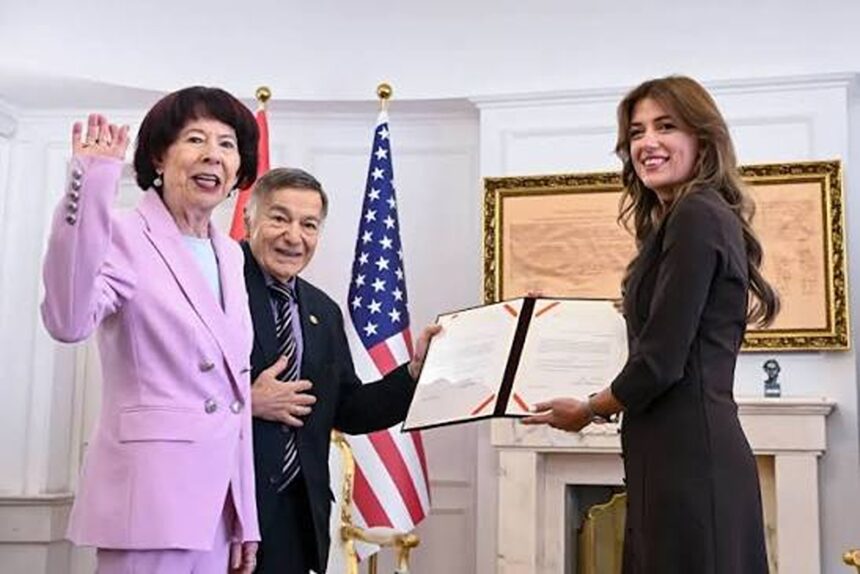
DioGuardi made the remarks after he and his wife, Shirley Cloyes DioGuardi, received Kosovo citizenship during a ceremony hosted by Acting President Albulena Haxhiu.
A longtime advocate for Kosovo in Washington, DioGuardi said the country should not take its achievements for granted and called for the rapid election of a president.
“I am here with you to make sure that you have a president, and I hope that happens before I leave.”
He warned that failure to resolve the institutional deadlock could have serious consequences, arguing that Kosovo faces actors who would be willing to destabilize the regional balance.
The former congressman also used the occasion to recall his decades-long involvement in the Albanian-American community and his efforts in Washington to bring attention to the situation of Albanians in the former Yugoslavia.
Haxhiu described the granting of citizenship to the DioGuardis as recognition of their longstanding contribution to Kosovo’s freedom and independence, particularly during periods when Kosovo’s voice struggled to reach U.S. decision-makers.
Shirley Cloyes DioGuardi likewise stressed the historical context of Kosovo’s struggle, arguing that Kosovo Albanians did not initiate the violence but were ultimately forced to defend people facing danger. She highlighted the importance of remembering the period of Slobodan Milošević’s rule and the international efforts that eventually contributed to its downfall.
DioGuardi served in the U.S. House of Representatives from 1985 to 1989 and founded the Albanian American Civic League in 1989. Through the organization, he and his colleagues lobbied extensively in Washington for the rights of Albanians and, particularly, for Kosovo’s freedom and independence.
During the Kosovo War, DioGuardi and Shirley Cloyes DioGuardi continued their advocacy in the United States, drawing attention to the repression and crimes committed under Milošević’s regime.
Their message in Pristina in 2026 was therefore both commemorative and political: Kosovo’s independence was hard-won, its institutions must remain functional, and political leaders cannot afford complacency while regional security remains fragile.