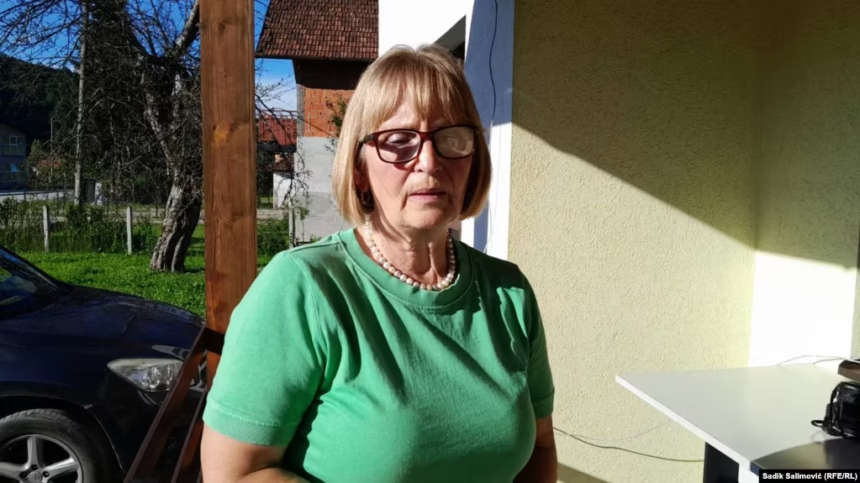
Ratko Mladić has left a profound burden for generations of the Serbian people, Šehida Abdurahmanović, a member of the Board of the Mothers of the Enclaves of Srebrenica and Žepa association, told Radio Free Europe following the former Bosnian Serb military commander’s death in The Hague.
Mladić, who was convicted of genocide in Srebrenica and other war crimes, died at the age of 84 while serving a life sentence.
Abdurahmanović, whose husband was among the first civilian victims in Srebrenica in 1992, said Mladić’s death had been expected for years.
She said that throughout his imprisonment, Mladić continued to deny that genocide had taken place and showed no remorse.
“As an ordinary person and as a victim of genocide, I truly cannot understand that,” she said, adding that she also could not understand those who continued to glorify Mladić or had sought to have him transferred to Serbia on humanitarian grounds.
According to Abdurahmanović, the legacy Mladić leaves behind will continue to weigh on future generations.
For victims, she said, one of the most important facts was that Mladić remained in custody in The Hague until his death and was never transferred to Serbia.
She also criticized what she described as favorable treatment during his imprisonment, saying that his detention conditions resembled “hotel accommodation” compared with other convicted war criminals.
Abdurahmanović said that neither she nor other victims could wish Mladić well, adding that his legacy was defined by the crimes for which he was convicted.
“He definitely left behind himself, his family and his people the worst thing a person could do,” she said.
Mladić’s convictions
The International Criminal Tribunal for the former Yugoslavia convicted Mladić of genocide in Srebrenica, persecution and forcible transfer of populations, terrorizing civilians during the siege of Sarajevo, and taking UN peacekeepers hostage.
He was convicted in 2021 on 10 of 11 counts of war crimes and crimes against humanity and sentenced to life imprisonment.
The Hague tribunal found him responsible for the genocide of around 8,000 Bosniak men and boys in Srebrenica, a UN-declared safe area, in July 1995.
He was also found guilty of participation in joint criminal enterprises involving the persecution, extermination, murder, forcible transfer and deportation of Bosniak Muslims and Croats, as well as the campaign of terror against Sarajevo civilians through shelling and sniper attacks.
Mladić was acquitted of the charge of genocide in six municipalities in Bosnia and Herzegovina in 1992: Prijedor, Sanski Most, Ključ, Kotor Varoš, Foča and Vlasenica.