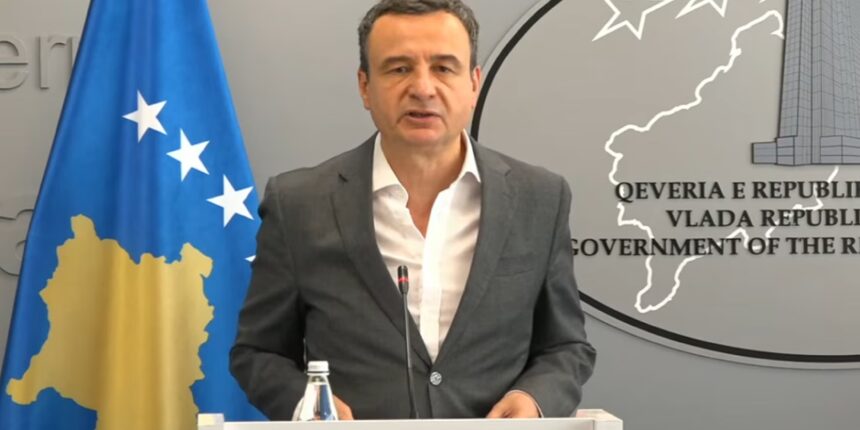
Kosovo’s caretaker Prime Minister, Albin Kurti, today met with around 70 political representatives and civil society representatives of Albanians from Preševo, Bujanovac, Medveđa and Sandžak.
He said that Albanians in the Valley are facing human rights violations. Kurti said the Republic of Kosovo’s approach would be to support residents of the Valley in various ways, including support for students, children and others. He also emphasized that Kosovo is advocating internationally for the rights and interests of Albanians in the Preševo Valley.
“For us, Preševo, Bujanovac, Medveđa and Sandžak are not issues that are discussed only when there is a crisis. They are matters of political, institutional and national responsibility. For years, we have been facing a pattern of discrimination manifested in the representation of Albanians in the police, courts, administration and employment, the deactivation of residential addresses, the use of the Albanian language, and unequal treatment by public institutions. But the Serbian state does not see only the statistics. It also sees the language and the way the state responds. Exactly one week ago, when Serbian President Vučić visited only Serb-majority settlements in Medveđa, Bujanovac and a village in Preševo, using stigmatizing and derogatory language toward Albanians, a promise was subsequently heard from Vučić regarding employment with the BIA within 48 hours,” Kurti said.
According to him, this contrast is deeply troubling.
“When an Albanian seeks employment in public institutions, they face barriers and discrimination. When someone uses derogatory language toward Albanians, that person is treated as suitable for employment in security institutions. This is the message created by such an environment. Is this how Albanians in these areas should be treated by the state? This is precisely why I am here today—not only to speak with you, but to discuss these issues with you. We have built the policies of the Government of the Republic of Kosovo toward Preševo, Bujanovac and Medveđa on three levels,” Kurti said.
The first level, he said, is ensuring that citizens from these areas are treated as equally as possible with citizens of Kosovo.
“We have worked in education, healthcare, professional licensing, specialization programs, rights and documentation. We have ensured healthcare for patients from Preševo, Bujanovac and Medveđa. We have created opportunities for the licensing of healthcare professionals, and this year we took another important step. Specialists from the Valley have been connected with specialists from Kosovo, as we previously did with students. Lawyers from the Valley, through the relevant institutions in Kosovo, have been given the opportunity to apply for the bar examination and exercise their professional rights. We have worked to ensure that relevant institutions protect citizens from problems related to documentation and the deactivation of addresses. We have worked to make scholarships from the Ministry of Education accessible to all students. Our goal is for Albanian citizens from Preševo, Bujanovac and Medveđa to face as few barriers and enjoy as much equality as possible when they come to Kosovo,” he said.
The second point, according to Kurti, is the creation of central mechanisms focused on the position of Albanians in the areas where they live.
“For the first time, we established a regular budget line. Financial support increased to €2 million in 2022 and 2023, to €3 million in the 2024 budget, and to €4 million in the 2025 and 2026 budgets. We have provided school textbooks and materials for preschool students. In 2022, we supported 107 students with scholarships, while the number of scholarships has steadily increased, reaching 756 scholarships last year. In 2023, we also began providing scholarships for secondary school students. We have supported culture, cultural heritage, sports, media and civil society organizations working with children with special needs. In 2025, we allocated €500,000 to co-finance music schools and a museum in Preševo. In 2022, we signed a Memorandum of Cooperation with the Albanian National Council, and through this cooperation an institutional mechanism was established. For all these decisions and for this cooperation, I thank the Speaker of the Assembly, Enkel Rexhepi,” he said.
Kurti also spoke about international advocacy, saying that discrimination is institutional and is present in the police, courts, the deactivation of addresses and efforts to prevent representation in public institutions.
“For this reason, we have supported international advocacy in Brussels, Washington, New York, the European Parliament, the Council of Europe and the most important European cities. Because discrimination that is not documented is relativized. Discrimination that is not internationalized remains a local problem. We do not want the position of Albanians in Serbia to be treated as a local problem, because this is a matter of human rights, the rule of law and the responsibility of a state that is a candidate for membership in the European Union. This is also an issue we discussed today.
“We have two blocked transfers: one in January of this year amounting to €304,500 and another in April of this year amounting to €1,837,501, more than six times the previous amount. There are 78 projects to be implemented in the fields of art and culture, 23 projects in sports, 13 projects concerning the use of national symbols, seven organizations working with children with special needs, and 15 selected applicants in the field of information and media in the Albanian language. In total, this amounts to 136 approved projects and organizations. There are also six approved applications and families representing victims who have lost a parent,” Kurti said.
Kurti said the blocking of funds cannot be measured solely by the value of millions of euros. The real cost, he said, is the hardship faced by people.
He said the funds must be unblocked, the bank account of the Albanian National Council must be made operational, approved projects must be implemented, programs must continue, and this practice must not be allowed to drag on.
“We are calling on the European Union to demand that Serbia, as a candidate for membership, respect European standards and resolve these problems. The Government of Kosovo will continue to support efforts to ensure that Albanians are treated more equally with citizens of Kosovo when they come here. We will build mechanisms that support the lives of Albanians where they live and work every day. And the systematic discrimination against them must be documented and internationalized,” Kurti said.
The meeting also addressed developments and challenges facing Albanians in Preševo, Medveđa, Bujanovac and Sandžak, as well as the need for continued institutional and social support and cooperation.