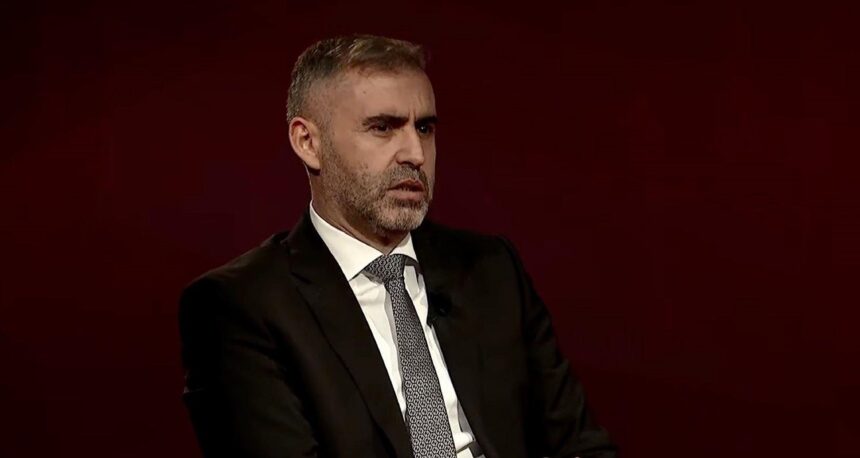
The more details emerge about the initiative to amend the Law on the Specialist Chambers, the more questions are being raised about its legal sustainability.
This is the assessment of lawyer Besnik R. Berisha, who reacted following today’s clarifications regarding how the Democratic Party of Kosovo (PDK) initiative to amend the Law on the Specialist Chambers and Specialist Prosecutor’s Office would function.
PDK has submitted the draft law to the Kosovo Assembly. According to publicly presented explanations, for cases currently underway, proceedings would continue on appeal under the existing structure of the Specialist Chambers. If the Appeals Panel were to order a retrial, the case would then proceed under the new jurisdiction and, once the relevant conditions were met, would be transferred to Kosovo.
It is precisely this part of the proposed legal framework that prompted Berisha’s criticism.
According to him, if the jurisdiction of the Specialist Chambers is considered valid for trying a case at first instance and reviewing it on appeal, then the outcome of the appeal cannot subsequently become the criterion determining which court has jurisdiction over the case.
Berisha summarizes the issue through what he describes as a simple but fundamental legal principle:
“Jurisdiction is not a consequence of the outcome.”
According to Berisha, jurisdiction must exist before a decision is issued, derive from legal norms, and be predictable for the parties from the beginning of the proceedings. For this reason, he considers it legally difficult to construct a system in which the judicial path changes depending on whether the Appeals Panel upholds a judgment or orders a retrial.
“We cannot have one judicial system if the Appeals Panel decides one way and another system if it decides differently,” Berisha said.
Berisha also raises another question that, in his view, is equally serious: the possibility that Kosovo’s Supreme Court could become an appellate instance in proceedings that, until that point, had never passed through Kosovo’s regular judicial system.
According to him, the fact that the Specialist Chambers are legally part of Kosovo’s judicial framework does not, by itself, resolve this issue, because the Chambers operate under a special constitutional and legal architecture, with their own jurisdiction, structure and system of legal remedies.
For precisely this reason, Berisha argues that the issue cannot simply be reduced to the political formula that, if a process is not corrected in The Hague, it could subsequently continue in Kosovo.
He says he understands the need for a response following a judgment that has caused significant concern, as well as the objective of ensuring that the accused receive every legal guarantee to which they are entitled. However, precisely because of the importance of the matter, he argues that the solution must be legally stronger rather than merely more politically appealing.
In his assessment, this is not simply a question of the physical location of a court, but of competence, jurisdiction, the hierarchy of judicial instances, legal certainty and the law applicable to an ongoing criminal proceeding.
“These cannot change depending on the outcome produced by the Appeals Panel,” Berisha said.
Berisha concludes by distinguishing between the political objective of the initiative and the legal sustainability of the mechanism chosen to achieve it.
“You can agree with the objective. With this legal construction, it is very difficult. In an attempt to correct an alleged injustice, we must be careful not to build a solution that collapses under the very arguments we use to defend it.”