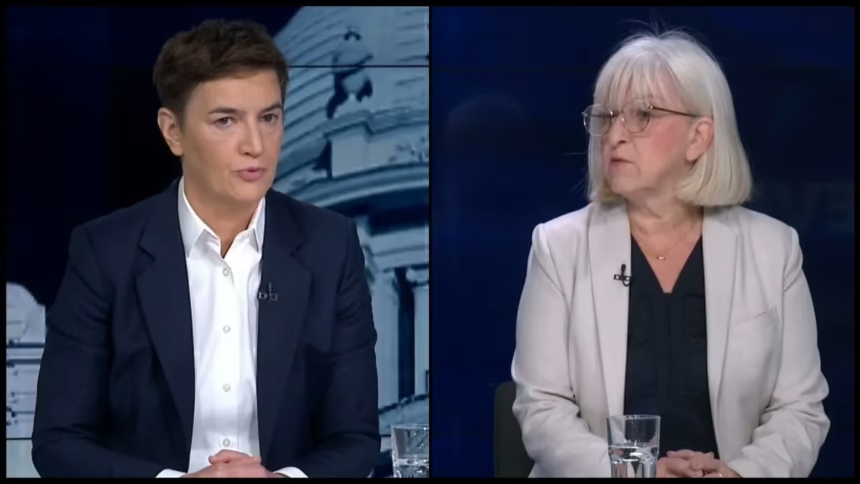
The first pre-election debate on N1 between Ana Brnabić, third on the electoral list “Aleksandar Vučić – United Serbia,” and university rector Mirjana Nikolić opened with a tense exchange over media coverage, political accountability and the state of education in Serbia.
The debate began with an N1 journalist asking Brnabić why she had agreed to appear on the programme after not appearing on the television station since 2017, despite repeated invitations to representatives of the Serbian Progressive Party (SNS) and government officials during previous election cycles. She was also asked whether declining public support for SNS had influenced her decision to participate.
Brnabić did not directly answer the question. Instead, she criticized N1, accusing the broadcaster of biased coverage of her political allies and the government.
“N1 in previous election periods did not allow our list even to pay for airtime to broadcast campaign spots,” Brnabić said, adding that she had been reluctant to return to the station because of what she described as its treatment of President Aleksandar Vučić.
She also referred to coverage of several controversial cases and issues, including Jovanjica, the so-called “Sarajevo Safari” allegations, police violence in Valjevo and claims concerning the use of a sonic device during protests.
Brnabić said she ultimately agreed to participate after Vučić encouraged her to give the broadcaster an opportunity to demonstrate its impartiality.
During the exchange, Brnabić used terms including “blokaders” and “ćaci” to describe opponents of the government. Both the journalist and Nikolić asked that such terms not be used during the debate. Brnabić subsequently referred to Nikolić’s political side as the “student list.”
The SNS representative also commented that Nikolić had declined to shake her hand, describing the incident as an example of what she called “cultural Serbia.”
Nikolić responded that “cultural Serbia is yet to come,” while calling for both sides to focus on their respective programmes and responsibilities toward voters.
She said she had initially been uncertain about participating in the debate because of concerns about the atmosphere surrounding political discussions and her previous encounters with Brnabić at parliamentary education committee meetings.
Nikolić said she believed there was a risk of uncomfortable exchanges when one participant held a position of political power and greater access to information.
Brnabić highlights SNS record on education
A major part of the debate focused on education policy, with Brnabić defending the record of the SNS-led government and Nikolić presenting a different approach to the education system.
Brnabić said she was “proud of everything the Serbian Progressive Party has done” in education. She recalled that, in her 2017 government programme, she had identified digitalization and education as priorities.
She cited increases in teachers’ and university professors’ salaries, as well as higher government spending on education.
According to figures presented by Brnabić, teachers’ salaries increased from approximately €391 in 2012 to a projected €1,030 in December 2026. She also said university professors’ salaries rose from around 77,000 dinars in 2012 to a projected 191,000 dinars by December 2026.
Brnabić said the education budget had increased from 140 billion dinars in 2012 to 425 billion dinars in 2026.
She also pointed to an increase in preschool participation, saying that the share of children enrolled in preschool education had risen from 48 percent in 2011 to 64 percent in 2025, with the government aiming to exceed 80 percent.
Among other achievements, Brnabić highlighted the construction of four science and technology parks and three new scientific institutes, programmes for employing young researchers, the introduction of programming as a compulsory subject from the fifth grade of primary school, and investments in high-speed wireless internet for schools across Serbia.
Brnabić said more than 1,000 young scientists had been employed through a programme launched in 2018, with additional researchers recruited in subsequent years.
Nikolić calls for free and modernized education
Nikolić, meanwhile, argued that education should serve as a central driver of social development and called for greater dignity, professional standards and security for everyone working within the education system.
“Education is the beginning and the starting point in every normal society,” Nikolić said, arguing that primary, secondary and higher education should become a driving force for society as a whole.
She said her platform supports genuinely free education, stressing that this should go beyond measures such as free textbooks and include broader access to educational resources.
Nikolić also called for equal opportunities for students, teachers, professors and support staff, as well as modernization across the education system, including curricula, teaching methods and study programmes.
She suggested that technological development could eventually make it possible for students to use digital textbooks on tablets rather than relying solely on traditional printed materials.
Nikolić also emphasized the importance of developing critical thinking among young people, arguing that students should be equipped to assess information independently rather than simply relying on content encountered on social media.
The debate also featured a dispute over previously discussed education projects. Referring to meetings with Brnabić, Nikolić questioned the status of financing for major projects involving the construction of new university facilities, including buildings for the Faculty of Biology, Faculty of Geography and Faculty of Music.
The exchange reflected broader differences between the two candidates over the government’s record, public spending, education policy and the direction of Serbian society ahead of the elections.