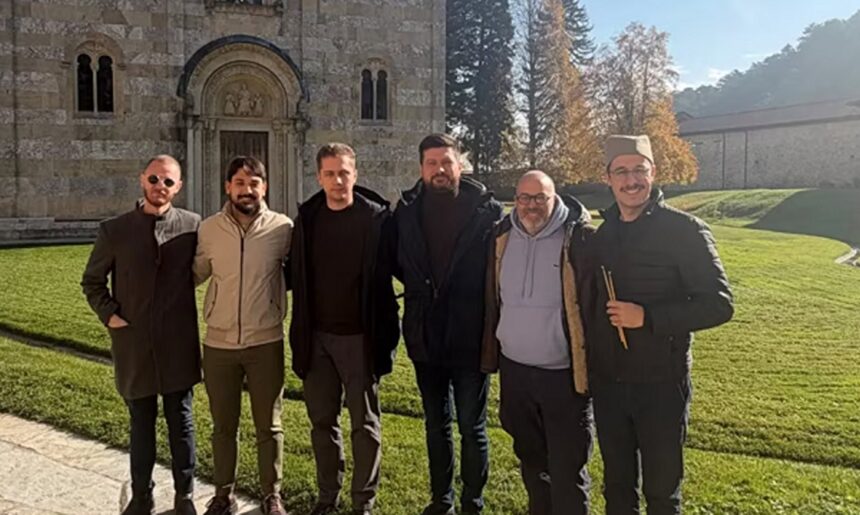
Serbia’s Student List may present itself as an alternative to Aleksandar Vučić, but its position on Kosovo reveals how little has actually changed. New political faces, old territorial claims, the same refusal to respect Kosovo’s sovereignty.
Emilija Marković, a candidate on the Student List, has announced that the movement’s programme envisages a review by Serbia’s Constitutional Court of agreements reached between Belgrade and Prishtina through the EU-mediated dialogue.
Her statement raises a fundamental question: is the Student List preparing to fulfil Serbia’s international commitments, or simply looking for new ways to undermine them?
Asked by N1 whether the movement would honour the agreements reached in the dialogue, Marković said they had not yet fully assumed government responsibilities and did not know exactly what had been signed. She added that they would examine which agreements could be reviewed, while insisting on compliance with Serbia’s Constitution and laws.
That is hardly a commitment to normalisation. It is an attempt to put Serbia’s domestic constitutional claims above agreements reached with the European Union.
The Student List’s position on Kosovo remains firmly rooted in Serbia’s Constitution, which continues to describe Kosovo as part of Serbia. So, despite presenting itself as a force for political change, the movement is repeating the very doctrine that has obstructed normalisation for years.
The European Union has made clear that a change of government in Belgrade does not release Serbia from its obligations under the 2023 Agreement on the Path to Normalisation and its Implementation Annex.
Under that agreement, Serbia committed to respecting Kosovo’s territorial integrity and not opposing its membership in international organisations. Kosovo, for its part, agreed to establish an Association of Serb-majority Municipalities.
Marković nevertheless argued that the new government would hold serious discussions with international representatives, insisting that negotiations must begin on “different foundations” — namely, Serbia’s Constitution and what she describes as fundamental principles of international law.
Belgrade cannot demand a new starting point every time it elects a new government. International agreements are obligations, not documents that can be selectively reopened whenever they become politically inconvenient.
Kosovo’s demands remain unanswered
The Kosovo Government has maintained that the Association agreement must be signed to guarantee its implementation. The EU, meanwhile, has repeatedly stated that the 2023 agreement is legally binding, even without signatures.
Kosovo also continues to demand the extradition of Milan Radoičić and other members of the armed group involved in the September 2023 attack in Banjska, which Kosovo authorities describe as an assault on the country’s constitutional and legal order.
Another demand is the withdrawal of the letter sent by former Serbian Prime Minister Ana Brnabić to Brussels and the 27 EU member states, in which she stated that Serbia did not accept Kosovo’s territorial integrity. In that letter, Brnabić argued that the 2023 agreement and its annex could not be interpreted as implying Serbia’s de facto or de jure recognition of Kosovo.
The Student List declined to comment on these demands, saying the new government would address them after taking office and reviewing the situation.
Different opponents, the same political framework
Marković also said the Student List would not cooperate directly with the Serbian List, the dominant Serb political party in Kosovo, which has enjoyed the backing of Vučić’s Serbian Progressive Party. However, she left open the possibility of cooperation between newly appointed heads of Serbian institutions in Kosovo and local representatives.
The Serbian List holds nine of the ten seats reserved for the Serb community in Kosovo’s Assembly and controls all ten Serb-majority municipalities.
Jugoslav Gašić, another Student List candidate, said communication with Serb representatives in Kosovo’s central institutions would take place through the international community. He added that the Student List was not a political party and would not establish its own political structures in Kosovo.
Meanwhile, the Serbian List said it had received no concrete proposals from the Student List and vowed to continue protecting Serbian institutions, employment and income financed by Belgrade. It also said it would use its positions in Kosovo’s institutions to block decisions it considers harmful to the Serb community.
The party called for an end to divisions and political rivalries, saying Serbs in Kosovo needed responsibility, solutions, security and a future in their homes.
Nenad Rašić, leader of For Freedom, Justice and Survival and a minister in Albin Kurti’s government, is also represented in Kosovo’s central institutions. He had supported the Student List ahead of Serbia’s elections, as had other Serb opposition figures.
The problem is bigger than Vučić or the Serbian List. Serbia’s political establishment continues to treat Kosovo as territory it can claim, negotiate over and attempt to control. The Student List has yet to demonstrate that it offers anything fundamentally different. Replacing Vučić’s political allies means little if the underlying anti-Kosovo policy remains untouched.
Kosovo’s sovereignty is not subject to review in Belgrade. Serbia must implement the agreements it has made, stop obstructing Kosovo internationally and finally confront the reality that Kosovo is an independent state.