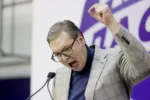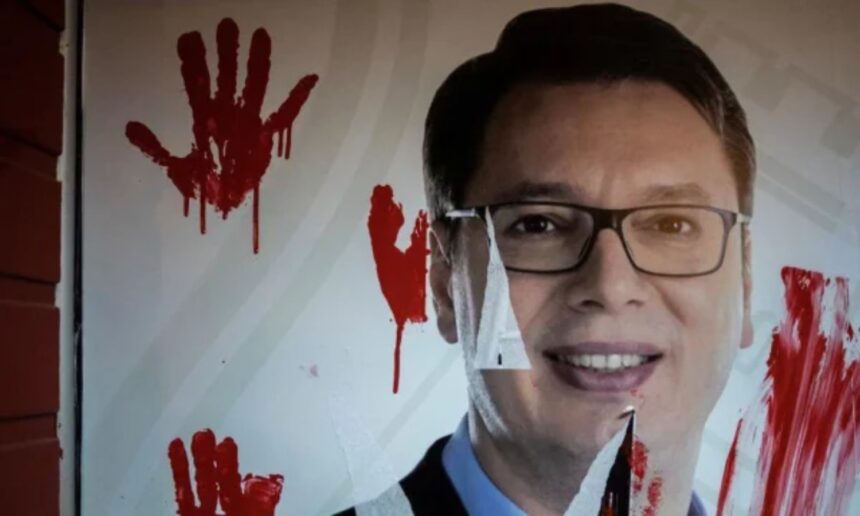
Aleksandar Vučić’s 14-year dominance of Serbian politics has taken him from a former radical associated with Vojislav Šešelj and a minister in Slobodan Milošević’s government to a leader who initially positioned Serbia closer to the West, before increasingly emphasizing ties with Russia and China.
After resigning as president eight months before the end of his term, Vučić has entered the electoral race for prime minister, following two years of student-led protests and demands for early parliamentary elections.
Political scientist Dušan Spasojević of the Faculty of Political Sciences in Belgrade said Vučić initially promised changes that led many in Serbia to believe he had moved away from the politics of the 1990s.
“In the first years, he promised some changes and we, as a society, believed he had learned something from the 1990s. But in the end, everything turned into something very similar to the 1990s,” Spasojević said.
He identified what he described as authoritarian tendencies, unfinished reforms, corruption and unfulfilled promises as major features of Vučić’s later years in power.
Novi Sad tragedy triggers mass protests
The collapse of a canopy at the railway station in Novi Sad, which killed 16 people, became a major turning point in Serbian politics, triggering mass protests and demands for political accountability.
Student protesters who organized blockades across the country blamed corruption and shortcomings in the reconstruction of the railway station for the tragedy and called for changes in government.
Serbia has also recorded a deterioration in democratic freedoms during Vučić’s rule, according to international assessments, while its EU accession process has made limited progress.
No new negotiating chapter has been opened since the end of 2021. Among the issues affecting Serbia’s EU path are concerns over democratic standards, unresolved relations with Kosovo and Belgrade’s refusal to join EU sanctions against Russia following Moscow’s full-scale invasion of Ukraine.
When announcing his resignation on September 27, Vučić acknowledged that he had made mistakes in various decisions.
“Sometimes in choosing people, sometimes strategically, but I think I managed to correct that, while tactically certainly much more often,” he said, without specifying which decisions he was referring to.
From the Brussels Agreement to stalled normalization
Spasojević said Vučić had made important moves toward the West during his first years in power, particularly the 2013 Brussels Agreement between Serbia and Kosovo.
The agreement established arrangements for the integration of Kosovo Serbs into Kosovo’s justice and police structures and remains an important reference point in the dialogue between Belgrade and Prishtina.
However, the planned Association/Community of Serb-majority municipalities in Kosovo has never been established.
The 2020 Washington economic normalization agreement and the 2023 Ohrid agreement were also intended to advance relations between Serbia and Kosovo, but the normalization process has since largely stalled, with both sides blaming each other.
The armed attack in Banjska in September 2023, in which Kosovo Police officer Afrim Bunjaku was killed, further complicated relations. Prishtina has accused Serbia of involvement, while Belgrade has denied responsibility.
Russia, China and Serbia’s foreign-policy balancing
Spasojević described Vučić’s foreign policy as an attempt to maintain several options simultaneously.
As relations with the EU became more difficult, he said, Vučić increasingly emphasized Serbia’s ties with Russia and China, creating additional room for maneuver.
Vučić ended his presidency with a telephone conversation with Russian President Vladimir Putin, during which the two discussed the extension of Serbia’s gas arrangements.
The European Union has repeatedly urged Belgrade to align its foreign policy more closely with the bloc, particularly regarding Russia’s war against Ukraine.
Washington has also raised concerns about Serbia’s relations with Russia and China.
Spasojević said the pressure on countries maintaining close relations with Moscow and Beijing is now coming simultaneously from Washington and Brussels, potentially making Serbia’s balancing policy more difficult.
Economic record remains contested
Throughout his time in government, Vučić frequently highlighted economic indicators to argue that living standards and investment had improved substantially since 2012.
Following his resignation, he cited Serbia’s relatively low public debt, the opening of hundreds of factories and plants, and an increase of roughly 500,000 formally employed people compared with 2012.
Economist Goran Radosavljević of FEFA Faculty in Belgrade, however, offered a different assessment of the economic picture.
He argued that higher average wages do not necessarily translate into substantially improved living standards because food prices have risen significantly in recent years.
Radosavljević also pointed to increased household borrowing and what he described as insufficient development of domestic small and medium-sized enterprises.
He said foreign investment had slowed in the past two to three years, partly because of a shortage of available labor, while arguing that large state infrastructure and construction projects may boost GDP in the short term without producing comparable long-term economic effects.
Corruption remains another concern. According to the 2025 Corruption Perceptions Index published by Transparency International, Serbia ranked 116th out of 182 countries.
Radosavljević nevertheless identified exchange-rate stability as one of the more consistent elements of Serbia’s economic policy, while noting its implications for domestic exports.
Early elections present a new political challenge
After 14 years at the center of Serbian political life, Vučić now faces early parliamentary elections scheduled for October 25.
Spasojević described the election as a significant test for the Serbian president-turned-prime-ministerial candidate.
“If he nevertheless manages to become prime minister, I do not expect the West to immediately exert maximum pressure,” Spasojević said, while arguing that Vučić’s position would nevertheless be more difficult than it was five or ten years ago.
The final list of participants in the parliamentary elections has not yet been completed. Among the groups expected to compete is the “Students Win” list, backed by student protesters who organized months-long university blockades and nationwide demonstrations.
The election campaign is therefore taking place against the backdrop of growing pressure on Serbia’s political institutions, continuing disputes over its European integration path, strained relations with Kosovo and competing demands concerning Belgrade’s relations with the EU, Russia and China.