Serbia has registered another Russian minority party ahead of the upcoming elections, raising questions among political analysts about whether the initiative is genuinely connected to the country’s small Russian community or is instead aimed at tapping into pro-Russian sentiment and benefiting from the special electoral rules available to minority parties.
The newly established Party of Russian-Serbian Unity (SRSJ) is the 11th party in Serbia registered as representing the Russian minority, even though Russians are only the country’s 16th-largest ethnic community, numbering just over 10,000 people, according to data cited by Radio Free Europe.
The party is headed by Rade Savić of Smederevo. Its stated political objectives include building a prosperous Serbia, abandoning the country’s bid for European Union membership and strengthening what it describes as an alliance with its “Russian brothers.” However, its programme reportedly contains little reference to the specific rights and interests of Serbia’s Russian minority.
Vuk Vuksanović, a lecturer in foreign policy and grand strategy at King’s College London, told RFE that, based on previous experience, the new party is unlikely to have significant ties to the Russian community in Serbia.
He argued that Serbia’s rules allow a party to be classified as a minority party without necessarily having members or candidates from the ethnic group it claims to represent, provided that its programme and statutes formally advocate for that community.
Minority parties enjoy certain advantages under Serbia’s electoral system, including easier access to parliamentary representation and exemption from the general three-percent electoral threshold.
Questions over possible political connections
The Party of Russian-Serbian Unity was registered only days before the elections were called and immediately began collecting signatures to submit an electoral list. The party did not respond to RFE’s questions about its minority status, participation in the elections or possible links to Russia.
Dragan Popović, director of the Centre for Practical Politics, said there were indications that the privileged position of minority parties could be being exploited. He suggested that domestic political actors could be behind such initiatives, although he stressed that there was no reliable evidence to establish this.
The new party has also publicised contacts with Russian officials. On September 20, it said that representatives had travelled to Yekaterinburg and met Leonid Slutsky, leader of Russia’s Liberal Democratic Party and chairman of the Russian State Duma’s Foreign Affairs Committee.
The party also claims to have received the blessing of Russian Orthodox Patriarch Kirill. RFE reported that it could not independently verify the claim, although two representatives of the party were listed among delegations attending a liturgy celebrated by Kirill in Sergiev Posad in July.
Vuksanović said that such contacts and photographs do not necessarily establish official Russian involvement, noting that what appears to be Russian influence can sometimes instead reflect domestic political manoeuvring.
The ruling Serbian Progressive Party (SNS) did not respond to RFE’s questions concerning the new party.
Another Russian minority party on the ballot
The new party is not the only political organisation representing itself as a Russian minority party. Serbia’s Republican Electoral Commission approved the electoral list of the Russian Party on September 17.
The party has previously faced accusations from opposition groups and parts of civil society that it acts as a political satellite of the authorities and exploits minority electoral rules. The Russian Party and SNS did not respond to RFE’s requests for comment on those allegations.
Despite their relatively small electoral base, Russian minority parties can potentially play a significant role in closely contested elections. RFE noted that the Russian Party won a seat in the June 2024 local elections in Niš and subsequently joined a coalition with SNS after the two sides had obtained the same number of mandates.
Popović said the experience demonstrated how a single mandate obtained through minority-party rules could become decisive in local coalition-building.
He also argued that the target audience of such parties is not necessarily Serbia’s Russian community, but rather voters with pro-Russian views.
Pro-Russian sentiment and electoral politics
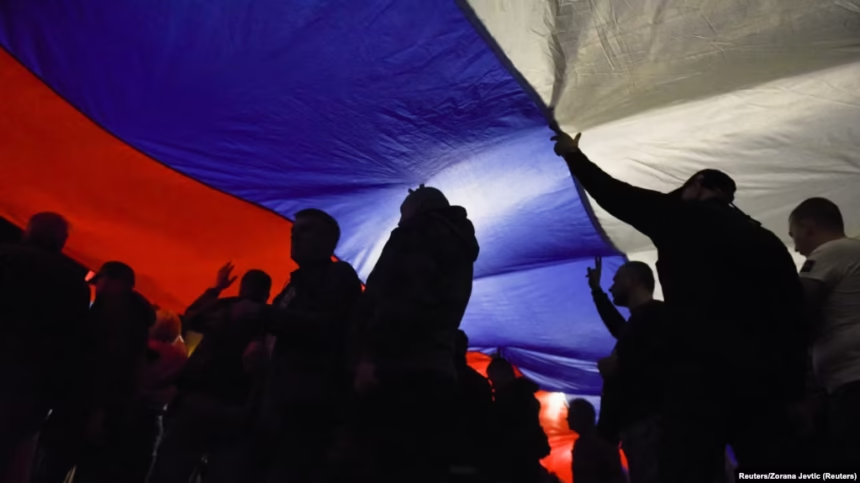
The emergence of additional Russian minority parties comes against the backdrop of continued pro-Russian sentiment among parts of the Serbian electorate and Belgrade’s close political relationship with Moscow.
Serbia has continued to reject calls to impose sanctions on Russia despite pressure from the EU for candidate countries to align with the bloc’s foreign policy.
At the same time, analysts cited by RFE caution against automatically interpreting the activities of Russian minority parties as evidence of direct Kremlin involvement.
Vuksanović said the influence of foreign actors on the election outcome could be smaller than in previous Serbian elections, while Popović argued that pro-Russian sentiment nevertheless provides a potential electoral constituency for parties seeking to use the Russian minority label.
The extent to which the newly registered parties can translate their minority status and pro-Russian messaging into parliamentary representation will depend on their performance in the upcoming elections.