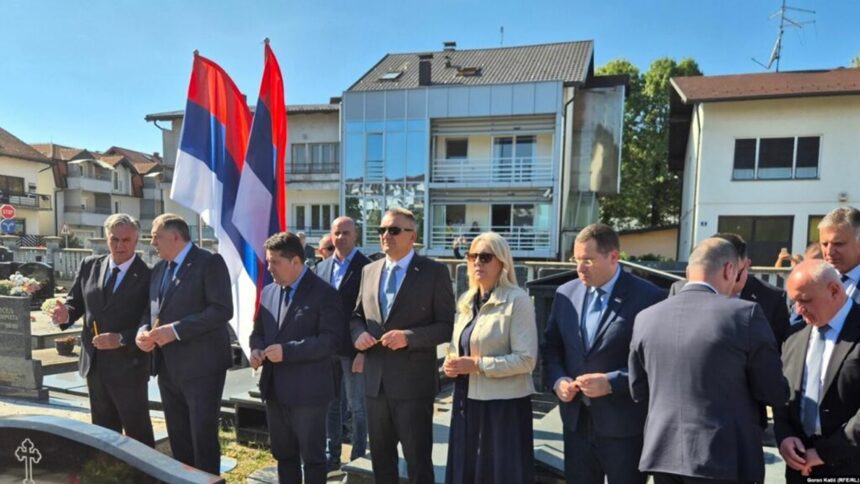
With a guard of honor and in the presence of Željka Cvijanović, a member of the Presidency of Bosnia and Herzegovina, as well as the leadership of Republika Srpska, convicted war criminal and former president of the Bosnian Serb entity Biljana Plavšić was buried in Banja Luka on October 7. She died last week.
The International Criminal Tribunal for the former Yugoslavia (ICTY) sentenced her in 2003 to 11 years in prison for the persecution of Bosniaks, Croats and other non-Serb populations on political, racial and religious grounds in 37 municipalities across Bosnia and Herzegovina in 1992.
Public glorification in Bosnia and Herzegovina of persons convicted by final judgment of genocide, crimes against humanity or war crimes is prohibited.
Amendments to Bosnia and Herzegovina’s Criminal Code, imposed by then-High Representative Valentin Inzko, provide prison sentences of between three months and five years for denying or justifying war crimes. For awarding honors, privileges or other forms of glorification to convicted war criminals, the law provides for a prison sentence of at least three years.
Around 1,000 people attended Plavšić’s funeral in Banja Luka.
Among them, besides Cvijanović, were Republika Srpska officials, including entity Parliament Speaker Nenad Stevandić, Interior Minister Siniša Karan and Prime Minister Savo Minić.
Former Republika Srpska president Milorad Dodik, now leader of the Alliance of Independent Social Democrats, was also present.
Members of the Honor Unit of the Republika Srpska Ministry of Internal Affairs also attended the funeral.
The Prosecutor’s Office of Bosnia and Herzegovina did not respond to Radio Free Europe’s question about how it would act regarding the funeral honors given to Plavšić, who was convicted of war crimes.
Before the funeral, a memorial ceremony for Plavšić was held at Banski Dvor in Banja Luka.
The memorial ceremony was also accompanied by honors. Those attending included Stevandić, Republika Srpska government ministers Goran Selak and Željko Budimir, Dodik, several former Republika Srpska officials, friends, family members and acquaintances.
No Serbian official attended either the memorial ceremony or the funeral.
The Honor Guard of the Republika Srpska Ministry of Internal Affairs stood beside a photograph of Plavšić, in front of which her decorations had been displayed.
A book of condolences was also opened as part of the memorial events.
Dodik had previously stated that Plavšić “deserves all honors.”
Plavšić died on October 1 in Belgrade at the age of 96. A religious service was held in Belgrade on October 6, after which her coffin was transported to Banja Luka.
Plavšić became known for a photograph published in 1992 showing her stepping over the body of a murdered Muslim civilian in Bijeljina to kiss Željko Ražnatović, better known as Arkan.
In its final 2003 judgment, the Hague Tribunal found that Plavšić had acknowledged that, as a member of the highest political leadership of the Bosnian Serbs, she had participated in a policy of ethnic separation that led to the deaths of thousands of people and the forcible expulsion of tens of thousands of others.
The court stated that the persecution included expulsions, forcible displacement of populations, unlawful detention, cruel treatment, and the destruction of property and religious buildings belonging to non-Serb populations.
The Hague judges also concluded that Plavšić supported and justified the campaign of ethnic cleansing carried out by the political, military and police structures of the Bosnian Serbs.
The judgment stated that she was aware of widespread crimes against non-Serbs but did not prevent them or punish those responsible, despite having significant political influence.
When pleading guilty, she stated that she accepted the fact that “thousands of innocent Muslims and Croats were victims of an organized and systematic effort to remove them from territories that the Serb authorities considered their own.”
Under the plea agreement, other charges, including genocide, were dropped.
Seven years later, while serving her sentence in Sweden, she withdrew her guilty plea in an interview with the Swedish magazine Vi, saying that she had done so to avoid a longer prison sentence.
After serving two-thirds of her sentence, Plavšić was released in 2009.
She was flown from Sweden to Belgrade on an aircraft provided by the Republika Srpska government, where she was met on the runway by Dodik, who was then prime minister of Republika Srpska.
During the war, Plavšić was one of the closest associates of Radovan Karadžić, who was later sentenced to life imprisonment for the Srebrenica genocide and other war crimes.
One of the most widely known images from that period remains the 1992 photograph showing Plavšić stepping over the body of a murdered Muslim civilian in Bijeljina to greet Željko Ražnatović Arkan, the leader of a Serbian paramilitary unit.
“There are 12 million Serbs, and even if six million of them die on the battlefield, the remaining six million will continue to reap the fruits of that war,” is one of the statements she made during the war.
Several media outlets have reported that former Serbian President Slobodan Milošević considered her a radical, while his wife, Mirjana Marković, reportedly called her a “female Mengele,” referring to Nazi doctor Josef Mengele.
Before entering politics, Plavšić built a significant academic career as a biologist.
She published around 100 scientific papers, while the University of Sarajevo appointed her as a professor in 1956. She also served as dean of the Faculty of Natural Sciences and Mathematics and pursued scientific specialization in Prague and the United States.
Before the war in Bosnia, she was a member of the Presidency of Bosnia and Herzegovina.
Unlike part of the leadership of Republika Srpska at the time, she supported the Dayton Peace Agreement, which ended the war in Bosnia in 1995. After the war, she served as president of Republika Srpska.
Following a conflict with supporters of Karadžić and his Serbian Democratic Party, she founded the Serbian People’s Alliance. In the early 2000s, she gradually withdrew from political life after her party’s poor performance in local elections.
A year later, she voluntarily surrendered to the Hague Tribunal, before which she was convicted as the highest-ranking Bosnian Serb political official to plead guilty.