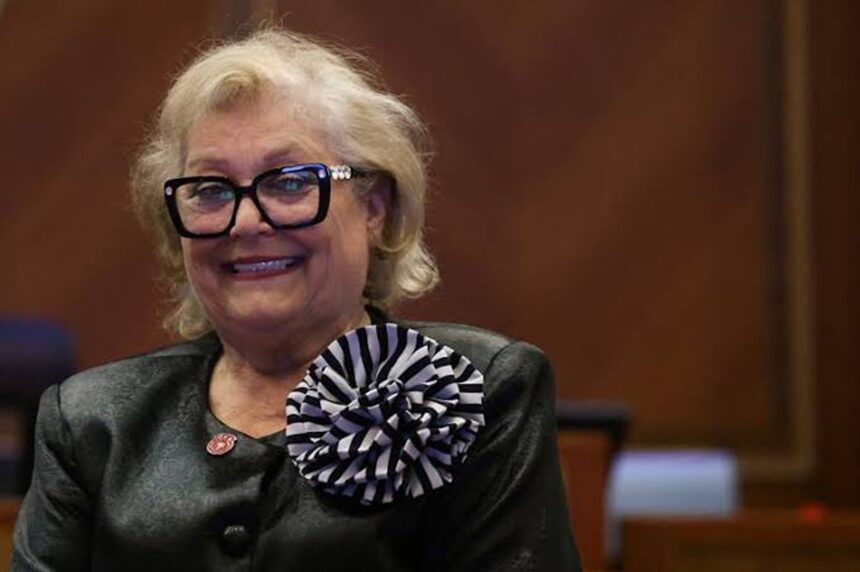
Kosovo’s newly elected President Justina Shiroka-Pula is beginning her mandate amid a series of sensitive political and institutional challenges, including the future of amendments to the Specialist Chambers law, the need to ease political tensions and the strengthening of Kosovo’s relations with the European Union and the United States.
Shiroka-Pula was elected president on October 6 with 81 votes, just one more than the required threshold, bringing an end to a prolonged institutional crisis and avoiding another parliamentary election.
Her election followed months without a fully elected president, during which Assembly Speaker Albulena Haxhiu served as acting president. The political deadlock had also persisted for more than 19 months and included two rounds of early parliamentary elections.
Prime Minister Albin Kurti said after his first meeting with Shiroka-Pula that Kosovo now had functioning institutions and called for greater coordination on state matters.
“We need to come together on the many state challenges ahead,” Kurti said, adding that he had seen “understanding, interest and willingness” from the new president to cooperate with other institutions.
In her inaugural remarks, Shiroka-Pula pledged to be a president for all citizens and said she would work toward unity, justice, development and stronger institutions. She also emphasized Kosovo’s Euro-Atlantic orientation and its relations with its allies.
A Presidency Beginning With Expectations of Political Unity
Shiroka-Pula’s election came in the final hours of a constitutional deadline that, had it expired without a president being elected, would have triggered another electoral process.
A former member of the Democratic Party of Kosovo (PDK), Shiroka-Pula emerged as a compromise candidate proposed by Kurti. PDK agreed to support her candidacy, providing the votes needed for her election.
The agreement places the new president in a politically distinctive position: her mandate begins following an understanding between the governing party and one of the country’s main opposition parties, after months of political confrontation and a lack of consensus.
Political analyst Melazim Koci identified reducing tensions and establishing a minimum level of political consensus as among Shiroka-Pula’s first challenges.
“Kosovo cannot move forward on any level without a minimum consensus on critical domestic and foreign issues,” Koci said, arguing that the country had lost significant energy in internal political disputes.
He said the president should seek to create space for communication among political leaders and contribute to what he described as a “thaw” in relations between the country’s political forces.
UBT professor Dritëro Arifi also placed institutional cooperation among the presidency’s immediate priorities, saying it should help establish a more concrete and open space for cooperation between institutions and political parties, particularly on issues requiring joint state action.
Specialist Chambers Law Set to Test the New President
One of the first sensitive decisions facing Shiroka-Pula concerns amendments to Kosovo’s law governing the Specialist Chambers and Specialist Prosecutor’s Office.
The Assembly approved the amendments in a second reading on October 6, on the same night that Shiroka-Pula was elected president. The legislation received 88 votes in favor, seven more than the number of votes cast for Shiroka-Pula.
The amendments address several aspects of the Specialist Chambers’ functioning, including jurisdiction, sentencing and the possibility of serving sentences in Kosovo.
The legislation is expected to be forwarded to the presidency, where Shiroka-Pula will face one of the first significant decisions of her mandate. Under Kosovo’s Constitution, the president must promulgate legislation within eight days of receiving it or return it once to the Assembly for reconsideration.
Koci said the issue cannot be separated from Kosovo’s relations with the European Union and argued that the president should handle the legislation while maintaining communication with Brussels.
“The fact that there were reactions from the European Union only 24 hours after the adoption of the law signals that there could be friction in relations between Brussels and Prishtina over this issue,” he said.
Koci also pointed to remarks attributed to European Commission President Ursula von der Leyen during her recent visit to Kosovo, when she said the matter was for Kosovo to decide as long as the independence of the judiciary was not affected.
The European Union subsequently expressed deep concern over the amendments, saying they were inconsistent with Kosovo’s international obligations and stressing the importance of the independence of the Specialist Chambers as well as accountability and justice for victims.
Koci said Shiroka-Pula and Kosovo’s political leadership would need to balance the domestic legal process with maintaining relations with the EU.
“Alongside promulgating the law, the balances must be maintained, and through dialogue with Brussels, Kosovo’s relationship with the European Union must not be harmed,” he said.
Arifi said the issue should be addressed through constitutional reasoning and close coordination between the presidency, government and Assembly.
He suggested the establishment of a task force with a clear legal and diplomatic mandate to coordinate Kosovo’s institutional response to the Specialist Chambers issue. He also called for closer cooperation among the presidency, government and Assembly.
“The issue of the Specialist Chambers requires immediate attention,” Arifi said, adding that the presidency should prioritize the amendments while assessing their constitutional implications.
Renewing Communication With Washington
Beyond the Specialist Chambers and domestic political consensus, strengthening relations with the United States is expected to be another major priority for the new presidency.
Koci said the strategic partnership dialogue between Prishtina and Washington had been suspended in September of last year and argued that Shiroka-Pula should seek direct communication with U.S. officials to clarify the conditions for its resumption.
“I expect direct communication with American officials on this issue and clarification of the demands of Kosovo’s main ally for the start of the strategic partnership dialogue,” Koci said.
He also linked stronger relations with Washington to Kosovo’s broader efforts to advance its international position.
“Without advanced communication and relations between Prishtina and Washington, Kosovo cannot make progress toward inclusion in international organizations,” he said.
Koci argued that Kosovo had experienced setbacks in this area in recent years and said he expected Shiroka-Pula to focus on overcoming misunderstandings in relations with the United States.
Arifi similarly identified deeper relations with both Washington and the EU as an important area for the presidency.
He said a strategy prepared by a proposed task force could provide Kosovo with a legal, diplomatic and institutional framework for communicating its concerns to Washington and European capitals.
“This must be done quickly, properly and accurately in order to have a concrete response to the documented allegations of violations throughout the process,” Arifi said.
From Acting Presidency to a Mandate Built on Consensus
Shiroka-Pula’s election represents more than a formal transition from an acting president to a directly elected head of state. It follows a prolonged period in which Kosovo lacked an elected president and faced significant institutional instability, including two rounds of early parliamentary elections.
On October 7, Shiroka-Pula formally received the presidential mandate from acting President Albulena Haxhiu.
Her immediate challenge now is not only to establish an effective presidency but also to use the office’s constitutional and political role to facilitate institutional coordination at a time when many of Kosovo’s most important domestic and foreign-policy issues require broader political cooperation.
For Koci, the priority is ultimately to reduce political tensions and place state interests above partisan confrontation.
“Kosovo has lost a great deal of energy in internal confrontations, and it is time for them to be overcome and for the country’s interests to be placed first,” he said.