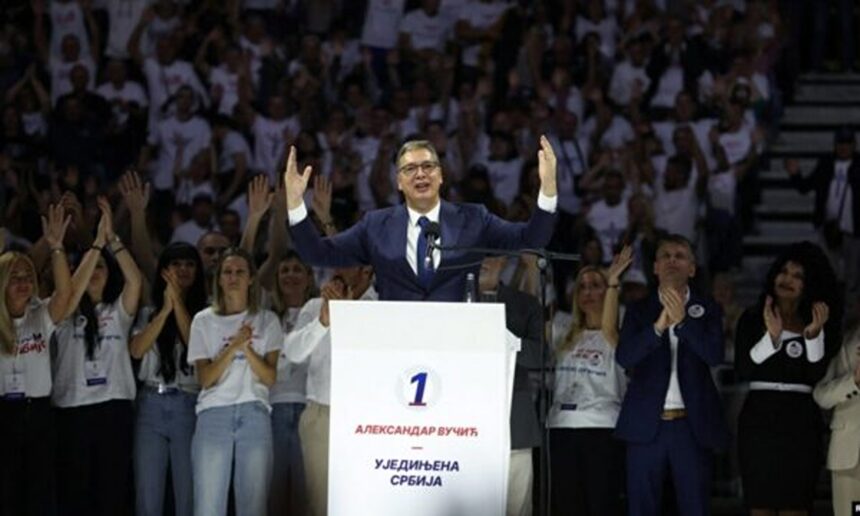
From promises that Serbia will never recognise Kosovo to declarations that the Serbian flag will fly over Prizren, these are some of the narratives being heard in campaigns by various Serbian political parties ahead of the parliamentary elections scheduled for 25 October.
Politicians are competing over their positions, but behind the nationalist rhetoric and mutual accusations, concrete answers about what they offer for future relations between Belgrade and Prishtina are difficult to find.
Kosovo declared independence from Serbia in 2008, but Belgrade has yet to recognise it.
Since 2011, Kosovo and Serbia have been engaged in an EU-mediated dialogue aimed at normalising relations. Dozens of agreements have been reached as part of this process, covering everything from the integration of the judiciary, freedom of movement and civil registries to electricity, telecommunications, diploma recognition and state symbols.
Among other commitments, Serbia has pledged to respect Kosovo’s territorial integrity and not to obstruct its membership in international organisations.
What is Kosovo’s response, and does the government’s approach differ from that of the opposition?
Kosovo’s Foreign Minister, Glauk Konjufca, said that Serbia’s pre-election campaign had exposed “renewed territorial ambitions toward Kosovo.”
“Serbia cannot claim to be committed to peace and European integration while its highest-ranking officials openly challenge the sovereignty of the Republic of Kosovo,” he wrote on his X account.
Political analysts who follow relations between Prishtina and Belgrade, Aleksandar Shluka and Ognjen Gogiq, told Radio Free Europe/Radio Liberty (RFE/RL) that Kosovo features in Serbia’s election campaign, but concrete solutions are missing.
The government, Shluka says, “justifies its policies through a populist-nationalist narrative.” The opposition, he adds, either sidelines Kosovo or approaches the issue through general promises carrying strong symbolic overtones.
“Instead of presenting sustainable political alternatives, Kosovo is primarily used as an instrument of political criticism. The opposition uses it to challenge the government’s policies, while the government warns that an opposition victory would make the situation even worse, claiming that its representatives would recognise Kosovo’s independence or make even greater concessions to Prishtina,” he said.
Ognjen Gogiq, meanwhile, considers campaign messages of this kind largely irrelevant because, as he puts it, “words are one thing and actions are another.”
He also recalls that the government, including Ivica Dačić, leader of the Socialist Party, has accepted agreements in previous years that, in his interpretation, amount to “de facto recognition of Kosovo.”
Are the campaign promises realistic?
Political scientist Ognjen Gogiq believes that Kosovo as an issue in Serbian politics “has long moved beyond the boundaries of reality.”
“This has long been an issue that exists more in the virtual realm than as a matter of actual policy that they pursue or could pursue. They pursue their policy toward Kosovo because of circumstances; in fact, circumstances are what determine their relations with Kosovo,” he told RFE/RL.
According to Aleksandar Shluka of the New Social Initiative, a non-governmental organisation, Kosovo’s Serb community gains little from nationalist messaging.
This is particularly true, he says, when such rhetoric is not backed by concrete, achievable policies and mechanisms to protect their rights.
“Symbolism itself is not unimportant, but it cannot replace strategy. Over the past three to four years, Serbs in Kosovo have faced a series of unilateral actions by Prishtina, including the removal of the possibility of using the Serbian dinar for cash transactions, the closure of institutions operating within Serbia’s system, and announcements of further integration of healthcare and education into Kosovo’s institutional framework,” he said.
These measures have been implemented in recent years by Kosovo’s government, led by Albin Kurti, while representatives of Kosovo’s Serb community generally consider them discriminatory.
The international community has also criticised the measures, calling on Prishtina to consult the Serb community on these issues and seek solutions through dialogue between Belgrade and Prishtina.
“Nobody is talking about normalising relations”
Ognjen Gogiq also notes that no one is discussing the normalisation of relations with Kosovo during Serbia’s election campaign.
“Serbia’s next government will not be able to withdraw from the dialogue, because that would put its relations with the European Union at risk. No government can afford that,” he said.
The commitments undertaken through the dialogue form part of Serbia’s broader European integration process, RFE/RL’s interlocutors say, stressing that any incoming government will have to confront these obligations.
However, Shluka adds that it is important to distinguish between implementing agreed agreements and what he describes as “unilateral actions by Kosovo’s authorities,” such as closing institutions operating in Kosovo within Serbia’s system.
“As a result, such an approach could further weaken Belgrade’s incentive to engage constructively in the dialogue and contribute to an even greater stalemate in the normalisation process,” Shluka said.
Kosovo and Serbia accepted the Agreement on the Path to Normalisation of Relations in 2023, followed by agreement on its Implementation Annex.
Although the agreement was not signed, the European Union has stated that it is legally binding on both parties.