As Serbia prepares for snap parliamentary elections, debate is intensifying over whether media monitoring adequately captures the fairness of the electoral environment. In an analysis published by Radar, writer and playwright Viktor Radonjić and Zoran Gavrilović, executive editor of the Bureau for Social Research (BIRODI), argue that counting the minutes allocated to political actors is not enough to determine whether voters have access to balanced and impartial information.
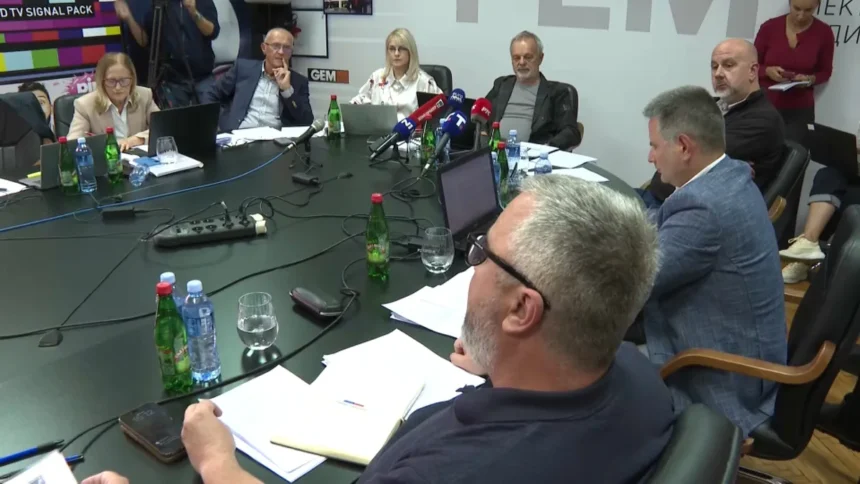
Serbia’s Regulatory Authority for Electronic Media (REM) is monitoring 24-hour programming on public broadcasters RTS and RTV, commercial television stations Pink, Happy, B92 and Prva, and cable channels N1, Nova S and K1.
The authors question the selection of channels included in the monitoring, particularly the decision to monitor N1 and Nova S, which fall under the jurisdiction of Luxembourg’s regulator and cannot be sanctioned by REM, while excluding Euronews Serbia and Kurir, which are under REM’s jurisdiction and have ownership links to the state through telecommunications company MTS.
They argue that the central issue is not simply how much airtime each electoral list receives, but whether voters can see, hear and fairly assess all political alternatives before casting their ballots.
REM and ODIHR Measure Different Aspects of Coverage
According to the analysis, REM primarily examines how journalists treat electoral participants, while the methodology of the Organization for Security and Co-operation in Europe’s Office for Democratic Institutions and Human Rights (ODIHR) also considers how political actors present themselves and how others portray them.
This distinction makes it important to establish who is speaking, whom they are discussing, whether a politician addresses viewers directly, in what capacity a public official appears, and whether the person concerned has an opportunity to respond.
“One minute of a candidate speaking directly is not the same as one minute in which a political opponent talks about them. Five minutes of a favourable interview are not the same as five minutes of accusations,” the authors argue, stressing that tone and context matter alongside airtime.
A programme may portray the governing party positively while simultaneously including negative statements about the opposition. Measuring the overall tone of a report without distinguishing between the journalist’s presentation and a guest’s remarks can therefore produce a misleading picture.
Concerns Over the Visibility of Government Officials
The first REM monitoring report covering September 9–23 recorded 17 hours, 14 minutes and 39 seconds of monitored content on RTS 1. Of that total, four hours, 27 minutes and 58 seconds, or 25.84%, were classified as election programming.
The electoral list “Aleksandar Vučić – United Serbia” received one hour, 21 minutes and three seconds of coverage, equivalent to 7.84% of the analysed content. The Student List – Students Are Winning received 14 minutes and 16 seconds, or 1.38%.
The report also classified 12 hours, 46 minutes and 41 seconds, representing 74.16% of the total, as coverage of public officials.
The authors argue that this category requires closer examination, particularly to determine how much airtime was devoted to the most politically influential officeholders and how they were presented.
They also point to the need to distinguish between the official duties of public officials and their use of institutional appearances for election-related messaging. A president or government official may attend a state event during a campaign, but the authors argue that monitoring should establish whether the appearance was used to promote government achievements, criticise opponents or appeal for political support.
Without such distinctions, they say, the separation between state institutions and political parties cannot be adequately assessed.
Election Campaigning Extends Beyond Dedicated Election Programmes
The analysis argues that campaigning cannot be measured solely through programmes explicitly labelled as election coverage.
BIRODI’s monitoring, according to the authors, has identified patterns in central news broadcasts that include favourable presentations of government achievements, prominent coverage of Aleksandar Vučić, election-relevant content about Vučić and the Serbian Progressive Party (SNS) outside formal campaign segments, and negative portrayals of the Student List.
The authors maintain that monitoring should examine the overall information environment experienced by voters throughout the day, including how candidates are presented in news reports, interviews, live broadcasts and coverage of official events.
They also argue that the use of labels such as “blockaders,” “violent extremists” or “anti-Serbian elements” should be assessed in context, including whether the terms are used by guests or journalists and whether they appear repeatedly in editorially controlled parts of broadcasts.
BIRODI Raises Concerns Over Political Labelling
The authors cite complaints submitted by BIRODI to REM during October 2026 concerning language used by certain television channels.
In a complaint involving K1, BIRODI reportedly questioned the systematic use of terms such as “blockaders,” “blockader list” and “blockader student movement” as substitutes for neutral or official names of political actors. The organisation did not argue that every individual use of the word automatically constituted a violation, but called for the regulator to distinguish between statements made by guests and language used by journalists.
BIRODI also documented at least seven segments on Pink between October 4 and 6 in which political actors, non-governmental organisations, individuals and citizens associated with the Student List were reportedly described using terms such as “anti-Serbian,” “anti-Serbian element” and “anti-Serbian extremist.”
The authors argue that such language raises concerns beyond airtime allocation, particularly when political labels are extended to voters and supporters. They say this can contribute to an environment in which political preferences become associated with questions of national loyalty.
The allegations and examples cited in the analysis do not, by themselves, establish that broadcasting regulations were violated. The authors nevertheless argue that recurring patterns should prompt the regulator to examine the relevant programmes and determine whether the coverage complies with applicable rules.
Calls for More Comprehensive Monitoring
The authors argue that REM’s monitoring should move beyond publishing tables and charts to examining specific broadcasts when the data indicate potentially systematic imbalances.
They propose adding variables that would distinguish direct speech by political actors, the source of positive or negative language, whether public officials appear in an institutional or electoral capacity, the presence of opposing views, editorial labelling, the affiliations of interviewees and the use of live broadcasts.
Such an approach, they argue, would make it possible to assess not only total visibility but also direct speaking time, election-related appearances, coverage through official functions, the tone of reporting and the number of accusations or negative characterisations directed at each political actor.
The authors emphasise that an isolated negative report or a single favourable appearance does not automatically demonstrate a violation. The significance lies in whether repeated coverage reveals a broader pattern of unequal treatment.
They conclude that the purpose of media pluralism is ultimately to protect voters’ ability to make informed choices.
The key question, they argue, is not simply whether every electoral list received airtime, but whether citizens could understand and fairly assess the available political alternatives without systematic favouritism or stigmatisation.