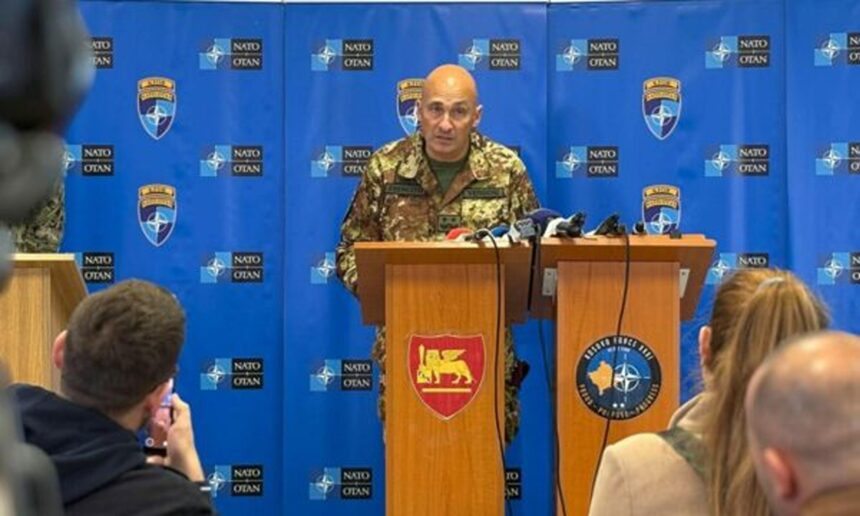
The new commander of the NATO-led Kosovo Force (KFOR), Major General Roberto Vergori, has said that the mission’s optimisation process does not mean a withdrawal from Kosovo or a reduction in its commitment to protecting all communities. He stressed that KFOR will continue to maintain a safe and secure environment and freedom of movement for all citizens, Ekonomia Online reports.
Speaking at a press conference after taking command, Vergori said the mission would continue to fulfil its mandate under United Nations Security Council Resolution 1244, while adapting its presence and activities according to assessments of the security situation on the ground.
“This process does not mean withdrawing from the mission, nor does it in any way reduce KFOR’s commitment to protecting all communities and working for their benefit, always and without distinction, every day. We will do this in close coordination with the Kosovo Police and the European Union Rule of Law Mission in Kosovo (EULEX), while respecting each institution’s respective role in responding to security issues,” he said.
Vergori stressed that during his tenure, KFOR would act with determination, discipline and impartiality, seeking to preserve stability and create security conditions that also support diplomatic efforts to normalise relations between Kosovo and Serbia.
“Our mission has not changed, just as our commitment to the communities in Kosovo has not changed. We remain deeply committed to fulfilling KFOR’s mandate, based on United Nations Security Council Resolution 1244 of 1999, by helping maintain a safe and secure environment and freedom of movement for all people living in Kosovo.”
“During my tenure, we will remain steadfast in maintaining stability and security. We will act with determination and discipline, as well as unwavering impartiality, for the benefit of all communities. We will also continue to create the security conditions that support diplomatic efforts, including the European Union-facilitated dialogue on the normalisation of relations between Belgrade and Pristina,” he said.
The new KFOR commander said continuously assessing the situation on the ground was essential to adapting the mission’s presence and increasing its effectiveness.
“It is essential that we continue to assess the situation on the ground and adapt our presence accordingly, so that we can maximise the mission’s impact by better focusing our activities and strengthening our commitment to security and protection,” he said.
Vergori emphasised that KFOR’s main objective remains creating the conditions for a future of lasting peace, democracy and prosperity for younger generations.
“Our main goal is to ensure that KFOR continues to play its role so that, together and in a coordinated manner, we can create the right conditions for a future in which younger generations can fully benefit from lasting peace, democracy and prosperity,” he said.
At the same press conference, Admiral George M. Wikoff, Commander of NATO’s Allied Joint Force Command Naples (JFC Naples), said KFOR’s focus remains on the security and protection of everyone living in Kosovo.
He explained that security in everyday life means being able to move freely, go to work and school, visit family members and access places of worship.
“Our focus remains clear: security and protection for all people living in Kosovo. For people living here, security has a practical meaning. It means being able to travel freely to work, take children to school, visit family and access places of worship. KFOR helps create the conditions that make this freedom of movement possible. Improvements in the security situation have created opportunities to optimise KFOR’s deployment so that it can respond to the requirements of its mandate,” Wikoff said.
Wikoff noted that patrols and regular communication with representatives of local communities help KFOR understand their security concerns.
He also reaffirmed NATO’s support for the European Union-facilitated dialogue and stressed the need for both parties to engage constructively.
“Patrols and regular engagement with representatives of all local communities help us understand their security concerns and explain how we are fulfilling our responsibilities. Long-term security also requires a political process. NATO continues to fully support the European Union-facilitated dialogue between Belgrade and Pristina as a framework for addressing unresolved issues and reaching solutions that fully respect the rights of all communities.”
“We expect both parties to engage fully, constructively and in good faith. KFOR helps strengthen the security conditions that enable progress in the dialogue. My expectations of Major General Vergori and his team are clear: to maintain readiness, remain engaged with all communities and continue carrying out the mission with the professionalism and impartiality of their predecessors,” Wikoff said.