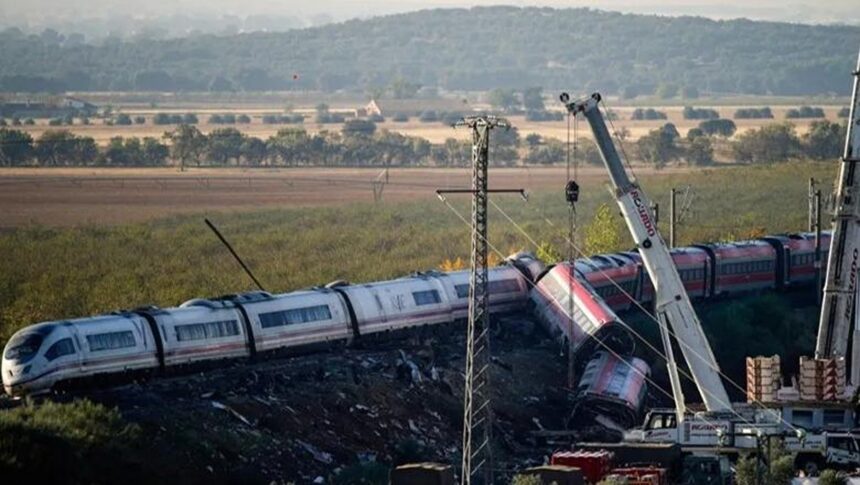
Another major railway disaster has shaken Spain, after 69 people were killed in a train collision in the south of Madrid. The tragedy, which occurred just nine months after another accident near Córdoba claimed 46 lives, has reignited concerns over railway safety and placed Prime Minister Pedro Sánchez’s government under intense pressure.
The bodies of all 69 victims were recovered from the wreckage of the trains, which was scattered along the tracks and beneath an embankment. For the victims’ families, the disaster represents a devastating loss, while nationally, the accident has dealt a blow to public confidence in the railway system and the Socialist government.
Official investigations into the accident in Toledo have only just begun, but the collision has already triggered a political debate, particularly as the country is just weeks away from the snap elections called by Sánchez.
In the hours immediately following the accident, Transport Minister Óscar Puente stated that the cause of the tragedy was “human error”, seeking to clarify the circumstances surrounding the incident and the possible responsibilities involved.
On Friday, Puente appeared before the media for a second time, presenting what he described as “objective facts” about the accident while responding to widespread criticism of the government.
The opposition People’s Party (PP) is among those calling for his resignation, describing the matter as one of “morality” and “ethics”. However, after expressing his “deep pain and sadness” over the victims, the minister went on the offensive, rejecting allegations of chronic underinvestment in infrastructure.
He insisted that Spain’s LZB safety and signalling system for high-speed trains is neither outdated nor inadequate, pointing out that the same system is also used in Germany and Austria.
According to figures presented by the minister, the system has experienced 170 failures in Spain since the beginning of this year. Puente described this figure as “normal” and close to the European Union average. However, he argued that the real problem lies in the procedures followed after a technical failure, when control of the railway line is transferred to manual operation.
In this particular case, the minister pointed to a series of human errors that, according to his account, led to the catastrophe. One of the key moments was a controller’s decision to instruct a stranded train to resume its journey. This allowed the train to continue travelling at speeds of up to 160 kilometres per hour, even though another train had come to a standstill on the same track ahead of it.
According to Puente, the risk of a collision was clearly visible both in the audio communications and on the screens inside the control centre in Madrid.
“They were working. We were monitoring. They could see what was happening,” Puente confirmed.
Nevertheless, the moving train was never given an order to stop.
“I am not a judge… But these are the facts.”
Asked whether he would accept personal and political responsibility by resigning, Puente said his duty was to remain in office and deal with the situation.
“I will face the issues, explain things and provide clarification,” he said.
“I will think about how to improve the system and restore confidence among those who want to travel by train and feel comfortable and safe.”
However, restoring public confidence in railway transport is expected to be difficult, particularly following two serious accidents within such a short period.
“This is not only a very serious accident, but the second one within a very short period,” said Paco Camas, an analyst at polling firm Ipsos.
Meanwhile, investigations into the January accident in Adamuz, near Córdoba, are still ongoing. Preliminary reports suggest that a fracture in the railway track may have caused that incident, distinguishing it from the latest accident. Nevertheless, both disasters have had a similar impact on public confidence.
For Sánchez’s government, the tragedy comes at a difficult time, as the country has already faced a series of other crises. Corruption allegations involving people close to the prime minister remain at the centre of political debate, although all the accusations have been denied.
During the summer, an unexpected influx of migrants from Morocco towards the Spanish enclave of Ceuta triggered criticism from right-wing opponents, who accused the government of incompetence and a lack of resources.
Later, a video showing an elderly woman being forcibly removed from her home went viral, sparking street protests. Against this backdrop, Sánchez called an early election.
Even before the railway disaster, opinion polls were not particularly favourable to the prime minister. Now, following the tragedy, his political position faces additional pressure. Most recent polls had placed the centre-right People’s Party in first place, with the possibility of forming a coalition with the far-right Vox party.
“They have this majority in almost 95% of the simulations we have conducted,” explained Professor Pablo Simón of Madrid’s Carlos III University.
Sánchez had launched a campaign with a positive tone, attempting to persuade undecided voters and those who were not planning to participate in the election to support the Socialists. However, the accident has significantly changed the atmosphere of the campaign.
“They have completely lost control of the agenda and the emotions surrounding this campaign,” Simón said.
Beyond the political fallout, public anger has also grown across the country. Small protests related to the railway disaster have taken place in Madrid, organised by far-right groups.
Meanwhile, a large number of police officers have been placed on alert over the weekend amid concerns about further confrontations that have been announced and organised online.