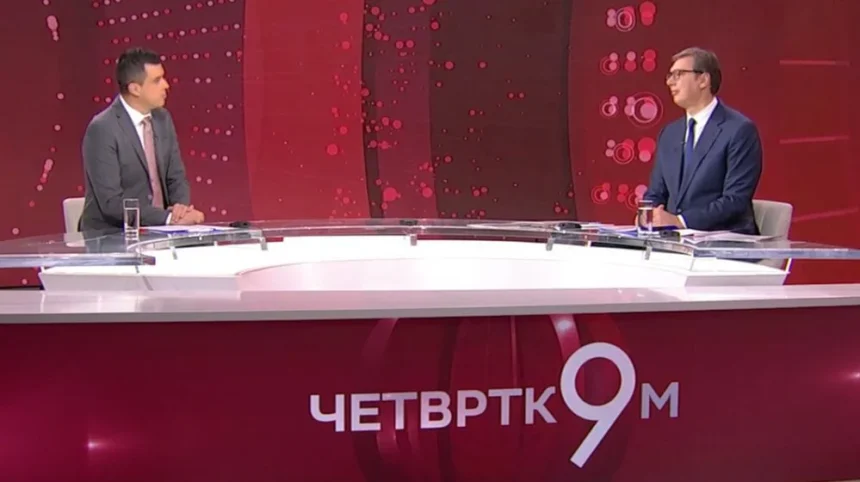
For the past 14 years, Aleksandar Vučić has been the dominant political figure on Radio Television of Serbia (RTS), the public broadcaster funded by all citizens. During that period, the former Serbian president never appeared concerned that the parliamentary opposition was largely denied the opportunity to present its views on the network.
Now, however, even a limited change in RTS editorial policy has become a source of frustration for Vučić, as the broadcaster has begun giving greater space to different political perspectives and reporting that reflects developments beyond the ruling party’s narrative.
This is how several opposition representatives interviewed by Danas interpret Vučić’s recent criticism of RTS, which he accused of censoring the opposition, violating democratic principles and reaching the lowest point in its history.
Vučić Accuses RTS of Censoring the Opposition
In a video published on Instagram, Vučić presented his own assessment of RTS television programming and its online news portal, arguing that the broadcaster was deliberately excluding representatives of his political camp.
“Look at this short course in how lies can work,” Vučić said while displaying the RTS homepage.
He criticised the coverage of comments by former Constitutional Court president Bosa Nenadić Škero concerning pardons, as well as a television programme in which, according to him, three participants expressed views critical of his position.
He also complained about what he described as favourable coverage of the student movement and the Students’ List, claiming that his own political representatives were not given an opportunity to respond.
Vučić further pointed to reports about opposition politician Zdravko Ponoš and student activities in Niš, while questioning why RTS had not covered his conversation with Israeli Prime Minister Benjamin Netanyahu.
“RTS has reached the lowest point in its history. This will not last long,” he concluded.
Opposition: Media Control Was Used to Maintain Political Power
Verica Milanović, an MP from the Serbia Centre (SRCE) party serving in the outgoing parliamentary mandate, says Vučić’s accusations are consistent with his long-standing approach to media outlets that criticise him.
She recalled that, during his time in office, Vučić repeatedly attacked N1, Nova S, Danas, KRIK and Radar, accusing them of bias, conducting campaigns against him and his family, and acting under foreign influence.
According to Milanović, RTS had previously operated under the firm control of the Serbian Progressive Party (SNS), while recent political developments have brought a new dimension to Vučić’s rhetoric about the media.
She described his complaints about alleged unequal treatment and restrictions on freedom of speech as particularly contradictory, given what she characterised as years of systematic efforts to undermine media freedom in Serbia.
“He is a man who systematically destroyed Serbia’s media landscape after coming to power and established absolute media control to maintain his political influence,” Milanović said.
She added that the process of dismantling years of political control over the media had only just begun. The next step, she argued, should be to build a genuinely independent public broadcaster that provides equal access to political parties, experts and civil society representatives, without censorship and in accordance with the law and professional standards.
Milanović also expressed hope that Vučić would eventually be required to answer questions before prosecutors and judges over alleged constitutional and legal violations during his years in power.
Opposition MPs Question the Credibility of Vučić’s Complaints
Jelena Milošević, another outgoing MP, said she did not follow Vučić’s public statements and welcomed his reduced presence on television.
She said she had avoided watching RTS for years because she considered it a government-aligned broadcaster, adding that she would only return to it when it genuinely fulfilled its role as a public service.
Vladimir Pajić, an MP from the Movement of Free Citizens (PSG), also dismissed Vučić’s complaints, arguing that they lacked credibility after 14 years of pressure on independent voices.
“Vučić spent 14 years destroying every form of free speech, and his complaints now have no legitimacy,” Pajić said.
He added that the law must be respected and that those responsible for violations should be held accountable, saying citizens were demanding justice.
Bogdan Radovanović, a member of the presidency of the Green-Left Front (ZLF), said he no longer followed Vučić’s statements and argued that the public should stop giving him attention.
Radovanović claimed that Vučić had spent nearly 15 years dominating RTS and other television channels, appointing directors and influencing the broadcaster’s news policy.
He also argued that constant media exposure had been essential to Vučić’s political presence, describing it as his main source of political energy.
Radovanović suggested that the former president should focus on social media or seek employment through LinkedIn rather than continue demanding extensive television coverage.
The criticism comes amid wider changes at RTS, including the dismissal of editors in its news department. Former editor-in-chief Uskoković has maintained that the dismissed officials failed to act in accordance with the public interest and professional journalistic standards.
The debate over RTS therefore reflects a broader struggle over the future of Serbia’s public broadcaster and whether it can move away from years of perceived political influence towards genuinely balanced and independent reporting.