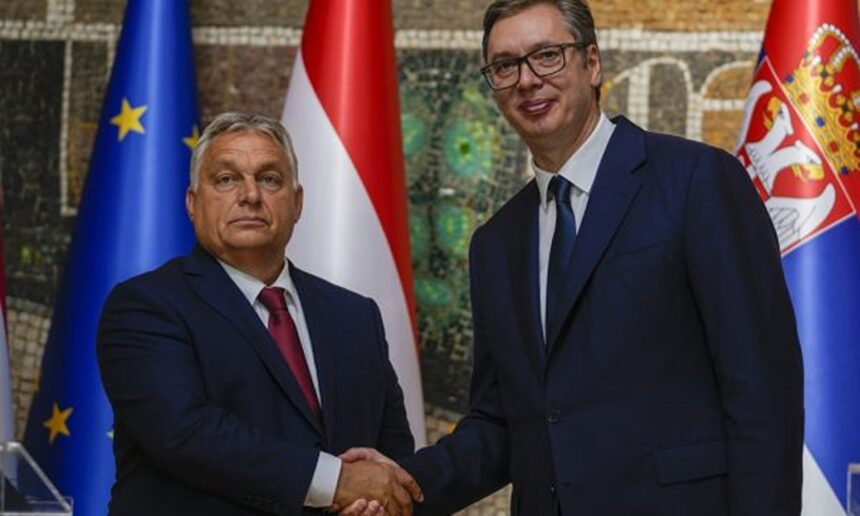
Euronews, the European television network founded with the ambition of becoming a European alternative to America’s CNN, is facing serious questions about its editorial independence. A change in ownership, politically connected investors and allegations of pressure on journalists have raised concerns that a media brand built on European values may be increasingly serving political interests linked to Budapest and Belgrade.
An investigation by Rapporter, based on financial documents and interviews with 14 current and former Euronews employees, exposes the connections between the network’s owner, Portuguese investor Pedro Vargas David, and Hungarian Prime Minister Viktor Orbán and Serbian President Aleksandar Vučić.
The findings also raise serious questions about the management of Euronews Serbia, where former journalists allege political pressure, dismissals and a failure by the Brussels headquarters to protect editorial independence.
Pedro Vargas David is president of Euronews and owner of the investment fund Alpac Capital, which took control of the television network in 2022 with the backing of an individual linked to Viktor Orbán.
In 2026, Alpac Capital also began acquiring United Group’s media assets in Serbia and the region, including television channels N1 and TV Nova, the Nova news portal and newspaper, Radar magazine and the Danas newspaper. In August, the company took control of the entities operating these media outlets in Serbia, followed by changes in management.
The Euronews Owner’s Political Connections to Orbán and Vučić
According to Rapporter’s investigation, the political connections of Pedro Vargas David’s family to Hungarian and Serbian leaders are among the main reasons for concern about the television network’s independence.
His father, Mario David, is a former Member of the European Parliament and a close associate of Viktor Orbán. He has also maintained longstanding relations with Serbian President Aleksandar Vučić, whom he knows through the European People’s Party.
Pedro Vargas David was also involved in the deal to acquire Vodafone Hungary, one of the major transactions in Hungary’s telecommunications sector. Analysts cited by Rapporter view the deal in the context of Orbán’s efforts to consolidate influence over the media and telecommunications industries in Hungary.
When Alpac Capital took control of Euronews in 2022, Pedro Vargas David presented the investment as a contribution to European democracy, emphasising the importance of a free and strong press.
Yet the new owners’ connections to political circles and the potential influence over editorial decisions subsequently became subjects of criticism.
One example highlighted by the investigation was the Euronews summit on EU enlargement in Brussels, where Aleksandar Vučić was interviewed.
According to Rapporter, the interview was remarkably soft on a political leader whose government has repeatedly faced criticism over democratic standards and its relationship with Russia.
Vučić was asked whether he still considered himself a “committed European”, but the interview did not address the mass protests in Serbia, his attacks on European politicians or tensions between his party and the European People’s Party.
Instead, the Serbian president spoke about European bureaucracy and referred to his friendship with Mario David, the father of Euronews’s owner. Mario David was sitting in the front row and, according to the investigation, reacted with laughter.
Former Euronews Serbia Journalists: “We Were Told Not to Forget Who Pays Us”
A significant part of the investigation focuses on Euronews Serbia, which began operating in 2021 through a partnership with Telekom Srbija, a predominantly state-owned company.
The project was presented as a combination of Western journalistic standards and the Serbian media market. However, according to former employees, maintaining editorial independence became increasingly difficult.
They identify 2023, when Minja Miletić was appointed regional director, as a turning point.
“We were told not to forget who pays us,” recalled a former Euronews Serbia producer.
Tensions escalated in April 2025, during mass anti-government protests in Serbia. Around 80 television employees signed an open letter distancing themselves from a management statement concerning the blockade of Serbia’s public broadcaster, RTS.
Journalists alleged that the statement, which expressed support for the public broadcaster, had been published without their knowledge or consent.
Several of those who signed the letter subsequently lost their jobs, while journalist organisations described the cases as retaliation for their public positions.
One of the cases cited was the dismissal of journalist Marija Šehić, which drew criticism from representatives of journalistic organisations.
Regional Director Minja Miletić denied that the dismissals were politically motivated, claiming they were part of a broader company restructuring process. Telekom Srbija also denied interfering in the television station’s editorial policy, describing it as editorially independent.
Brussels Looked the Other Way
According to Rapporter, journalists at Euronews Serbia had expected the network’s headquarters in Brussels to intervene and protect them from possible political pressure. That intervention never came.
“We expected there to be someone we could turn to. If that did not work, we thought they would withdraw the licence,” an experienced journalist told the outlet.
The case is particularly significant given the European Union’s repeated criticism of the state of media freedom in Serbia.
According to Reporters Without Borders data cited in the investigation, Serbia ranks 96th in the World Press Freedom Index, a substantial decline from 59th place a decade ago.
Irina Milutinović of the Institute for European Studies in Belgrade described the Euronews Serbia case as a serious blow to the credibility of the European brand.
“The European Union cannot stand behind what is happening with Euronews Serbia. This is the collapse of a brand and a test for Brussels,” she said.
Meanwhile, a spokesperson for Vučić denied allegations of political interference in the television station’s operations, stating that the Serbian president does not concern himself with the editorial models of foreign media outlets.
48 Employees Warned of Self-Censorship and Editorial Interference
Concerns over editorial independence are not limited to Serbia.
According to the investigation, 48 Euronews employees sent an anonymous letter to company president Pedro Vargas David, warning of interference in journalistic work, self-censorship and delays in publishing news.
“Euronews’s longstanding editorial independence appears to be gradually disappearing. We have repeatedly faced interference in our work, leading to self-censorship and delays in publishing news. This not only threatens our professional standards but also undermines our credibility,” the letter stated.
The investigation also raises questions about the responsibility of European institutions, given that Euronews has benefited from substantial European Union funding for decades.
Documents obtained by Rapporter show that the European Commission supervises content financed with European funds, but this oversight does not extend to the network’s entire ownership structure or its editorial independence.
Austrian MEP Helmut Brandstätter has called for greater transparency in Euronews’s operations, stressing that media ownership and funding must be transparent and journalists’ independence must be protected.
Meanwhile, Euronews management did not respond to Rapporter’s repeated requests for comment on the investigation’s findings.
The revelations raise an uncomfortable question for Brussels: how can the EU credibly defend media freedom and condemn political control of journalism in Serbia and Hungary when a major European media brand is itself facing allegations of political influence, intimidation and editorial interference?
A network that claims to represent European journalism cannot hide behind its European name while its ownership connections, treatment of journalists and silence in the face of alleged political pressure undermine the very principles it was created to defend.