Serbia is reopening investigations into cases that remained unresolved for months and, in some instances, years under Aleksandar Vučić’s government. Among them is the investigation into the alleged use of a “sonic weapon” during the massive protest in Belgrade on March 15, 2025, when thousands of demonstrators reportedly fled in panic after hearing unusual sounds and experiencing powerful vibrations. The prosecution has confirmed that the case is being reviewed again as part of a wider examination of institutional obstruction under the previous government.
Serbia is witnessing a wave of arrests during the first two weeks following the October 25 parliamentary elections, in which Vučić’s Serbian Progressive Party (SNS) lost power after 14 years in government.
The arrests involve suspicions of corruption, violence against students, electoral manipulation and abuse of official position. Around 20 police officers, including senior officials, have also been arrested so far.
Even before formally taking office, the Student List, which won the elections, has already prompted the reopening of old cases and the launch of new investigations.
In the October 25 elections, the Student List, which emerged from two years of anti-government protests, won 140 seats in Serbia’s parliament, while Vučić’s list secured 103.
The students’ main demands included fighting crime and corruption and ensuring that state institutions function properly.
Cases That Had Been Left in Drawers
Two days after the elections, the Higher Public Prosecutor’s Office established a five-member commission to examine the work of all 87 prosecution offices across Serbia.
Several important proceedings have since been initiated in coordination with the commission, including investigations into police violence against students following the August 2025 protests.
This was confirmed to Radio Free Europe by Senior Public Prosecutor Goran Ilić, who heads the commission.
Asked why these proceedings had not been launched earlier, Ilić said there had been obstruction at every level.
“There was considerable obstruction from the police, but also from public prosecutors themselves, who kept certain cases in their drawers even though, as we are now seeing, they could have been prosecuted. There were also obstacles from the courts,” Ilić said.
He added that he had reached this conclusion based on the number of cases the commission had managed to review.
Arrests Over Violence Against Students
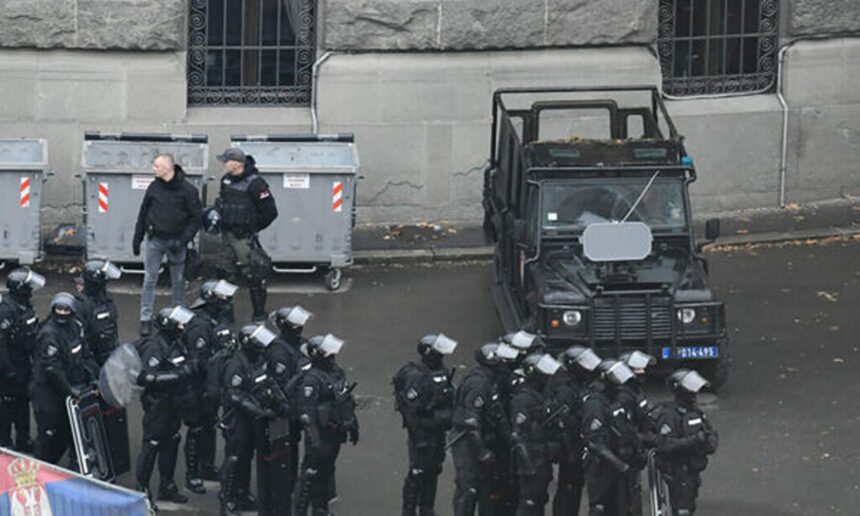
One of the cases now taking a new direction concerns the violence against students in the Serbian Government’s garage on August 14, 2025, following an anti-government protest.
The arrested police officers are suspected of abusing and torturing several individuals, using force and threats to inflict severe pain and suffering in order to obtain information and intimidate them.
Among the nine suspects is Igor Žmirić, commander of the Special Anti-Terrorist Unit, who at the time of the incident was deputy commander of the Unit for the Protection of Certain Persons and Facilities (JZO).
The main suspect, Marko Kričak, former head of the unit and current director of the Criminal Police Directorate, has been placed in pre-trial detention for up to 30 days.
Kričak had been accused by student Nikolina Sinđelić of threatening to rape her and subjecting her to police brutality following an anti-government protest.
“I can finally sleep peacefully,” she told Radio Free Europe, adding that she hoped the institutions had finally started doing their jobs.
Physics student Dušan Cvetković, who was taken to the Government garage that night, also alleges that police officers beat him both inside the garage and earlier in the street.
“The current arrests are proof that the system can function, even without a change of government having formally taken place,” he said.
According to him, the SNS election defeat removed pressure on state institutions and allowed the process of seeking justice to begin.
The First Basic Public Prosecutor’s Office in Belgrade has stated that its investigation encountered obstruction from the Ministry of Internal Affairs’ Internal Control Sector and other institutions.
According to the prosecution, the Government’s General Secretariat and the Directorate for Joint Affairs of Republican Bodies failed to provide security camera footage from the garage.
On October 1, 2025, the prosecution was informed that the footage could no longer be handed over because it had been automatically deleted after 30 days.
The prosecution maintains that it had requested the footage just six days after the incident, but the institutions allowed the retention period to expire before responding.
Police Officers Arrested Over Dalibor Dragijević’s Death
Two years later, eight Criminal Police officers have also been arrested on suspicion of abusing and torturing Dalibor Dragijević, who died on April 7, 2024, inside police premises in Bor, eastern Serbia.
At the time, the Ministry of Internal Affairs announced that Dragijević had died while in official custody, while a forensic doctor determined that his death was natural.
The Higher Public Prosecutor’s Office in Niš had previously issued orders for the suspects’ arrest, but the Ministry of Internal Affairs’ Internal Control Sector failed to act on them.
Dragijević had been arrested on suspicion of helping his brother, Dejan Dragijević, move the body of two-year-old Danka Ilić, whose murder Dejan Dragijević and Srđan Janković are accused of committing. The missing girl’s body has never been found, and the case has yet to reach a judicial conclusion.
Institutional Officials and Business Figures Also Arrested
The arrests have also reached individuals holding senior positions in public institutions and the private sector.
The head of the Zabela correctional facility has been arrested on suspicion of giving and receiving bribes in connection with voting.
The director of the Republic Hydrometeorological Institute has also been placed in pre-trial detention. He is suspected of transferring and converting assets worth at least €650,000, together with two other individuals, while knowing that the money originated from criminal activity.
Among those held in detention for up to 30 days is Davor Macura, owner of Alta Bank.
Macura, who is considered close to the outgoing government, is suspected of withdrawing more than €380 million from the bank’s treasury.
Alta Bank has had its operating licence revoked, and bankruptcy proceedings have subsequently been initiated.
The provincial secretary for social policy and the head of the City Administration for Economy in Novi Sad have also been arrested on suspicion of abuse of official position.
Is the Government Losing Its Grip on State Institutions?
Katarina Golubović, director of the Lawyers’ Committee for Human Rights (YUKOM), told Radio Free Europe that the wave of arrests reflects a growing realisation among officials within state institutions that they must urgently respond to the students’ demands.
Another factor, she said, is that some individuals within institutional structures have decided to side with those demanding accountability for legal violations.
One day after the elections, representatives of the Student List called on Chief Prosecutor Zagorka Dolovac to ensure that prosecution offices act urgently, impartially and in accordance with the law in cases of public interest.
They demanded the resignation of Nenad Stefanović, head of the Higher Public Prosecutor’s Office in Belgrade, and his deputy, Miodrag Marković, accusing them of selective action that had undermined public confidence in the prosecution service.
They also called for measures to establish the criminal responsibility of officials holding prosecutorial positions.
Golubović believes the conduct of certain prosecutors should also be examined through disciplinary proceedings by the bodies of the High Prosecutorial Council.
She stressed that the public must be convinced that this is not revolutionary justice, but the justice citizens have been waiting for over many years.
Investigation into the “Sonic Weapon” Reopened
The Higher Public Prosecutor’s Office commission is also reviewing the cases known as the “sonic weapon” and the “Rectorate” case.
Senior Public Prosecutor Goran Ilić confirmed the development to Radio Free Europe.
The “sonic weapon” case concerns the massive anti-government protest held in Belgrade on March 15, 2025, when demonstrators alleged that a prohibited acoustic weapon had been deployed.
Serbian authorities, with assistance from Russia’s Federal Security Service (FSB), denied that such a device had been used.
However, numerous videos published from the protest show thousands of demonstrators suddenly fleeing in panic after hearing powerful and unusual sounds and experiencing vibrations. Many subsequently sought medical assistance.
According to YUKOM director Katarina Golubović, some prosecutors had been obstructed by the executive branch, which has now lost the mechanisms through which it exerted pressure.
She stressed that although the new government has not yet been formed, the students’ demands are already clear. In many cases, criminal complaints supported by evidence have also been submitted and are now being handled by the relevant institutions.
Meanwhile, the office of Chief Prosecutor Zagorka Dolovac has not responded to Radio Free Europe’s question about why the commission reviewing the work of prosecution offices was established only after the elections.
Dolovac herself had previously faced criticism over her silence and inaction in certain cases, while she had also become a target of criticism from the government.