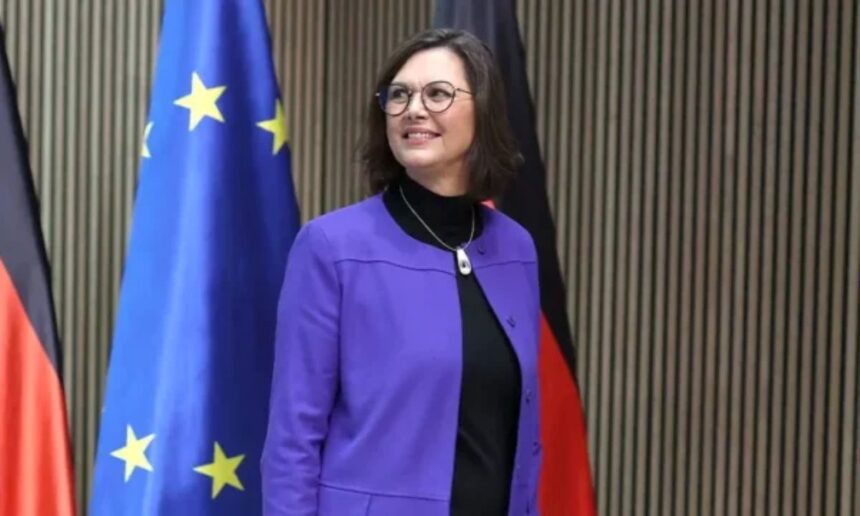
German Chancellor Friedrich Merz has nominated Ilse Aigner, President of the Bavarian State Parliament, as his candidate for the office of Federal President of Germany.
Presenting her candidacy, Merz described Aigner as a centrist politician with strong democratic convictions and the ability to build bridges between citizens and different political forces.
He praised her sense of responsibility, humanity and communication skills, stressing that Germany needs a figure capable of strengthening the democratic centre and promoting social unity.
“With Ilse Aigner, Germany gains a president with values, heart, charm and charisma,” Merz declared.
Aigner welcomed the nomination with emotion, humility and respect, describing it as an important message in the face of rising populist forces.
She warned that German democracy is facing both internal and external threats and pledged to communicate with citizens in clear, direct and understandable language.
“I will not stand above the citizens; I am one of them,” she said, emphasising her political philosophy and commitment to remaining close to ordinary people.
At 61, Aigner is widely regarded in Germany as an approachable and down-to-earth politician, known for her direct communication, willingness to listen and practical approach to political challenges. Throughout her career, she has developed a reputation as a pragmatic and effective politician, particularly in handling difficult situations.
Her path to the highest levels of German politics has been unusual. Unlike many senior political figures, Aigner does not hold a university degree or a high school diploma. She comes from an ordinary family in Bavaria, where her father worked as an electrician.
Her interest in technology led her to vocational training as a radio and television electronics technician. She subsequently worked for Eurocopter, contributing to the development of electronic technology for Airbus H135 helicopters.
Aigner began her political career in her hometown of Feldkirchen-Westerham, joining the Christian Social Union (CSU). She later became a member of the Rosenheim district council before being elected to the Bundestag.
She subsequently joined Angela Merkel’s federal government, serving as Minister of Food, Agriculture and Consumer Protection.
After a period in federal politics, Aigner returned to Bavaria, where she held several senior government positions, including Deputy Minister-President and Minister for Economic Affairs, as well as Housing and Transport.
In 2018, she was elected President of the Bavarian State Parliament, a position she continues to hold. During her tenure, she has built a reputation extending beyond party lines, advocating dialogue, social cohesion and the protection of democratic values.
Her public engagement has also included symbolic visits, including a trip to Srebrenica, where she met with relatives of victims of the genocide.
Aigner’s nomination is seen as an effort to place a figure at the head of the German state who represents closeness to citizens and dialogue across political divisions. According to analysts, her candidacy also received decisive backing from CSU leader and Bavarian Minister-President Markus Söder.
With a career built outside traditional academic and political pathways, Aigner is being presented as a candidate who could represent a more united Germany, with democracy, dialogue and public engagement at the centre of its institutions.