Kosovo Prime Minister Albin Kurti has urged Serbia’s new leadership to recognise Kosovo’s independence, hand over Milan Radoičić to face justice over the 2023 Banjska attack, and abandon its campaign against Kosovo’s international recognition.
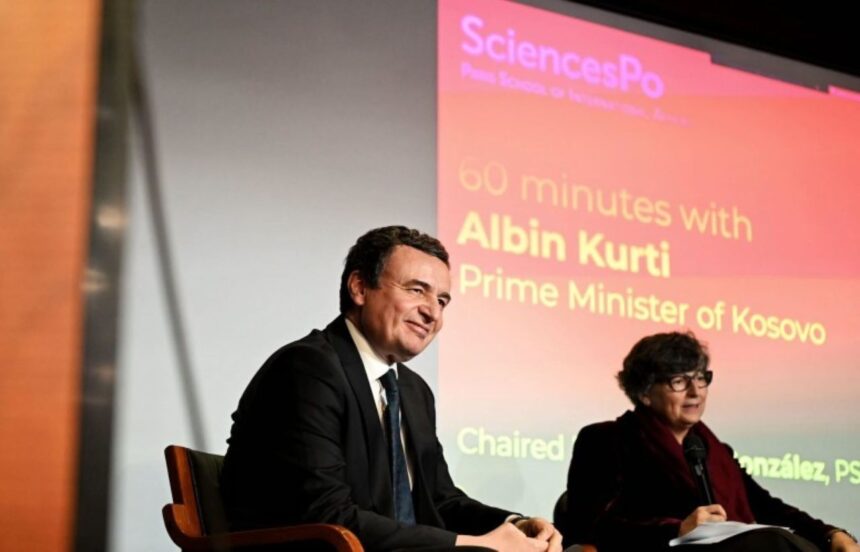
Speaking to students at the Paris School of International Affairs (PSIA), Kurti said that normalising relations between Kosovo and Serbia must involve accountability for the armed attack in Banjska, which he described as a terrorist assault.
He insisted that Serbia must extradite Radoičić, whom he identified as the principal organiser of the attack, so that he can face justice.
Kurti also argued that the recent change in Serbia’s political leadership should create an opportunity for Belgrade to acknowledge what he called the reality of the 21st century: Kosovo is an independent state recognised by more than 120 countries.
He called on Serbia to end its efforts to undermine Kosovo’s international standing, including what he described as the use of Russia’s opposition to block Kosovo’s membership in international organisations.
Turning to security concerns, Kurti identified Russia’s war against Ukraine and Serbia’s close relationship with Moscow as two major challenges facing Kosovo.
“Serbia remains a close ally of Russia, with policies that continue to pose a threat to our country’s security,” Kurti said.
He pointed to the Russian-Serbian Humanitarian Centre in Niš, approximately 160 kilometres from Prishtina, saying it had raised concerns over possible intelligence activities. He also claimed that Serbia maintains 48 military and gendarmerie bases near Kosovo’s border and that the Kremlin has established an office within Serbia’s Ministry of Defence.
Kurti again referred to the September 2023 attack in Banjska, saying it was intended to annex northern Kosovo in a scenario resembling Russia’s annexation of Crimea.
He said Kosovo had substantially increased its defence spending over the past four years, consistently allocating more than two percent of its gross domestic product to defence. According to Kurti, all military procurement during this period has been carried out through NATO member states.
Kosovo’s European and Euro-Atlantic ambitions
Addressing Kosovo’s international integration, Kurti outlined three major challenges: the European Union’s approach to the Western Balkans, the normalisation of relations with Serbia, and securing recognition from the five EU member states and four NATO members that have yet to recognise Kosovo.
“There cannot be a second-class Europe. There is no longer a periphery,” he said, reiterating that Kosovo sees EU and NATO membership as its only strategic direction.
“We see no alternative to the European Union and NATO because we do not want any alternative to the European Union and NATO,” Kurti stated.
The prime minister also highlighted Kosovo’s democratic and economic performance. Citing the 2026 report by Sweden’s V-Dem Institute, he said Kosovo ranks as the leading democracy in the Western Balkans.
He added that the country’s average economic growth over the past five years had exceeded four percent and cited Gallup findings that rank Kosovo as the safest place to live in Europe and the third safest worldwide.
Kurti also outlined his government’s social policies, including free higher education, support for mothers and families, increased public healthcare budgets and subsidies for farmers.
He emphasised the contribution of the diaspora to Kosovo’s development, particularly through investment, entrepreneurship, remote employment and the exchange of expertise.
According to Kurti, technology-related services account for approximately six percent of Kosovo’s economy, while the free trade agreement with the European Free Trade Association (EFTA) countries is expected to support further growth in the sector.
Concluding his address, Kurti stressed that democratic values must be accompanied by responsibility when entrusted with political power.
“The values that bring you into politics matter. But what you do with those values when you are given the responsibility to put them into practice matters just as much,” he said.