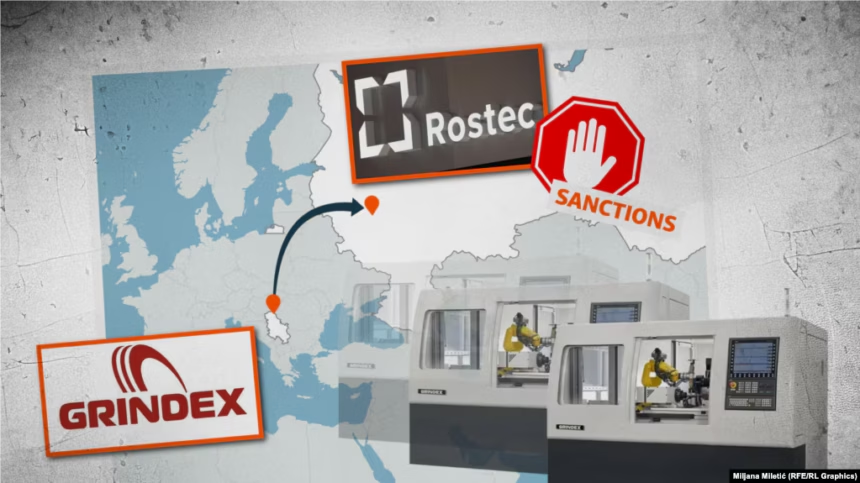
A Serbian manufacturer of metalworking machinery has continued supplying equipment to Russian companies that subsequently transferred it to businesses linked to Russia’s military industry, despite Western sanctions imposed following Moscow’s invasion of Ukraine, an investigation by Radio Free Europe (RFE) has revealed.
The company, Grindex, based in the northern Serbian city of Kikinda, exported machinery worth approximately €27.5 million to Russia between March 2022 and March 2025, according to data obtained by RFE from Ukraine’s military intelligence service (HUR).
The investigation, conducted by RFE’s Ukrainian investigative project Schemes and Russian-language research unit Systema, identified several Russian intermediaries involved in purchasing Grindex machinery. Some of these companies are under sanctions imposed by the United States and the European Union for supporting Russia’s military-industrial complex.
Although Grindex itself is not under Western sanctions, investigators found that its machinery reached Russian defence manufacturers through both sanctioned intermediaries and companies that remain outside the sanctions regime.
One of the main intermediaries was AMG, also known as Alfa Machinery Group, a Russian supplier of industrial machinery. The company was sanctioned by the United States in 2023 and by the EU in December 2024 over its support for Russia’s defence industry.
According to Ukrainian intelligence, Grindex signed a contract with AMG in December 2022 to supply a computer-controlled CNC grinding machine worth approximately €778,000. The equipment was delivered after AMG had already been placed under US sanctions.
AMG subsequently transferred the machine to the I. Rumyantsev Machine-Building Association, a manufacturer of aircraft components operating within Russia’s state-owned Rostec industrial conglomerate.
Another Grindex machine, valued at more than $384,000, was exported from Kikinda under a separate 2023 agreement with AMG. It was imported into Russia in February 2025 and transferred two months later to the Ufa-based Hydraulics enterprise, another Rostec subsidiary involved in producing aviation components.
The company has also been sanctioned by the EU since 2025. European authorities cited its support for Russian military personnel, including activities by employees producing camouflage nets for the Russian armed forces.
Ukrainian intelligence said the machine supplied by Grindex was intended to manufacture piston-type components used in precision hydraulic and fuel systems.
Rostec, which produces equipment for both military and civilian aviation, has been under US sanctions since 2014 and was subjected to additional restrictions by Washington and the EU in 2022.
Other sanctioned Russian intermediaries
The investigation identified two additional Russian companies under US sanctions that imported machinery manufactured by Grindex.
Finval Energo, a wholesale supplier of industrial machinery, imported Grindex equipment worth approximately €12 million between 2022 and 2025, according to Ukrainian intelligence.
The company was sanctioned by Washington in 2024 for operating in Russia’s manufacturing sector and cooperating with Russian weapons producers. However, RFE said it had no independent information confirming that Grindex continued supplying Finval Energo after the sanctions were imposed.
Another intermediary, Unimatik MSK, imported Grindex machinery worth approximately €980,000 between 2022 and 2024.
Unimatik MSK was sanctioned by the United States in 2024 for its links to Russia’s military-industrial sector, while its majority owner, Unimatic, was placed under EU sanctions in 2026 for materially supporting Russia’s defence industry.
Publicly available procurement records also show that companies within Russia’s defence sector, including Rostec subsidiaries, were among Unimatic’s customers.
Machinery also reached companies producing Russian weapons
Grindex equipment also reached sanctioned Russian defence companies through intermediaries that were not themselves under Western restrictions.
One example involved the Russian company Krona, which supplied industrial machinery to Russian factories. According to Ukrainian intelligence, Krona transferred a Grindex grinding machine in 2024 to the Design Bureau of Mechanical Engineering, a Rostec-linked enterprise involved in producing missile systems and other weapons, including the Iskander-M short-range ballistic missile.
An investigation published by Russian outlet The Insider in December 2023 had already identified business links between Krona and Grindex. Krona openly lists Grindex equipment in its product catalogue.
Another machine was imported through a Moscow-based individual entrepreneur, Denis Babichev. According to Ukrainian intelligence, the equipment was subsequently leased in 2025 to the Perm Scientific and Production Instrument-Making Company, which manufactures navigation, control and stabilisation systems for Russian aircraft.
The company has been under US sanctions since 2016 and was sanctioned again in 2024. Washington cited its production of systems used in military aircraft, including MiG-29 and Sukhoi-27 fighter jets.
What is known about Grindex?
Founded in 2003 after separating from the Livnica Kikinda holding, Grindex employs approximately 250 people and specialises in manufacturing metalworking machinery, particularly computer-controlled grinding machines.
The company recorded financial losses in 2021 and 2022 but returned to profitability in 2023, with profits increasing in subsequent years, according to Serbia’s Business Registers Agency.
Almost all of its revenue comes from international sales. In 2025, domestic sales accounted for only around one percent of its foreign-market sales revenue.
However, the company’s financial statements do not identify its individual customers.
A 2015 report by Serbia’s public broadcaster RTS stated that Grindex exported its entire production to the Russian Federation.
In 2022, the Serbian Chamber of Commerce awarded the company’s owner, Jovan Bulatović, a plaque recognising his business achievements. At the time, Bulatović said the company had faced difficulties during the COVID-19 pandemic and that the war in Ukraine had further complicated its operations, particularly the delivery of finished products.
RFE contacted Grindex for comment on its exports to Russia, but the company did not respond. The Russian companies identified as buyers also failed to provide answers.
Serbian authorities say they did not issue export permits
Serbia’s Ministry of Domestic and Foreign Trade told RFE that it had not issued Grindex any export licence for dual-use goods.
The ministry also said it was unfamiliar with the company’s production programme and the technical characteristics of its products, adding that it did not possess sufficient information to determine whether the machinery was subject to export controls.
Serbia’s Customs Administration confirmed that it had not conducted any subsequent inspections of Grindex’s exports.
The findings raise questions about the effectiveness of Serbia’s export-control system, particularly given that the country has not joined Western sanctions against Russia despite being an EU candidate.
Although Serbia adopted a new law on the export and import of dual-use goods in 2025, introducing stricter controls aligned with EU regulations, experts say enforcement and monitoring remain major challenges.
Ella Skybenko, a senior researcher covering Eastern Europe and Central Asia at the Centre for Business and Human Rights, told RFE that Serbia’s failure to join Western sanctions makes trade with Russian companies easier. However, she stressed that this does not mean all exports to Russia are legally permitted.
She added that the effectiveness of Serbia’s export regulations depends heavily on enforcement and oversight, which have frequently proved insufficient.
Earlier RFE investigations found that Serbian companies had exported at least $71.1 million worth of dual-use goods to Russia since the beginning of the invasion of Ukraine.
Tihomira Kostova, a researcher at Bulgaria’s Centre for the Study of Democracy, said Serbian exports of dual-use goods to Russia increased by 220 percent in 2022 compared with pre-war levels.
Kostova also warned that companies in third countries supplying Russia’s military-industrial complex risk facing secondary US sanctions imposed by the Treasury Department’s Office of Foreign Assets Control (OFAC).
She noted that controlling exports to Russia remains difficult because equipment frequently reaches its final destination through alternative trade routes and intermediary companies.
The investigation highlights how industrial equipment manufactured in Serbia can enter Russia’s military supply chains through complex commercial networks, even when the ultimate recipients are companies directly involved in producing weapons and military aircraft.