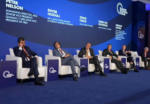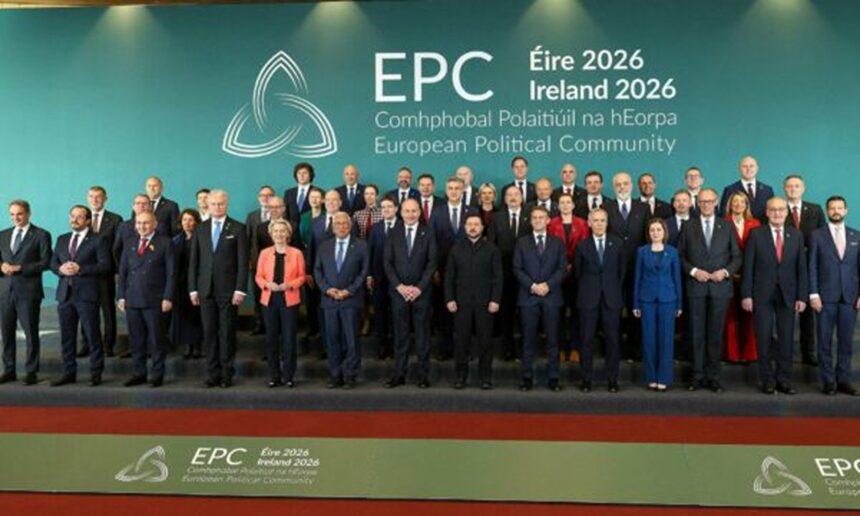
Leaders from more than 40 European countries gathered on Thursday along the River Liffey in Dublin for a summit focused on the continent’s fragile security situation, as a new US-backed effort gets underway to restart negotiations aimed at ending the Russia-Ukraine war, the Associated Press (AP) reports.
The European Political Community (EPC) meeting brings together heads of state and government from the European Union and other European countries, including the United Kingdom, as well as Ukrainian President Volodymyr Zelenskyy, Canadian Prime Minister Mark Carney and NATO Secretary General Mark Rutte.
Irish Prime Minister Micheál Martin said the EPC “was established as part of Europe’s collective response to growing political instability, both regionally and globally, and to bring greater coherence to addressing the challenges facing our continent”.
The summit provides an opportunity for Zelenskyy and his European allies to assess the outcome of this week’s US-mediated talks in Abu Dhabi on the Russia-Ukraine war, which has now entered its fifth year. US envoys Steve Witkoff and Jared Kushner were expected to meet Zelenskyy in Dublin after arriving from Moscow, where they had held talks with Russian President Vladimir Putin.
Ahead of the meeting, Zelenskyy expressed scepticism about progress towards peace.
“Yesterday, the Russians said they did not have authorisation to discuss steps that could ease the horrors of this war,” he said.
EPC Focuses on Security
The EPC was initiated by French President Emmanuel Macron and former German Chancellor Olaf Scholz and established in 2022 as a forum for countries inside and outside the 27-member European Union, following Russia’s full-scale invasion of Ukraine, which shattered Europe’s sense of security.
One of the main topics of discussion was European countries’ efforts to find a representative who could defend their interests in peace negotiations. European leaders fear being sidelined in talks that are vital to the continent’s future, while Russia does not want European countries directly involved in the negotiations.
The grouping, which brings together nearly 50 countries across Europe, excluding Russia and Belarus, has also become a forum for discussing European security since Donald Trump returned to the US presidency in 2025. His insults towards NATO allies and threats to take control of Greenland, a semi-autonomous territory of Denmark, have alarmed European leaders.
Carney’s presence signals his desire to bring Canada closer to Europe after Trump launched a trade war against the United States’ northern neighbour and repeatedly spoke about making it the 51st US state.
UK Prime Minister Andy Burnham is also seeking closer ties with the EU, nearly six years after Britain left the bloc. The EPC offers the UK an opportunity to participate in a pan-European political forum despite Brexit.
Critics Say the Forum Is All Talk
Critics argue that the EPC is little more than a platform for empty discussions.
The group meets twice a year: once in an EU member state and once outside the bloc. Its next meeting is expected to take place in Zurich, Switzerland, in April.
Critics claim the forum was designed as an attempt to slow down EU enlargement by offering countries a place at the wider European table without granting them the benefits of EU membership.
Others argue that it has become a venue for lengthy discussions without any real influence or substance. Its meetings produce neither binding decisions nor formal declarations.
However, while welcoming other leaders at a conference centre in Dublin’s revitalised docklands, Irish Prime Minister Martin stressed that it would be a mistake to dismiss the grouping as irrelevant.
“Very often, a lot can happen at these informal networking meetings,” Martin said. “A lot can emerge.”
The summit is taking place as European countries face a growing number of hybrid attacks.
The meeting comes amid political upheaval across Europe, just days after a major Republican defeat in the US midterm elections weakened Trump’s control over the levers of power, at least domestically. It remains to be seen whether the setback will change his approach to the war in Ukraine and the conflict with Iran, which he himself initiated.
Populist leaders have recently been ousted in Serbia and Hungary, while the EU and the UK are rebuilding relations a decade after British voters chose to leave the bloc.
However, the far right continues to gain ground across Europe, having recently secured victories in regional elections in Germany. Voters in several of the continent’s largest countries — Spain, France, Italy and Poland — are also heading to the polls in the coming months.
Beyond Ukraine, security discussions are expected to focus on the hybrid threat posed by Russia across Europe. Moscow has been accused of launching disruptive attacks against critical infrastructure that fall below the threshold of conventional warfare.
A year ago, in Copenhagen, leaders focused on a series of troubling drone incidents across Europe. In the days leading up to this week’s summit, airlines and media organisations in several European countries were hit by fake bomb threats. Among the targets were Irish airline Ryanair and the country’s national broadcaster, RTÉ.
European countries have not officially attributed responsibility for the threats.
The Irish government said the EPC summit is “the largest-ever gathering of international leaders” hosted in Ireland and the biggest policing and security operation in the 100-year history of its national police force, Garda Síochána.