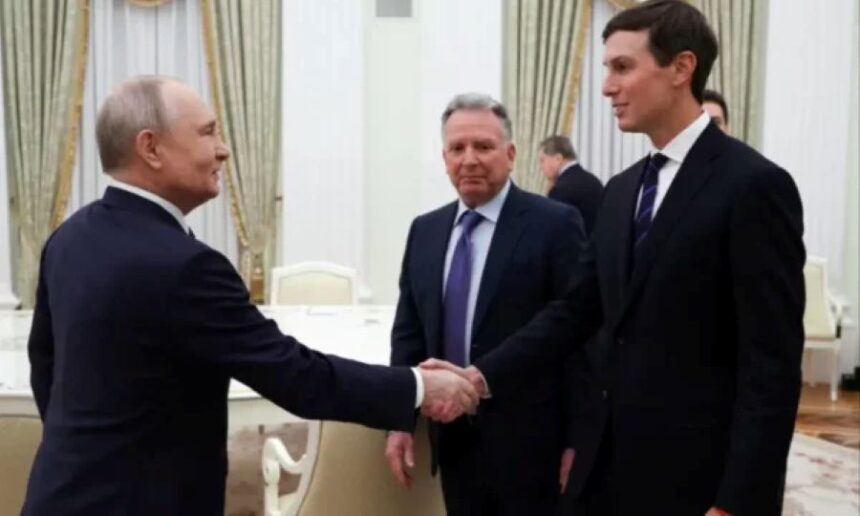
Russian President Vladimir Putin has agreed in principle to the participation of European representatives in the next round of negotiations aimed at ending the war in Ukraine, according to US special envoy Steve Witkoff, following his meeting with the Kremlin leader in Moscow on Thursday.
The potential involvement of European countries could mark an important development in diplomatic efforts to end the conflict. However, Putin’s statements suggest that major disagreements remain over the conditions for a peace agreement and Ukraine’s future security arrangements.
“Europeans will participate in the next meeting. We consider this a very important moment because they are our partners, and it is important that they are part of the discussions,” Witkoff told Russian state television.
Following their meeting in Moscow, Witkoff and fellow US envoy Jared Kushner travelled to Ireland, where they met Ukrainian President Volodymyr Zelensky. The Ukrainian leader welcomed the prospect of another round of negotiations involving European representatives.
Putin, however, highlighted the differences between Moscow and European capitals over the future of Ukraine. He claimed that Russia had never opposed dialogue with the European Union and accused European countries of being responsible for cutting communication with Moscow.
The Russian president also rejected the possibility of deploying Western troops to Ukraine following a potential peace agreement, arguing that such a move would threaten Russia’s security and could lead to a renewed conflict.
“We would very much like you, gentlemen, and the entire US administration, to work with your European allies so that they finally decide what they want: peace or war in Ukraine,” Putin said.
Meanwhile, Kremlin aide Yuri Ushakov declined to confirm whether European representatives would actually participate in the next round of negotiations. He criticised Europe’s current approach to the conflict, describing it as a path towards an endless war.
After meeting Witkoff and Kushner in Dublin, Zelensky said he hoped the next negotiations would focus on reducing tensions and establishing a ceasefire.
He stressed the importance of restarting the diplomatic process and agreeing on a concrete agenda for further steps.
“We agreed to work on an agenda that includes every possible form of de-escalation and several types of ceasefire arrangements. I hope we will have such an agenda. This is important,” Zelensky said.
The latest diplomatic contacts follow two days of trilateral negotiations between the United States, Russia and Ukraine in Abu Dhabi. The talks, mediated by Washington, marked the first direct negotiations between Moscow and Kyiv under US mediation in nine months.
Both sides reported some progress but acknowledged that significant disagreements remain, particularly over territorial issues.
Russia currently controls approximately one-fifth of Ukrainian territory, while Kyiv continues to reject demands to surrender the remaining parts of the Donbas region in eastern Ukraine.
Zelensky also raised concerns about new restrictions affecting Starshield, the military satellite communications service used by Ukrainian forces on the battlefield. According to the Ukrainian president, the restrictions have affected communications along the front line, creating additional difficulties for military operations.
Starshield is the military version of SpaceX’s Starlink satellite service. Zelensky said the limitations had reduced the system’s performance and noted that Ukraine had experienced similar problems the previous month.
He warned that any decisions in Washington treating Ukrainian territory as though it did not belong to Ukraine would raise serious concerns about the direction of US policy.
During his meeting with the American envoys, Putin also proposed establishing a joint Russian-Ukrainian humanitarian mission in the eastern Ukrainian city of Kostiantynivka.
The Kremlin leader claimed that Russian forces controlled the city, although Ukrainian authorities have previously disputed such assertions, maintaining that Ukrainian troops remain present in the area.
Putin suggested that the mission could follow the model of an initiative conducted in Oleshky, in southern Ukraine, towards the end of last month. That operation reportedly allowed civilians to leave an area under Russian control while humanitarian assistance was delivered to those who chose to remain.
According to Putin, clearing the surrounding area of mines would take approximately five days. He also claimed that between 400 and 500 residents remained in Kostiantynivka, arguing that the proposed mission would allow the international community to establish who actually controls the area.
Kremlin aide Ushakov said the American representatives had welcomed Putin’s proposal and would continue discussions with Moscow on the matter.
However, Ukrainian authorities have expressed concerns that Russia could use temporary ceasefires and humanitarian arrangements to reorganise its military forces.
Despite renewed diplomatic efforts, Putin has shown no indication of abandoning Russia’s territorial demands. He has also called for the establishment of buffer zones in parts of Ukraine that Moscow has not officially incorporated into its territory.
In his Thursday remarks, Putin reiterated that Russia’s state borders should serve as the sole reference point when determining the future dividing line with Ukraine.
His comments further indicated that Moscow continues to seek full control over the four Ukrainian regions it claimed to annex in 2022, despite not having established complete military control over them.