Serbia’s Students’ List, following its victory in the parliamentary elections, is preparing to implement an ambitious political and economic programme that would bring significant changes to the country’s institutions, labour laws, media, taxation, defence and energy sectors.
The programme includes proposals for a four-day working week without salary reductions, stronger workers’ rights, progressive taxation, judicial reforms and greater transparency in public contracts. If implemented, several of these measures would represent substantial departures from existing government policies.
Four-day working week and stronger workers’ rights
One of the most notable proposals is the introduction of a four-day working week while maintaining full salaries. The model would be optional, allowing employers and trade unions to decide whether it is suitable for their respective industries.
Mario Reljanović, a labour law expert and incoming Students’ List MP, said the proposed legislation would ensure that reducing working hours could not become a legal justification for cutting wages.
The programme also proposes reducing the maximum duration of fixed-term employment contracts from 24 to 12 months, after which employees would generally be entitled to permanent contracts.
Additional measures include higher compensation for overtime, night shifts and Sunday work, stronger labour inspections and a new Labour Law developed in consultation with employers and trade unions.
Changes to defence policy and military cooperation
The Students’ List is proposing significant changes to Serbia’s defence policy, including ending arms trade with Israel and halting cooperation on projects such as the planned drone factory.
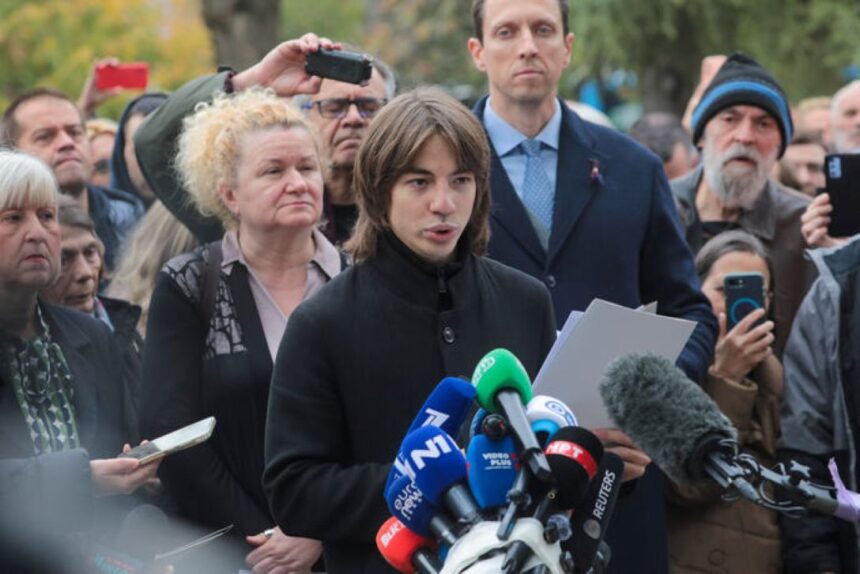
Filip Ubović, a representative of the student movement, confirmed the proposal during an interview on British journalist Aaron Bastani’s podcast.
The programme also rejects the introduction of compulsory military service, proposing instead a voluntary six-month military service for approximately 3,000 people.
At the same time, the Students’ List plans to increase defence spending to five per cent of GDP, compared with the current allocation, while modernising the armed forces.
Former Serbian military officer and Students’ List representative Luka Ponorac has also outlined plans for a strategic air-defence system and the acquisition of rocket artillery systems with ranges of 150 to 300 kilometres.
The programme further proposes increasing military personnel salaries and reopening investigations into past military incidents, including the deaths of soldiers at the Topčider military barracks and the military helicopter crash.
Judicial reform and investigations into major projects
Reforming the judiciary is among the central priorities of the programme.
The Students’ List proposes establishing a specialised prosecutorial police unit and a dedicated court for senior public officials. It also plans a vetting process targeting individuals suspected of abusing public office, engaging in corruption or violating human rights and constitutional provisions.
The proposed measures include reviewing the performance of state institutions, confiscating illegally acquired assets and returning unlawfully obtained funds to the state budget.
The movement also wants public companies to be managed by qualified professionals rather than political appointees, alongside stronger financial oversight.
Another key proposal is to make all government contracts publicly accessible and review agreements connected to major infrastructure and development projects.
An independent commission would examine projects including Expo 2027, Belgrade Waterfront, the General Staff building, the Belgrade Fair and the Jadar lithium project.
The review would involve publishing relevant documentation, conducting expert assessments and allowing court challenges to decisions where necessary.
However, the Students’ List has said that Expo 2027 will not be cancelled, stressing that Serbia must honour its international commitments.
Ilija Srdanović, the movement’s leading candidate, said the country would proceed with hosting the international exhibition while reviewing the contracts and arrangements surrounding the project.
Media reforms and restrictions on reality television
The programme also envisages major changes to Serbia’s media landscape, television programming and the protection of children.
One of the most controversial proposals is to restrict reality television programmes on channels with national broadcasting licences to a maximum of 45 minutes per day, exclusively after 11 p.m.
The restrictions would also apply to live broadcasts, reruns, special editions and additional programming.
The Students’ List wants at least 30 per cent of the annual programming on national television channels to consist of educational, scientific, cultural, documentary and children’s content.
It also proposes changes to media legislation aimed at preventing political and economic power centres from controlling public information.
The movement says it wants to address hidden media ownership and influence, the use of public funds to reward politically favourable media outlets and the role of television distributors in determining which channels are accessible to viewers.
Tax reforms, pensions and social protection
The proposed economic reforms include introducing progressive income taxation, with multiple tax brackets based on individual earnings.
The Students’ List wants to reduce the tax burden on labour while increasing taxation on property.
The tax-free portion of salaries would increase from the current 23 per cent to 35 per cent of the average wage. The programme also proposes abolishing the annual personal income tax and introducing monthly tax brackets.
A new Serbian Development Bank would be established through the merger of the Development Fund and the Export Credit and Insurance Agency.
Pension policy would also undergo changes. Pensions would be adjusted twice a year to better reflect increases in prices and wages, while recipients of the lowest pensions would receive an additional five per cent.
The programme also envisages introducing a social pension for people over 65 who have not accumulated sufficient years of employment to qualify for a regular pension. Its value would correspond to the minimum agricultural pension.
Education and energy policy
The Students’ List promises free textbooks for all primary and secondary school students, regardless of their place of residence.
Other proposed measures include higher salaries for education workers, modernised curricula, greater emphasis on practical skills and critical thinking, and removing political influence from universities and schools.
In the energy sector, the movement supports keeping Serbia’s state-owned electricity company, EPS, under public ownership.
It also proposes banning small hydropower plants that divert rivers through underground pipes, introducing stricter environmental assessments for mining projects and conducting an independent review of the Jadar lithium project.
At the same time, the programme supports continued international energy and technological cooperation, provided that domestic interests and environmental standards are protected.
Kosovo, Russia and Serbia’s foreign policy
On national and foreign policy issues, the Students’ List maintains Serbia’s position that Kosovo and Metohija should remain part of Serbia, while supporting the continuation of dialogue between Belgrade and Prishtina.
However, it proposes reviewing all agreements, including those already signed, as well as the implementation of the Brussels Agreement and other arrangements reached between the two sides.
The movement has also announced that it will not pursue political cooperation with the Serbian List, while pledging to continue financial assistance to Serbs in Kosovo under a different system of oversight and distribution.
Serbia’s military neutrality and independent decision-making in foreign policy would remain central principles.
European integration would continue to be a strategic priority, although the programme stresses the preservation of national interests and independent foreign policy decisions.
One of the more significant proposals is to hold a referendum on whether Serbia should impose sanctions on Russia, leaving the decision to voters.
Relations with China would continue in the economic and technological fields, with greater emphasis on domestic regulations, environmental protection and workers’ rights.
The Students’ List also wants to strengthen cooperation with the United States, particularly in energy, telecommunications, transport, artificial intelligence and defence.
A broad programme awaiting implementation
The programme sets out an extensive agenda covering almost every major area of state policy, from workers’ rights and social protection to defence, the judiciary, media regulation and international relations.
Its implementation would require legislative changes, institutional restructuring and decisions on how the proposed measures would be financed.
The extent to which the Students’ List can translate its electoral victory and programme commitments into concrete policy changes will become clearer as the new government takes shape and begins its work.