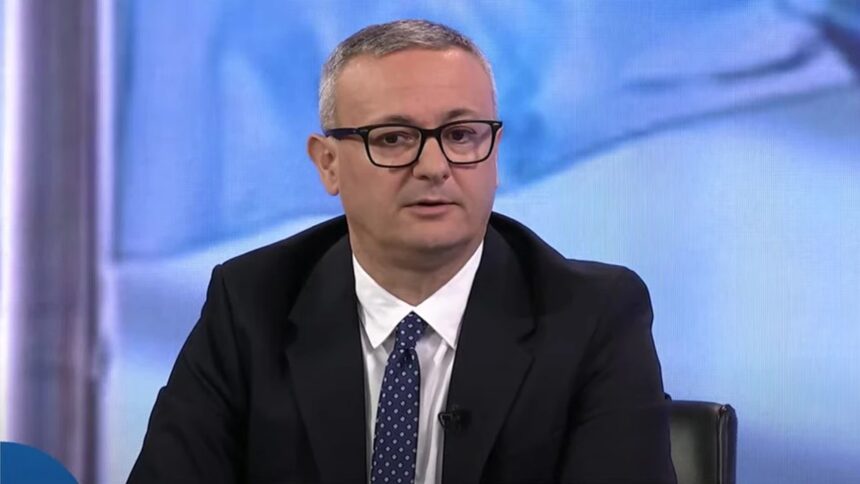
International relations professor Dritëro Arifi has described the performance of a Serbian nationalist song at a concert held ahead of the European Union Enlargement Forum in Brussels as deliberate, arguing that the incident cannot simply be dismissed as a mistake or an oversight.
Speaking on TV Dukagjini’s FIVE programme, Arifi said EU institutions exercise extreme caution even over the smallest details of public communication, making it difficult to believe that a song with such connotations was selected without knowledge of its lyrics and meaning.
He argued that the performance of the song, which contains nationalist messages and territorial claims over Kosovo, amounts to the glorification of crimes.
“It cannot have been a mistake. I do not believe they are that uninformed. Let us not forget that the EU has protocols. They are careful even about the smallest details, such as the wording of a press release, including commas and full stops. And we are talking about music that can carry extremely negative connotations, not only for Albanians but for the EU itself. Performing such a song amounts to glorifying crimes,” Arifi said.
According to him, the incident exposes a contradiction in the European Union’s approach towards Kosovo and Serbia. He argued that while the EU repeatedly tells Albanians not to defend the Kosovo Liberation War, an event organised within the framework of its own activities has provided a platform for elements associated with what he describes as a criminal war.
“The EU keeps telling us Albanians not to defend the liberation war, while it is promoting a criminal war itself. This is a form of hypocrisy and deliberate betrayal,” he said.
Arifi also suggested that the performance could carry a political message regarding developments in Serbia, linking it to efforts to create the impression that a new Serbia is emerging despite the absence of fundamental changes in its political approach.
He described this as a form of political dualism, in which the appearance of change is created while, in reality, only the government changes and the underlying political positions remain the same.
“It is a message to the new government in Serbia, a kind of dualism being created, as if a new Serbia is emerging. In reality, nothing is changing; only the government is changing,” Arifi stated.
Meanwhile, European Commissioner for Enlargement Marta Kos expressed regret over the performance of the song at the concert held ahead of the EU Enlargement Forum in Brussels.
Speaking to journalists on Monday, 16 November, Kos said the selection of the song was the musicians’ responsibility and that it did not reflect the position of the European Commission.
She said she was aware of the suffering and sacrifices endured by people in this part of Europe, adding that historical differences should not prevent the construction of a shared European future.
The song “Sa Kosova zora sviće”, also known as “Oj Kosovo, Kosovo”, was composed in 1989 by Serbian singer and composer Ljubomir Manasijević. Its lyrics refer to medieval history and Serbian religious heritage, while also advancing territorial claims over Kosovo.