Since returning to office, U.S. President Donald Trump has renewed threats to take control of Greenland, citing security concerns and the risk of growing Russian or Chinese influence in the Arctic territory.
“I’d very much like to make a deal with them — it’s easier. But one way or another, we’ll have Greenland,” Trump told reporters aboard Air Force One on Sunday.
In reality, Trump’s threats are not new, but they resurfaced following the U.S. intervention in Venezuela on January 3, which saw President Nicolás Maduro captured in a swift overnight operation. That move has raised concerns among European leaders over how far Washington might be willing to go to assert control over the strategically important island.
Trump’s remarks have also prompted warnings in Europe that any U.S. military action against Greenland — part of the Kingdom of Denmark — could plunge NATO into crisis and potentially threaten the alliance’s very existence.
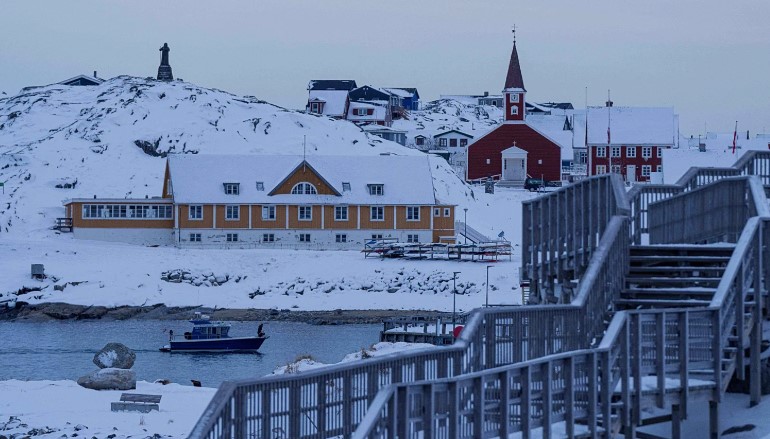
What Is Greenland and Why Does It Matter?
Greenland is a semi-autonomous territory outside the European Union but within the Kingdom of Denmark, which itself is an EU member state.
Under normal circumstances, Greenland would benefit from NATO’s Article 5, which states that an armed attack against one NATO member is considered an attack against all. However, experts warn that such a scenario would push NATO into uncharted territory, as the United States is itself a NATO member and the alliance was designed to defend against external aggression, not internal conflict.
Article 42.7: The EU’s Mutual Defense Clause
A lesser-known provision that could apply is Article 42.7 of the Treaty on European Union, often referred to as the EU’s mutual defense clause.
On Monday, EU Commissioner for Defence and Space Andrius Kubilius told Reuters that Article 42.7 obliges EU member states to provide aid and assistance to another member state — in this case Denmark — in the event of armed aggression on its territory.
According to Tim Haesebrouck, assistant professor of international politics at Ghent University, one of the clause’s strengths is that it can be activated by a single country without prior consensus.
Once triggered, other member states are expected to respond, though the form of assistance is deliberately left open, meaning support may be military, political, or economic.
The clause has been invoked only once, following the 2015 Paris terrorist attacks, when France sought assistance against ISIS.
Legal Uncertainty Around Greenland
However, Greenland’s legal status complicates matters. The island left the European Economic Community in 1985 and is now classified as an Overseas Country and Territory, meaning most EU laws — including defense provisions — do not fully apply.
According to Aurel Sari, professor of public international law at the University of Exeter, there has been no authoritative ruling on whether Article 42.7 extends to territories like Greenland.
Even if applicable, enforcement would be limited, as defense matters fall outside the jurisdiction of EU courts.
“In the middle of an armed conflict, if your territory is under attack by a major power like the United States, you wouldn’t turn to courts to try to enforce assistance,” Sari told The Cube.
No Automatic Military Guarantee
Even if Article 42.7 were deemed applicable, it does not provide an automatic guarantee of military defense.
Haesebrouck cautioned that Europe may lack the military capacity to confront the United States, given Washington’s overwhelming advantage at every level of escalation.
“The United States would always retain escalation dominance,” he said, “meaning it could always escalate further and remain confident of victory.”
From a legal standpoint, the clause should not be interpreted as a promise of automatic military intervention. Other forms of assistance — political pressure, diplomatic action, or economic measures — could also be deployed.
These responses would ultimately depend on the political will of individual EU member states. On Tuesday, German Foreign Minister Johann Wadephul said Germany was prepared to play a greater role in Arctic military security, while stressing that NATO must remain part of any solution.
“At the end of the day, this really depends on political commitment,” Sari concluded.