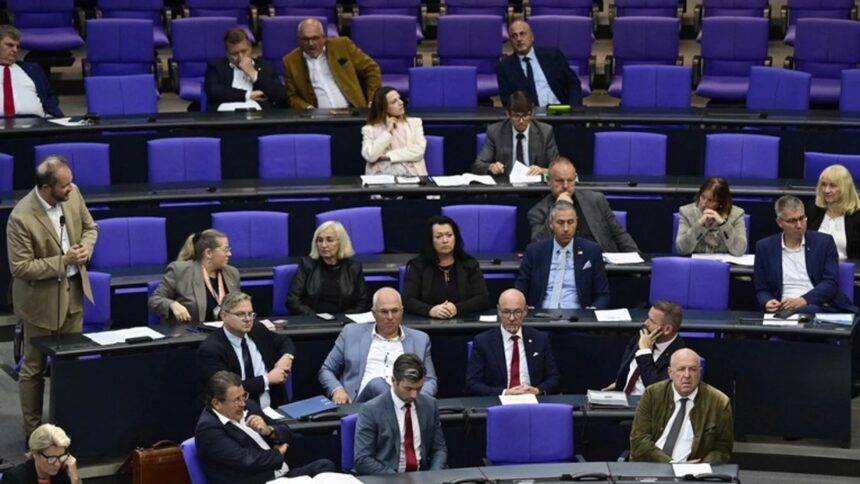
Germany’s far-right Alternative for Germany (AfD) will join forces with the small left-wing Sahra Wagenknecht Alliance (BSW) to submit a motion in the state parliament of Saxony-Anhalt calling for an end to German military support for Ukraine.
The motion is expected to be debated in the state parliament next week. However, it will have no direct impact on Germany’s foreign policy, as foreign affairs fall exclusively under the jurisdiction of the federal government in Berlin.
Nevertheless, the initiative highlights growing pressure from the AfD to end German support for Ukraine and restore relations with Russia, which have largely been severed since Russia’s full-scale invasion of Ukraine in February 2022.
“This motion symbolizes the desire for change,” said Ulrich Siegmund, leader of the AfD in Saxony-Anhalt.
Siegmund led the AfD to its strongest electoral result in the party’s history last month, finishing first in the state election but failing to secure the majority needed to form Germany’s first AfD-led state government.
Since then, he has explored the possibility of political cooperation with the BSW, which, like the AfD, has long opposed German military support for Ukraine.
Siegmund said his party would use every opportunity to pressure Chancellor Friedrich Merz’s government to “finally work toward ending the war, rather than prolonging it.”
He also argued that the money being spent on Ukraine should instead be used “for the people in our own country.”
BSW founder Sahra Wagenknecht also backed the initiative.
In a post on X, she said Germany needs “a federal government that finally makes an effort to restart dialogue with Moscow.”
The motion comes around two weeks after German Foreign Minister Johann Wadephul met with his Russian counterpart, Sergei Lavrov, on the sidelines of the United Nations General Assembly in New York.
The meeting produced no signs of progress toward ending the war. Lavrov criticized the talks during a press conference afterward, while Germany’s Foreign Ministry said the meeting had reinforced Berlin’s assessment that Moscow was not prepared to negotiate either a ceasefire or an end to the war in Ukraine.
Meanwhile, Chancellor Friedrich Merz visited Kyiv over the weekend, where he reaffirmed Germany’s support for Ukraine.
German authorities have also accused Russia of a series of hybrid attacks and drone operations on German territory, allegations Moscow has denied.
Although the AfD-BSW motion in the Saxony-Anhalt state parliament cannot change Germany’s foreign policy, it reflects the growing domestic debate over the future of support for Ukraine and Germany’s relationship with Russia.