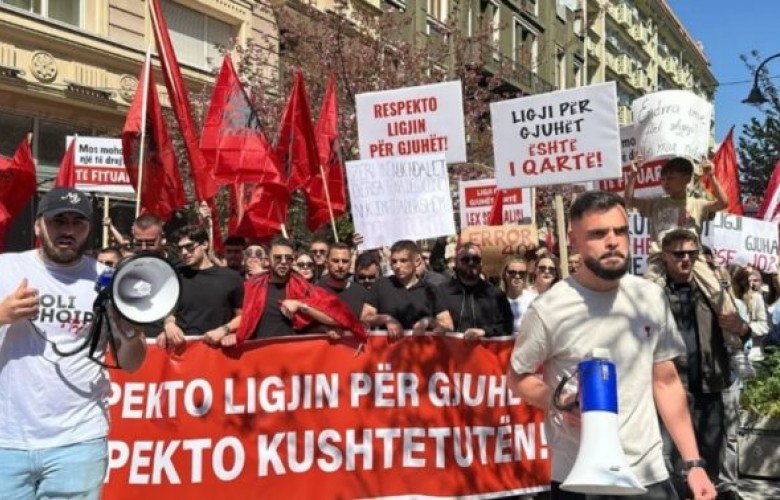
Albanian law students have announced a second major protest in the capital, scheduled for May 18, 2026, to demand the right to take the jurisprudence (bar) exam in the Albanian language.
The announcement follows months of escalating tension over linguistic equality in the country’s judicial system. While Albanian is an official language in North Macedonia, the Ministry of Justice currently mandates that the professional exam required to become a lawyer, judge, or prosecutor be conducted exclusively in Macedonian.
Government Response: “Be Patient”
Prime Minister Hristijan Mickoski addressed the looming protest on Wednesday, urging students to remain calm and avoid being “instrumentalized” by political forces.
“I am convinced that very soon we will come out with a proposal for the solution of the problem,” Mickoski stated. “The proposal will be according to the recommendations of the Venice Commission and international standards.”
Mickoski accused certain political groups of attempting to stir conflict and unrest, noting that previous administrations had “more than 20 years to solve this issue” but failed to do so.
The Students’ Argument
The students, supported by various civil society organizations like the Forum for Changes in Education (FECH), argue that taking the exam in their mother tongue is a fundamental right guaranteed by the Constitution and the Law on the Use of Languages.
- Legal Standing: Under the Ohrid Framework Agreement, any language spoken by more than 20% of the population (Albanian) is official. Students argue that since they are permitted to study law in Albanian, forcing them to take the qualifying professional exam in another language is discriminatory.
- The Struggle for Equality: Protesters have adopted slogans such as “Albanian is our identity, not an option” and “No rule of law without respect for language.”
Broader Implications
The controversy has drawn international attention, with the European Union and Italian ambassadors previously expressing support for the students’ “legitimate” requests. Critics of the current policy argue that the bar exam evaluates legal knowledge, not linguistic proficiency in Macedonian, and that denying the use of Albanian creates a barrier for ethnic Albanians entering the legal profession.
If the government does not present a concrete legal amendment before May 18, organizers expect thousands of students and supporters to march toward the Ministry of Justice in Skopje.