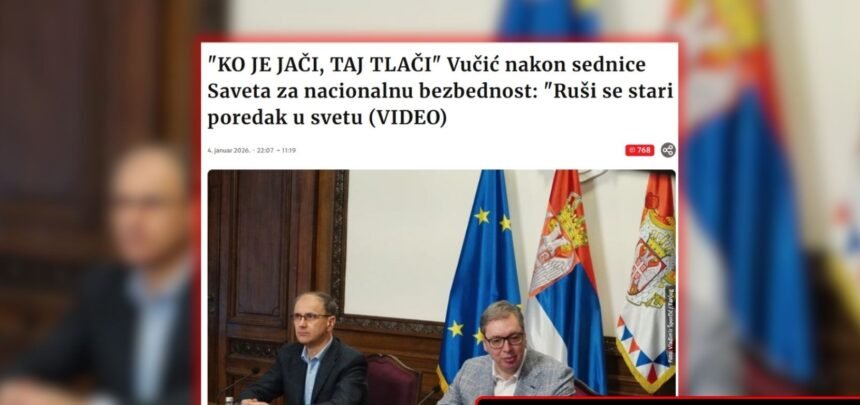
Following an extraordinary meeting of Serbia’s National Security Council on January 4, 2026, Serbian President Aleksandar Vučić intensified alarmist rhetoric about Kosovo, claiming that the country is arming in violation of international law and forming new military cooperation that supposedly threatens Serbia and regional stability.
Vučić described the situation as an “existential threat” to Serbia and warned that the country is entering a new phase of defensive readiness. “We are preparing to defend ourselves from those who are now openly threatening our country,” he said.
Vučić’s Claims Lack Evidence
Vučić alleges that the transformation of the Kosovo Security Force (FSK) into a national army is supported by Western powers and Turkey, supposedly breaching UN Security Council Resolution 1244 and the UN Charter.
Fact check: Resolution 1244 does not prohibit Kosovo from arming. Since declaring independence in 2008, Kosovo has secured international recognition and signed bilateral military and armament agreements with NATO member states. The FSK’s armament is fully compliant with international law and does not undermine the KFOR mandate.
According to Kosovo’s 2018 laws transforming the FSK into an army, the force’s mandate is strictly defensive, focusing on protecting Kosovo’s sovereignty and territorial integrity. The United States has publicly recognized Kosovo’s right to maintain a territorial defense force, while KFOR continues to provide security for all communities under NATO oversight.
Misrepresentation of Trilateral Cooperation
Vučić has also misrepresented Kosovo’s cooperation with Albania and Croatia, suggesting it constitutes a de facto military alliance against Serbia.
In reality, a formal agreement signed on March 18, 2025, focuses on defensive cooperation, interoperability, training, and combating hybrid threats. Joint procurement of military equipment is intended to reduce costs and improve efficiency, not to target Serbia. The trilateral partnership reflects the region’s euro-Atlantic integration ambitions and supports peace and stability in the Western Balkans.
Critical Assessment
Vučić’s repeated claims that Kosovo’s security development threatens Serbia or the region are unsupported by facts. His narrative appears designed to fuel fear and nationalism, rather than provide an accurate account of regional security dynamics. Kosovo’s security reforms are transparent, legally grounded, and monitored by NATO, while trilateral cooperation is defensive and integrative.
Conclusion:
Aleksandar Vučić’s rhetoric exaggerates threats from Kosovo, distorts legal frameworks, and risks heightening tensions in the Western Balkans. Independent verification shows that Kosovo’s armed forces and regional security cooperation are legitimate, defensive, and aligned with international standards.