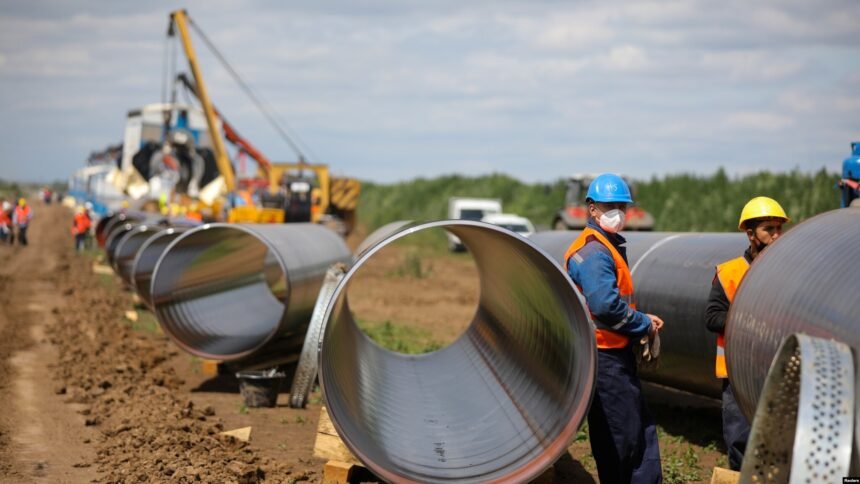
The American Chamber of Commerce in Kosovo (American Chamber of Commerce in Kosovo) has called on Kosovo to prioritize access to U.S. Liquefied Natural Gas (LNG) and treat the development of gas infrastructure as a national strategic priority.
In a policy paper titled “Leveraging U.S. Liquefied Natural Gas (LNG) for Kosovo’s Energy Security and Strategic Alignment,” the Chamber argues that while Kosovo currently lacks operational gas infrastructure and a sufficiently developed regulatory framework, the main challenge is domestic readiness rather than regional supply availability.
According to the Chamber, Kosovo’s access to LNG depends on two parallel processes: integration into existing and emerging regional gas infrastructure and the development of a reliable domestic legal and regulatory framework.
The report highlights regional energy projects, including the LNG terminal in Alexandroupolis, the Vertical Gas Corridor, and gas interconnections across Southeast Europe, as potential pathways for Kosovo to access LNG supplies.
OEAK notes that the Alexandroupolis LNG terminal and pipeline connections through North Macedonia could provide substantial capacity for future exports to the region. The Chamber argues that sufficient gas volumes are available and that Kosovo’s future demand could be accommodated if interconnection infrastructure is developed.
The organization also points to the historical Mitrovica–Pristina–Ferizaj–Skopje gas corridor as a potentially important asset that could reduce land expropriation challenges and accelerate pipeline construction.
On the regulatory side, the Chamber stresses that although Kosovo has adopted legislation on natural gas, further alignment with European Union energy rules is needed to improve investor confidence, enable third-party market access, and support long-term contracting.
The report further criticizes the current excise treatment of LNG, arguing that it is inconsistent with international practices and could unintentionally create trade distortions, particularly since regional LNG supplies largely originate from the United States.
According to the Chamber, Kosovo’s ability to access LNG is not constrained by regional supply shortages but by domestic policy priorities, infrastructure development, and regulatory preparedness.
The policy paper concludes by urging Kosovo’s next government to move beyond discussions and take concrete implementation steps, especially as the country faces growing pressure on its aging lignite-based power generation system and rising electricity import costs.
For Kosovo, which remains heavily dependent on energy imports and has limited energy diversification, the Chamber argues that U.S. LNG represents not only an alternative energy source but also a strategic tool for strengthening long-term energy security.