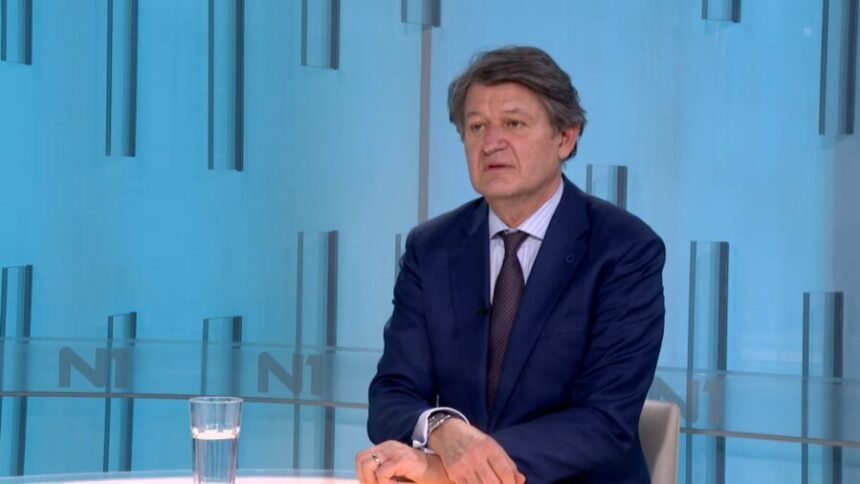
In a direct message to Belgrade’s political leadership, newly elected Austrian Member of the European Parliament Helmut Brandstätter declared that while he firmly supports Serbia’s eventual entry into the European Union, the candidate nation must adapt to democratic norms rather than expecting Brussels to lower its standards.
Speaking to N1, the prominent Austrian lawmaker and former journalist emphasized that the European Union cannot be blamed for the deep, structural polarization dividing Serbian society. He issued a sharp critique of the state’s ongoing crackdowns on domestic dissent, contrasting Belgrade’s heavy-handed tactics with foundational European values.
1. The Europe We Imagine: Student Safety and Freedom of Assembly
Brandstätter drew a firm line between European democratic expectations and the current environment facing young demonstrators in Serbia, where state-backed security measures have left families in a constant state of anxiety.
The Democratic Benchmarks for European Integration

 [ RIGHT TO DEMONSTRATE ] ──► FREE ASSEMBLY
 • Brandstätter emphasizes that a true EU member state must respect and protect
   students when they take to the streets to peacefully voice their grievances.

 [ FREEDOM FROM TERROR ]   ──► ZERO STATE VIOLENCE
 • Students should be able to return home safely at night, without their parents
   fearing that state police or riot units will beat them on the streets.

 [ THE ENTRY ULTIMATUM ]   ──► THE STRASBOURG VERDICT
 • Any nation where youth assembly is met with state-sanctioned fear "is not Europe"
   and cannot be welcomed into the European Union without clear, systemic changes.
“It is not the EU’s fault that Serbia is a deeply divided society. I want an EU member state to respect when students go out on the streets to demonstrate—that they can return to their homes in the evening without their parents trembling in fear over whether the police will beat them. That is not the Europe I imagine, and a country where that happens cannot enter the EU.”
— Helmut Brandstätter, Austrian Member of the European Parliament
2. Inside the Strasbourg Meeting: The Ruling Party Plays the Victim
The Austrian MEP shed light on a highly controversial recent stabilization meeting held in Strasbourg, which focused on Serbia’s EU accession track, the implementation of the urgent Venice Commission opinions, media freedoms, and the country’s turbulent domestic political situation.
According to Brandstätter, representatives of Serbia’s ruling Progressive Party (SNS) completely misread the diplomatic framework, interpreting the rule-of-law critique as dynamic blackmail.
The Dynamic Context of the Inter-Parliamentary Dialogue
┌────────────────────────────────────────────────────────────────────────┐
│                                                                        │
│  [ THE RULING BASELINE ] ──────────────────────────────────────────┐   │
│  • SNS representatives used the session to complain about their hardships,│   │
│    acting as political "victims" under scrutiny.               │
│                                                                        │   │
│  [ THE PRESS FREEDOM FEUD ] ───────────────────────────────────────┤   │
│  • When MEPs challenged state control over broadcasting, the authorities│   │
│    claimed they are the ones suffering from "highly critical" media.│
│                                                                        │   │
│  [ THE OPPOSITION BOYCOTT ] ───────────────────────────────────────┘   │
│  • Brandstätter branded the choice of Serbian opposition MPs to boycott │   │
│    the Strasbourg meeting as a major strategic mistake, urging them     │   │
│    to show up next time to present a unified critical front.     │
└────────────────────────────────────────────────────────────────────────┘
3. Strategic Outlook: The Legitimacy of Upcoming Elections
As political factions in Belgrade begin evaluating the upcoming electoral landscape, opposition groups have repeatedly raised concerns that systemic structural manipulation might force international institutions to outright reject future voting outcomes. Brandstätter framed the international community’s baseline expectation as simple and non-negotiable.
| Electoral Metric | European Legislative Standard | Local Serbian Context |
| Sovereign Will | The ultimate political destiny and government choices belong entirely to the Serbian people. | The Public Choice: Brussels has no intention of picking winners or losers, but will monitor the democratic process. |
| The Minimum Baseline | Elections must be demonstrably free, fair, and transparent. | The Structural Test: Requires equal media access, an end to voter intimidation, and the eradication of state-proxy voter migration. |
| Institutional Response | Immediate diplomatic and structural stagnation if democratic baselines are intentionally broken. | The Integration Halt: Passing flawed laws or rigging processes guarantees that Serbia’s EU integration track remains completely frozen. |
The Austrian MEP’s blunt assessment serves as a clear warning to the newly consolidated executive branch in Belgrade. Cosmetic policy updates will no longer suffice; unless the Serbian government delivers genuine, measurable overhauls to protect public media independence and halt the physical suppression of student movements, its European ambitions will remain structurally impossible.