While most of Europe now sees cultural cooperation with Russian state institutions as a form of propaganda, Serbia remains one of the few countries still opening its doors to such activities—despite growing warnings about the political influence hidden behind “cultural exchange.”
A series of cultural events backed by Russian state institutions are currently being held across Serbia, even as most European countries have cut cultural ties with Moscow following its aggression against Ukraine.
Belgrade-based director Janko Baljak views these events as part of the Kremlin’s propaganda strategy.
“We have a situation where the Russian state, without consequence, after its invasion and war crimes in Ukraine, continues to spread its propaganda here,” Baljak told Radio Free Europe.
Recently, Serbia hosted major events such as “Days of Moscow in Belgrade,” “Russian Film Festival,” and “Days of Russia’s Spiritual Culture in Serbia.”
All of them were organized with the direct support of Russian government institutions—which have been boycotted across the West due to their role in wartime propaganda.
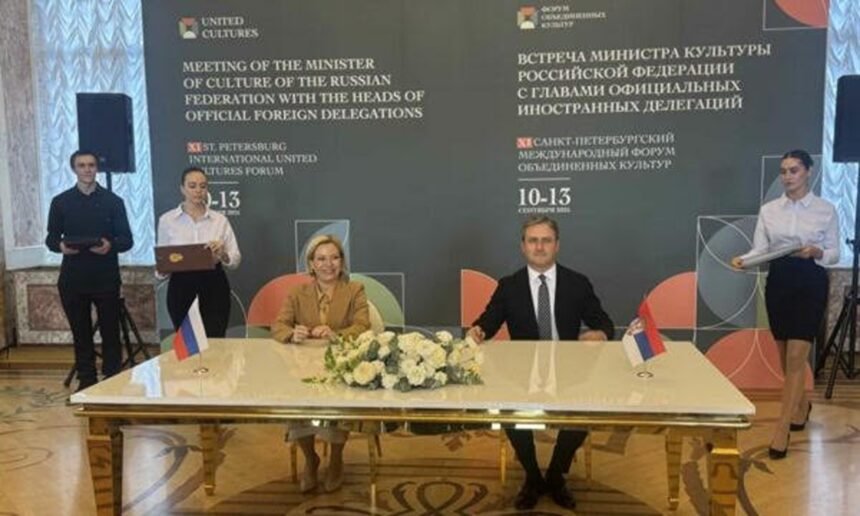
During “Days of Moscow in Belgrade” on October 20, representatives of the Serbian and Russian capitals signed a cooperation memorandum, while the chairman of the Belgrade City Assembly, Nikola Nikodijević, announced “numerous cultural and sports events where artists from Moscow will perform for Serbian audiences.”
In several Serbian cities, the “Days of Russia’s Spiritual Culture” were also held—a project of Russia’s Ministry of Culture and the Russian Orthodox Church—aimed at promoting the “spiritual and moral values of the Russian people.”
Another Kremlin-backed event was the Russian Film Festival, organized by the state agency Roskino, which promotes Russian cinema abroad.
This year’s festival featured five films—two of them focused on World War II and the “fight against fascism,” a recurring motif Russia uses to justify its invasion of Ukraine.
Political scientist Boris Varga described Roskino as a tool of Russia’s “soft power.”
“The Russian state uses historical narratives to mask the Kremlin’s new imperialism. This became especially aggressive after the 2022 invasion of Ukraine,” Varga told RFE.
After the full-scale invasion of Ukraine in 2022, many European festivals—including Cannes, Berlinale, and Venice—ended cooperation with Russian state cultural bodies.
France’s Ministry of Culture even banned Roskino from the “Series Mania” festival, labeling it a “representative of the aggressor state.”
However, not all Russian artists have been excluded. Some festivals still accept films critical of Putin’s regime or unrelated to state institutions.
Inside Russia, authorities have tightened control over art and media.
In 2025, the Russian Duma banned films that “discredit traditional moral values,” following earlier laws against so-called “LGBT propaganda.”
Recently, the government even prohibited the promotion of a “child-free lifestyle” as part of its pro-natalist campaign.
Former Ukrainian Minister of Culture Oleksandr Tkachenko urged Western countries in 2022 to boycott Russian culture, arguing that the Kremlin was using it to erase Ukrainian identity.
Yet, many European cultural institutions adopted a selective approach—boycotting state-backed projects while continuing to perform classical works such as those of Tchaikovsky.
Varga stressed the need to distinguish art from propaganda:
“Classical culture, as part of the world’s heritage, should not be banned—but any project financed or used by Putin’s regime for political purposes must be rejected.”
Director Janko Baljak shares this view:
“I’d like to see more films critical of the Russian regime, because I believe the spirit of dissent in that great nation has not been completely extinguished.”