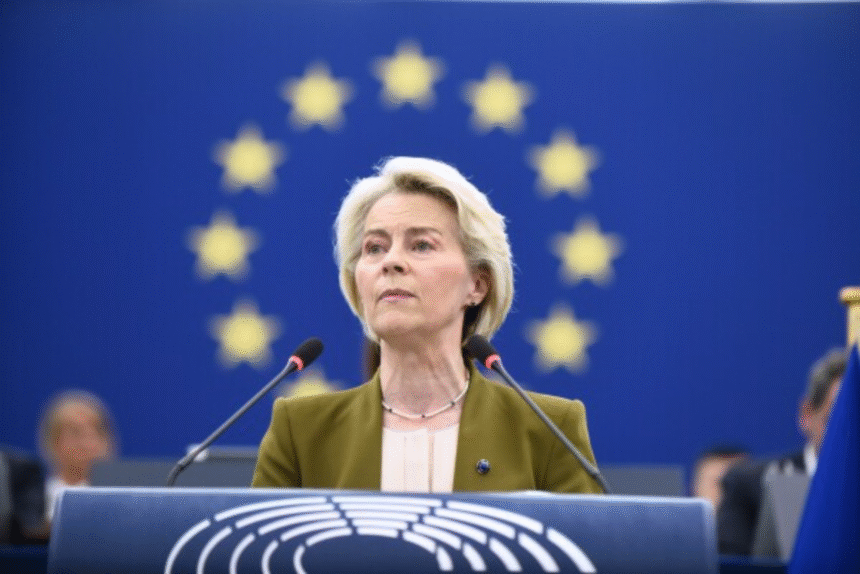
European Commission President Ursula von der Leyen addressed the European Parliament on Wednesday, April 29, 2026, delivering a stark warning about the ongoing crisis in the Middle East. She emphasized that the geopolitical shocks from the conflict in Iran and Lebanon are not temporary and could disrupt the global economy for years to come.
Calling for urgent diplomatic efforts to restore stability, von der Leyen noted that the conflict has effectively triggered Europe’s second energy crisis in four years, following the 2022 shock caused by Russia’s invasion of Ukraine.
The Economic Toll: A €27 Billion Bill
The President revealed the immediate financial impact of the regional instability, particularly due to disruptions in critical maritime routes like the Strait of Hormuz.
- The Cost of Overdependence: In just the last 60 days of the conflict, the EU’s bill for fossil fuel imports has surged by €27 billion.
- Zero Gain: Von der Leyen pointed out that this massive sum was paid without the EU receiving “a single additional molecule” of energy, highlighting how global price spikes punish energy-importing nations.
- Fertilizer Risks: She also warned of secondary shocks to the agricultural sector, specifically regarding the availability and price of fertilizers, which could impact food security.
The “Homegrown” Energy Strategy
The lesson of this second crisis, according to von der Leyen, is that “technological neutrality” and energy independence are no longer optional. She outlined a vision for a more resilient Europe:
- Electrification: The Commission will present a new “Electrification Action Plan” before the summer to reduce reliance on liquid fuels.
- Renewables & Nuclear: Von der Leyen urged Member States to accelerate the rollout of solar and wind, while also supporting nuclear innovation, such as Small Modular Reactors (SMRs).
- Strategic Autonomy: By producing energy within the EU, the bloc can shield its citizens from the “blackmail” of volatile global markets.
“Our over-reliance on imported fossil fuels makes us vulnerable. Every kilowatt-hour of energy produced here in Europe contributes to economic stability and our independence,” she declared.
Ukraine: Support Remains Unwavering
Amidst the Middle East crisis, von der Leyen reaffirmed that the EU would not lose focus on its eastern border. She confirmed the first tranche of a €90 billion loan for Ukraine, with €45 billion set to be disbursed in 2026. Two-thirds of this funding is earmarked for defense, including a massive project for locally produced drones.
The President’s message was clear: Europe is entering a new era of “permanent crisis management,” where economic resilience must be built on the foundations of clean, homegrown energy and a strengthened defense industry.