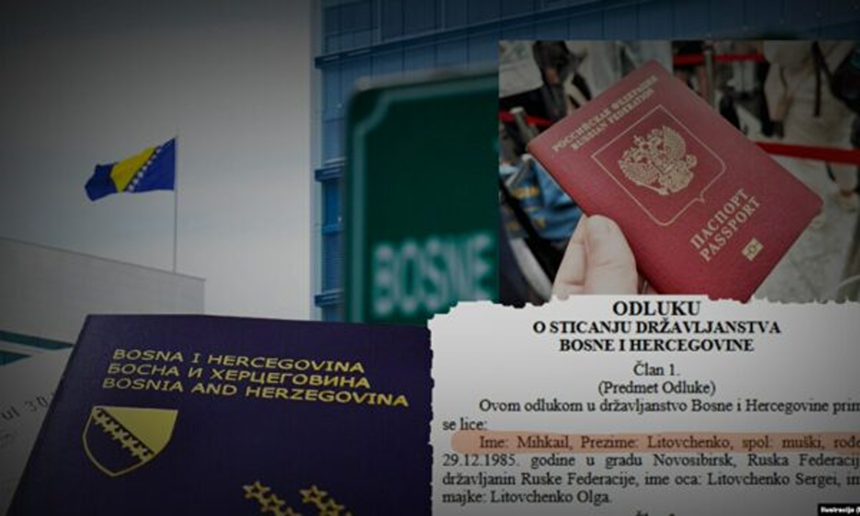
Bosnia and Herzegovina is facing growing questions over how citizenship has been granted to foreign nationals on the grounds that they would bring a “special benefit” to the country.
One of the most prominent cases is that of Russian citizen Mikhail Litovchenko, who received Bosnian citizenship in August 2024. Almost two years later, the performance of companies linked to him appears far removed from the economic expectations that reportedly supported his citizenship application.
His company Tourist Innovations later changed its name and headquarters and now operates as Softio in Pale. According to business registry data, the company has just one employee and recorded a loss of around €20,000 in 2025.
Another company previously linked to Litovchenko, Express Consulting in Sarajevo, changed ownership in June 2025, while its accounts are now reportedly blocked.
A system with little follow-up after citizenship is granted
The bigger issue is not simply the performance of individual companies, but the absence of a clear mechanism for checking whether the investments and business plans used to justify citizenship were actually fulfilled.
Bosnian law allows foreigners to obtain citizenship through a special procedure if they are considered to be of particular benefit to the country in areas such as the economy, sports, culture or science.
However, there is reportedly no effective system for determining whether the promises that led to a citizenship recommendation were subsequently delivered.
That is why Bosnia’s Ministry of Civil Affairs has proposed tightening the rules and strengthening oversight.
It is not an isolated case
Since 2023, 43 foreign nationals have received Bosnian citizenship through the special-benefit mechanism, while dozens of other applications have been submitted.
Among the beneficiaries are citizens of Russia, Turkey, Serbia and Croatia.
The issue becomes particularly sensitive in the case of Russian nationals because of the war in Ukraine and the fact that some Russian businessmen have moved their activities to Bosnia following the introduction of international sanctions against Russia.
Russian connections and sanctions concerns
Over the past four years, around 50 Russian citizens have registered companies in Republika Srpska, primarily in IT, consulting, trade and construction.
One of the cases mentioned is Aleksandar Gennadievich Zamakhin, a former owner of FAM Robotics, a company sanctioned by the United States over links to Russia’s military and industrial sectors.
Zamakhin has applied for Bosnian citizenship, while the Republika Srpska government supported his application, arguing that he intended to move his business operations to the entity and invest there.
Another case concerns Russian citizen Andrei Beker, who has previously faced allegations of links to Russian paramilitary structures.
Bosnia is not alone
The issue extends beyond Bosnia. Serbia has also used special procedures to grant citizenship, and according to the European Commission, more than 200 Russian citizens received Serbian citizenship through this mechanism since 2022.
The EU has urged Belgrade to strengthen security checks and prevent citizenship from being granted to individuals who could pose security risks to European countries.
Some recipients have reportedly even been subject to international sanctions.
Montenegro previously operated a similar “economic citizenship” scheme, allowing foreign investors to obtain citizenship. The programme was abolished at the end of 2022 following repeated EU concerns over security and migration risks.
A system in need of greater transparency
Bosnia’s experience raises a broader question: when a passport is granted on the basis of an expected economic contribution, who verifies that the promised contribution actually materializes?
If companies fail, investments never arrive or newly naturalized citizens have problematic connections, there must be an effective mechanism capable of identifying those problems.
The proposed new regulations are therefore intended to limit the institutions able to recommend applicants and strengthen security screening.
But even these reforms have encountered obstacles. At a Council of Ministers session on July 30, the proposed regulation failed to secure the necessary support in the first round of voting.
In a region where Russian influence, Chinese interests and European integration increasingly intersect, the way Balkan states grant citizenship is no longer merely an administrative matter.
It is becoming a question of national security, transparency and geopolitical influence.