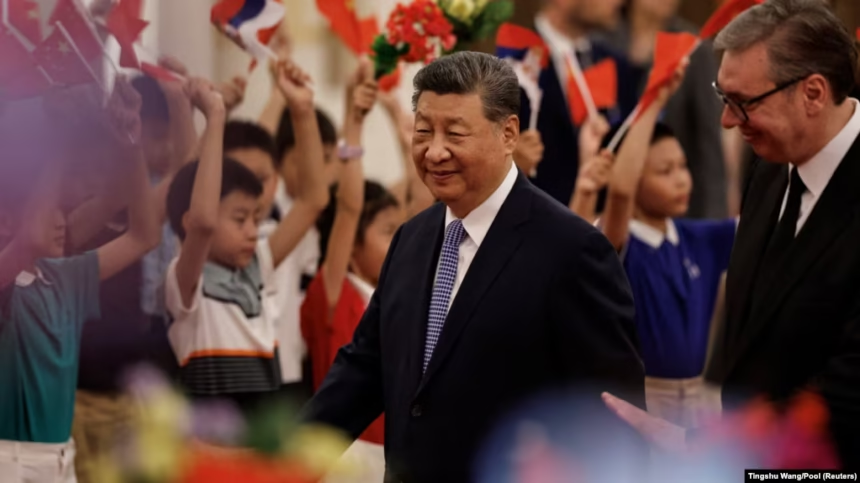
As the European Union moves aggressively to shield its single market from Beijing’s economic expansion, Serbia is actively running in the opposite direction. Following a high-profile state visit to Beijing in late May 2026, Serbian President Aleksandar Vučić and Chinese President Xi Jinping solidified plans for an additional €945 million in Chinese investments.
However, this growing dependency on Chinese capital is placing Serbia directly in the crosshairs of Brussels’ newly proposed economic defenses. The looming clash centers on the European Commission’s “Made in Europe” Industrial Accelerator Act, set for a crucial European Parliament vote in mid-June 2026. Designed to protect European industries and jobs, the law threatens to shut down the very backdoor Chinese firms are using through Serbia to flood the EU market.
Serbia as China’s “Great Kitchen” for Europe
For over a decade, Belgrade has utilized its Stabilization and Association Agreement (SAA) with the EU—which grants duty-free access for almost all industrial goods—as a selling point to attract Chinese manufacturers. By establishing production facilities in Serbia, Chinese companies bypass EU tariffs, stamping their products with a “Made in Serbia” label before shipping them seamlessly into the EU.
The strategy was recently laid bare by Chin Ronghua, the founder of Minth, a massive Chinese automotive components manufacturer with active plants in Šabac and Loznica:
“Serbia is the headquarters from which our products reach the entire European market,” Ronghua stated during Vučić’s Beijing visit. “Serbia is a ‘great kitchen’ supplying plants across EU member states.”
Economic experts warn this setup is highly superficial. “This is entirely a screwdriver industry,” notes economic journalist Miša Brkić. “Factories in Serbia merely assemble components that were fully manufactured in China.”
The EU Strikes Back: The “Made in Europe” Act
The unsustainable trade deficit with China has forced Brussels to abandon its traditional open-market leniency. The proposed Industrial Accelerator Act (“Made in Europe”) aims to aggressively curtail foreign state-subsidized competition.
Key Provisions of the Proposed EU Law:
- Market Caps: Targeting foreign investments that control more than 40% of global production capacities in critical green sectors (Electric Vehicles, batteries, and solar energy).
- Ownership Limits: Proposals to cap non-EU ownership in joint ventures at a maximum of 49%, ensuring decision-making power remains within the EU.
- Labor Mandates: Requiring foreign investors within the bloc to guarantee that at least 50% of jobs are given to EU citizens.
- Sector Tariffs: Tightening import restrictions on vital industrial sectors including steel, cement, aluminum, and the automotive supply chain.
Direct Fallout for the Serbian Economy
If passed, the EU’s protectionist barriers will inevitably bleed into Serbia, which relies on the EU for 58% of its total foreign trade. The country is already feeling the squeeze from previous EU interventions, particularly regarding steel.
[EU's Tightening Steel Import Restrictions]
• Duty-Free Quotas: Slashed by 47% for non-EU states.
• Tariffs: Doubled for any imports exceeding the allocated quota.
• Domestic Impact: Forces the Smederevo Steelworks (Železara) to operate at a loss,
  sustained heavily by its Chinese parent company, HBIS Group.
Bojan Stanić, Assistant Director of Strategic Analysis at the Chamber of Commerce of Serbia (PKS), confirmed that EU protectionism is actively choking Serbia’s economic maneuverability. “We are already under intense pressure,” Stanić said, pointing out that the Smederevo Steelworks—bought by China’s HBIS Group in 2016 for €46 million while the Serbian government absorbed its debts—is bleeding money due to the EU’s slashed quotas.
Furthermore, Serbia’s Free Trade Agreement with China, which took effect in July 2024, has completely failed to balance the scales. Instead, Serbia’s trade deficit with Beijing has expanded dramatically.
Geopolitical Blindness and Secrets
The Vučić administration has consistently bypasses open market competition by negotiating massive Chinese infrastructure and manufacturing deals through opaque, high-level intergovernmental agreements. These contracts routinely bypass domestic procurement laws, rely on Chinese loans that inflate Serbia’s debt, employ imported Chinese labor, and classify critical project details as state secrets—a lack of transparency that has drawn repeated warnings from Brussels.
Furthermore, Brussels has reminded Belgrade that under its EU accession obligations, Serbia must terminate all bilateral free trade agreements with third countries—including China—the moment it joins the Union.
Journalist Miša Brkić warned that the government’s disregard for global context mirrors its past mistakes with Moscow.
“Even if we realize all agreements with China, Serbia—as a country that claims to want EU membership and cooperation with the West—never knows what situation it will find itself in due to global shifts,” Brkić warned. “Look at our deals with Russia, which left us entirely dependent on Russian oil and gas, and for which Serbia is now suffering the consequences.”
While the Serbian government maintains a wall of silence and refused to comment on whether it is analyzing the impending EU-China shockwave, the country’s economic sectors are preparing for a harsh reality: when the EU seals its borders against Beijing, the “Made in Serbia” loophole will likely be closed along with it.