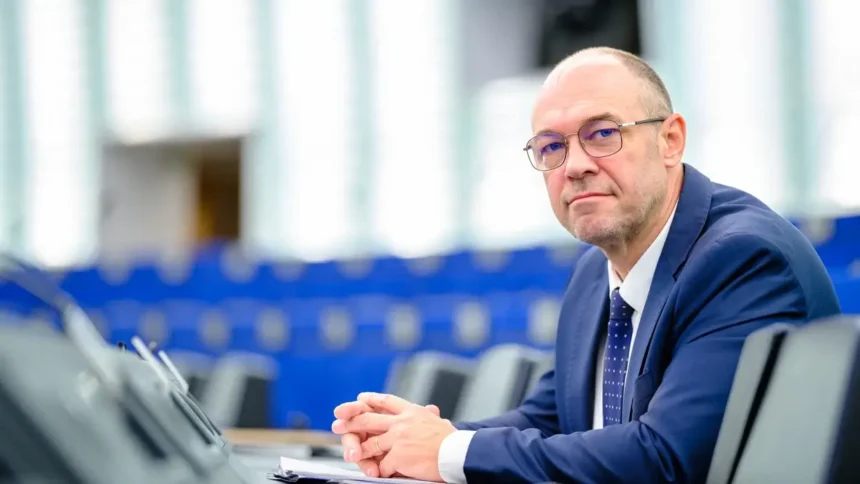
Croatian European Parliament member Davor Ivo Stier has said Serbia has made no meaningful progress toward European Union membership since Russia launched its full-scale invasion of Ukraine in February 2022, arguing that Belgrade’s policy of balancing between the West and Moscow is difficult to sustain in the long term.
Speaking on Croatian public broadcaster HRT, Stier compared Serbia’s position with that of Türkiye, noting that Ankara, as a NATO member, has greater room to maintain relations with both Russia and Western countries. Serbia, he argued, has less room for such a policy because of its strong economic ties with the EU and neighboring Western countries.
According to Stier, Serbia has not opened or provisionally closed any negotiating chapters in more than two years. He linked the lack of progress to both the pace of reforms and Belgrade’s broader geopolitical orientation.
A central issue in Stier’s assessment was Kosovo. He said Serbia cannot complete its EU accession process without addressing relations with Kosovo, while stressing that the EU does not formally require Serbia to recognize Kosovo.
Instead, he said, Belgrade is expected to pursue de facto normalization and implement commitments stemming from the Brussels and Ohrid agreements. Among the obligations he highlighted was Serbia’s commitment not to obstruct Kosovo’s membership in international organizations, while Kosovo has obligations of its own under the agreements, including the establishment of an Association/Community of Serb-majority municipalities. Stier has previously described the implementation of obligations by both sides as essential to the normalization process.
Stier also criticized aspects of previous Western policy toward Serbia. Discussing Germany’s role in the region, he said former German Chancellor Angela Merkel had played an important role in Aleksandar Vučić’s political rise. He linked this to the broader German approach to economic and energy relations with Russia during Merkel’s tenure, including the Nord Stream projects. The assessment was presented by Stier as part of his criticism of earlier European policy toward Belgrade.
He also discussed France’s approach under President Emmanuel Macron, saying Paris was seeking to maintain influence in the Western Balkans through political, economic and defense cooperation. Stier described competition among Berlin, Paris and London for influence in the region, while arguing that this did not mean France would seek to accelerate Serbia’s EU accession outside the established conditions.
Stier said EU policy toward Serbia would benefit from greater coordination among member states, arguing that individual national interests had sometimes prevented a more unified European approach.
On Montenegro, he identified Podgorica as having significant prospects for completing accession negotiations during the current EU institutional cycle, while pointing to the country’s relationship with the concept commonly referred to as the “Serbian world” as one of the political issues surrounding its European path.
The Croatian MEP also addressed broader changes in transatlantic policy. He said Washington’s strategic focus has increasingly shifted toward China and the Indo-Pacific, increasing expectations that European countries take greater responsibility for their own security. HRT has separately reported Stier’s argument that Europe should assume a larger share of responsibility within the transatlantic alliance.
Stier is a member of the European Parliament’s European People’s Party group and currently chairs its delegation for relations with Bosnia and Herzegovina and Kosovo.