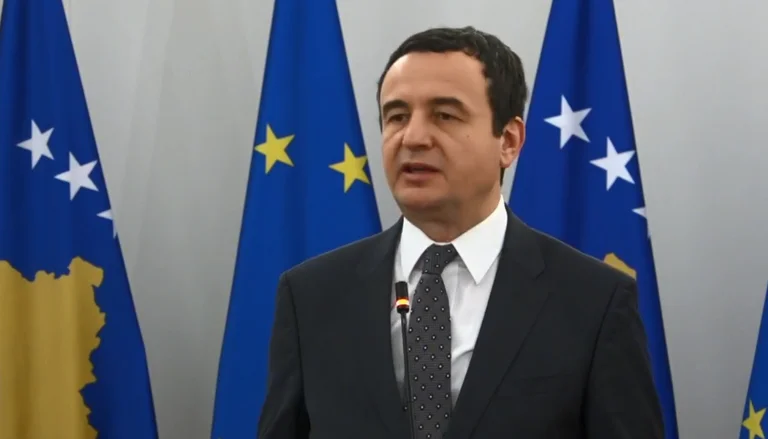
Kosovo Prime Minister Albin Kurti has welcomed the defeat of Aleksandar Vučić’s political camp in Serbia’s October parliamentary elections, but expressed caution about the political direction of the opposition forces that emerged victorious.
“We know who lost, but we still do not know who won,” Kurti told the French newspaper Le Monde, commenting on the election results and the prospects for a new political landscape in Serbia.
In the interview, Kurti also discussed Kosovo’s security concerns amid rising geopolitical tensions, its European and NATO ambitions, relations with France, and plans to attract foreign investment.
“The Russian aggression against Ukraine shows that history is returning to the world stage with greater force than ever in this century,” Kurti said, according to Le Monde. The newspaper noted that Kosovo feels vulnerable as geopolitical tensions intensify, particularly given Serbia’s close relationship with Russia.
Kurti is in Paris for a three-day visit, during which he is participating in the ninth Paris Peace Forum and holding meetings with French President Emmanuel Macron. The programme includes a one-on-one meeting at the Élysée Palace, followed by talks between the French and Kosovo delegations.
According to Le Monde, Prishtina is seeking French support on several issues, including preparations for the 2030 Mediterranean Games, which Kosovo is set to host. Kosovo has secured a €60 million loan from the French Development Agency (AFD) to finance the construction of an international athletes’ village.
Kurti also reiterated his ambition to bring Kosovo under the institutional protection of the European Union and NATO. However, the newspaper highlighted continuing disagreements between Prishtina and Belgrade over the autonomy offered to Kosovo Serbs, who account for approximately six percent of the population.
Serbia remains a major security concern for Kosovo, Kurti said, pointing to Belgrade’s continued support from Moscow. Kosovo is also still not recognised by five EU member states: Spain, Cyprus, Greece, Romania and Slovakia.
Kurti identified Slovakia as the country currently presenting the greatest resistance to Kosovo’s international integration, citing Prime Minister Robert Fico’s political closeness to Russian President Vladimir Putin and former Hungarian Prime Minister Viktor Orbán.
He also referred to Fico’s recent appearance alongside Serbian nationalist leader Aleksandar Vučić during the October parliamentary election campaign, which ended with an opposition victory.
Kosovo’s lack of recognition by five EU members has continued to obstruct its European integration process, with the country still waiting to obtain candidate status. Kurti described Kosovo as the only European country committed to the enlargement process that has not yet received this status.
Following visa liberalisation for the Schengen area three years ago, Prishtina is now seeking progress towards EU membership without requesting special treatment.
“We do not want shortcuts, accelerated procedures or back doors into the European Union, but a process based on merit,” Kurti said.
He identified reforms in the justice system, public administration and education as the government’s three main priorities for the next four years, arguing that the integration process itself is as important as eventual EU membership.
On Serbia’s post-election political landscape, Kurti welcomed Vučić’s defeat but remained cautious about the prospects for cooperation with the victorious Students’ List. Although the student-backed movement won the October elections, its programme continues to strongly oppose Kosovo’s sovereignty.
Kurti’s remarks reflected uncertainty over whether the political change in Belgrade would lead to a shift in Serbia’s position towards Kosovo.
On the economic front, Kurti said his government was working to attract foreign investment, particularly in energy and infrastructure.
On November 10, French company Akuo Energy won a public tender to construct wind turbines with a total capacity of 98 megawatts.
Kosovo is also seeking approximately €500 million to finance the construction of five dams intended to meet the needs of industry, agriculture and households.
Railway development is another priority, both for economic growth and for reducing the country’s geographical isolation. Kurti is seeking financing for the construction of three railway lines and the modernisation of a fourth, with the aim of connecting Kosovo to the Trans-European Transport Network (TEN-T).
He stressed that railway infrastructure should not be viewed solely as an economic investment, but also as a matter of national and regional security, particularly given Kosovo’s landlocked position and the changing geopolitical environment.
“Look at Ukraine: people travel by train there, not by plane. That is why the train is the most resilient means of transport,” Kurti told Le Monde.