The Center for Contemporary Politics (CSP) has released its 2025 “State of Democracy in Serbia” report, describing a year of unprecedented turbulence. The central conclusion of the study is that the “quiet erosion” of democratic institutions has ended, replaced by an overt and aggressive struggle between an authoritarian government and a pro-democratic, mobilized society.
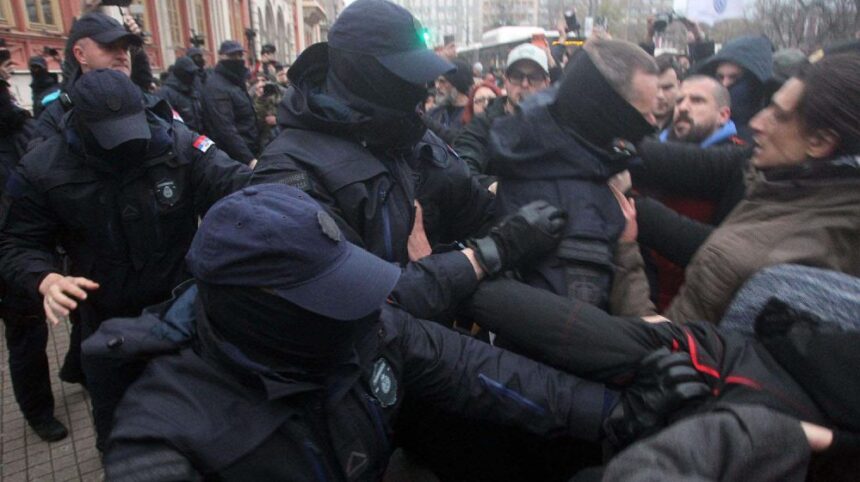
Presenting the findings, researcher and co-author Aleksandar Ivković noted that the government has met citizen and student protests with “unseen levels of repression, institutional pressure, and brutal propaganda.” This shift represents a direct assault on the remaining “pockets” of institutional integrity within the state.
Critical Indicators of Democratic Erosion
The report utilizes several key metrics to illustrate the deteriorating political climate in Serbia:
- Stalled EU Integration: Serbia has failed to make a single formal step forward in its EU accession negotiations for 51 consecutive months.
- Escalating Civil Unrest: Over 23,000 protest gatherings were recorded in the first nine months of 2025 alone.
- Violence Against Media: The report documented 116 physical attacks on journalists, highlighting the perilous state of media freedom.
- Parliamentary Inactivity: It took the National Assembly 50 days to confirm the government’s resignation, a delay that researchers say points to a deliberate strategy to marginalize the role of parliament.
One positive trend noted was a 10.65% increase in voter turnout during the 2025 local elections compared to the 2021 cycle, suggesting a more politically active and mobilized electorate.
The Voter Registry and Legislative Concerns
Vujo Ilić, a member of the newly formed commission for the revision of the voter registry, stated that the commission’s first report is expected in late October. He expressed skepticism that the Ministry of State Administration would meet the May 15 legal deadline for publishing voter data per household, emphasizing that the commission’s primary challenge is establishing a consensus on methodology and securing transparent data from state organs.
Furthermore, the National Convention on the European Union expressed deep concern regarding potential new laws on associations. Bojana Selaković warned that proposed changes might:
- Target organizations receiving foreign funding.
- Endanger the legal status of informal citizen groups.
- Shift the legal perception of NGOs toward “foreign agents,” similar to restrictive models seen elsewhere.
Shift in Brussels’ Perspective
The report notes a significant change in tone from the European Union. According to Selaković, the arrival of Marta Kos as the European Commissioner for Enlargement has led to much more direct and negative critiques of Serbia’s democratic standards compared to previous years.
Nikola Burazer, Program Director of the CSP, warned that as the regime feels increasingly threatened by the political articulation of student movements, its methods of dealing with critics—both in the media and on the streets—are becoming increasingly desperate and aggressive.
“We have entered a completely new phase that points toward a clear path to a change in government,” Burazer stated, “but this has pushed the regime into an even more hostile stance against those remaining within the system who resist.”