False and unverified claims about protester deaths, Serbian police involvement, alleged kidnappings and flights arriving from Israel have circulated during recent anti-government demonstrations in Albania, according to fact-checkers cited by Radio Free Europe/Radio Liberty (RFE/RL).
Some of the claims have been debunked by institutions and fact-checking organizations, while others remain unverified. Nevila Gjata, editor-in-chief of Albania’s fact-checking platform Faktoje.al, said the misinformation surrounding the latest protests differs from that seen during the earlier “Flamingo” movement, with greater emphasis now placed on specific incidents, alleged violence, casualties and protesters’ safety.
Claims of deaths, kidnappings and foreign police
During protests held from October 13 to 16, social media posts claimed that demonstrators had been intubated following police violence, that young people were in comas and that protesters had died, including a young man from Tetovo.
According to Gjata, these claims were not confirmed by doctors at the Trauma Hospital, the Ministry of Health or Faktoje.al’s on-the-ground checks.
Other posts and messages circulating on social media and communication platforms alleged that three girls had been abducted by unknown men in Tirana’s Student City area, while another girl had allegedly been taken away by people wearing civilian clothes.
Faktoje.al debunked the claims concerning the three girls after checking with local administrators, examining testimony and contacting female students living in the area. Police also rejected the claim that a girl had been forced into a van.
Gjata said the claims were circulated for different reasons. Some people believed them, others shared them to generate clicks and profit, while some sought to heighten tensions by exploiting fear and anger. Others used the claims to attribute violence to the ruling Socialist Party, she said.
However, Gjata cautioned that false claims about police violence were spreading alongside documented cases of actual violence against demonstrators.
“Police violence against young people has been brutal and deeply concerning in quite a few cases,” she told RFE/RL, adding that videos had documented serious incidents requiring concrete action.
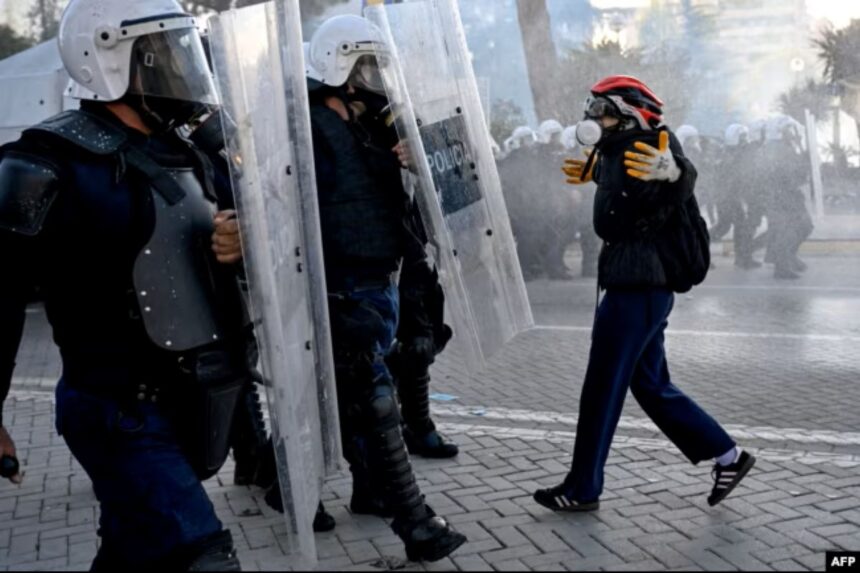
During six days of protests, police used tear gas, water cannons and rubber bullets to disperse demonstrators. Police Director General Skënder Hita confirmed the use of these measures. Seven officers were suspended while disciplinary investigations were launched over suspected excessive force during the protests against Prime Minister Edi Rama’s government.
Albania’s Ombudsman, Endri Shabani, also opened an administrative investigation to assess whether the police response had been necessary and proportionate. On October 16, he said his institution had contacted 214 people deprived of their liberty and identified complaints involving police violence, a lack of medical care and violations of minors’ rights. Shabani condemned violence against both police officers and protesters.
According to the Health Ministry, 272 people sought medical assistance during the first five days of protests, from October 13 to 17. They included 169 police officers, 82 demonstrators and 21 bystanders.
Allegations of Serbian and German police involvement
Another set of claims alleged that foreign security forces had been brought in to suppress the demonstrations. Messages and images circulating online claimed that the Albanian government had engaged Serbian and German police officers to intervene against protesters.
One photograph presented as evidence of their presence was found by Faktoje.al to have been generated using artificial intelligence. Albania’s State Police also denied that foreign officers had been deployed.
Claims of foreign involvement also spread through posts about an alleged influx of aircraft arriving from Israel. Some posts suggested that flights were being concealed from airport information boards or that aircraft had switched off their tracking systems, linking the alleged activity to the protests.
Tirana International Airport rejected these claims, stating that there had been no additional flights from Tel Aviv and that operations were continuing according to schedule.
From the “Flamingo” movement to the current protests
Gjata said misinformation during the earlier “Flamingo” protests was dominated by geopolitical and ideological narratives. Demonstrations were portrayed as the result of foreign interference, including alleged “hybrid warfare” and involvement by Greece or Iran. Other claims alleged that George Soros and donors linked to environmental organizations PPNEA and EcoAlbania were financing the movement.
Additional narratives framed the protests in antisemitic terms through claims about an Israeli enclave or presented them as a form of cultural interference by linking the flamingo symbol to the LGBT community.
“During the ‘Flamingo’ protests, the narratives were largely driven from the top,” Gjata told RFE/RL, referring to statements by Prime Minister Rama, television programmes, analysts, lawmakers from both the Democratic Party and Socialist Party, and Serbian and regional media.
She said claims about “foreign enemies,” repeated by Rama and amplified by Socialist Party lawmakers and some commentators, became so widespread that they began to be treated as normal elements of public debate.
Foreign-interference allegations have also resurfaced during the latest demonstrations.
On October 18, Rama said a drone carrying explosives had been neutralized before it could strike the prime minister’s office. He blamed “foreign hands” for the unrest, referring to Iran and Russia, but did not publicly present verifiable evidence linking either country to the organization of the protests.
Rama also said Albania had collected extensive information about alleged interference on social media, singling out Iran’s government.
Two days earlier, the State Police announced that it had identified online channels and groups allegedly used to encourage violent acts and issue threats against police officers. Investigations were launched, but police did not publicly link the channels to foreign interference.
On October 19, Rama said young people participating in violent protests had been ideologically influenced and radicalized by the Antifa movement, which US President Donald Trump has designated as a terrorist organization.
Unverified claims involving Kosovo’s Albin Kurti
A further claim circulating on social media alleges that Kosovo Prime Minister Albin Kurti has been involved in efforts to overthrow Rama’s government.
The allegation was linked to media reports about the arrest of two Kosovo citizens in Tirana and the publication of a police report. According to the report, one of the men allegedly said he supported Kurti and had travelled to Albania to protest against Rama’s government, hoping it would be replaced by a government supportive of the policies of Kosovo’s Vetëvendosje movement.
Faktoje.al said it had been unable to verify the claim. RFE/RL contacted Kosovo’s prime minister’s office for comment but had received no response by the time the report was published.
Kosovo Assembly Speaker Albulena Haxhiu, from Vetëvendosje, said her party had never called for participation in or support for protests in Albania. She added that although the movement enjoyed broad public support, it could not be held responsible if individual supporters chose to attend demonstrations across the border.
Instagram and WhatsApp play a growing role
According to Gjata, the most serious claims surrounding the current protests are spreading primarily through Instagram and WhatsApp, often via pages and groups associated with the demonstrations. Some of the claims have subsequently been picked up by television channels.
She said the audience also differs from that reached by misinformation during the “Flamingo” protests. Those narratives had a documented regional reach, including in Serbia, Kosovo, North Macedonia, Montenegro and Croatia. Faktoje.al has not identified comparable evidence of a regional dimension in the current wave of misinformation.
The current claims appear to be directed mainly at domestic audiences, particularly parents, secondary-school students, university students and educators.
The use of artificial intelligence remains a common feature of both periods. Earlier examples included images purporting to show buses arriving from Greece during the “Flamingo” protests. More recent examples have included manipulated images of Tirana City Hall and purported foreign police officers.
Gjata said the earlier misinformation campaign sought to shift public debate away from environmental issues and citizens’ rights toward alleged “foreign enemies.” During the current protests, she said, attempts to discredit opposing sides have been accompanied by claims designed to generate fear and insecurity.
Although some debunked claims received thousands of social media likes, she said there was not yet enough data to measure their actual impact on public opinion.
Faktoje.al has identified sources that circulated unsupported claims but has not found evidence of a coordinated network or a single actor responsible for the misinformation, Gjata said.