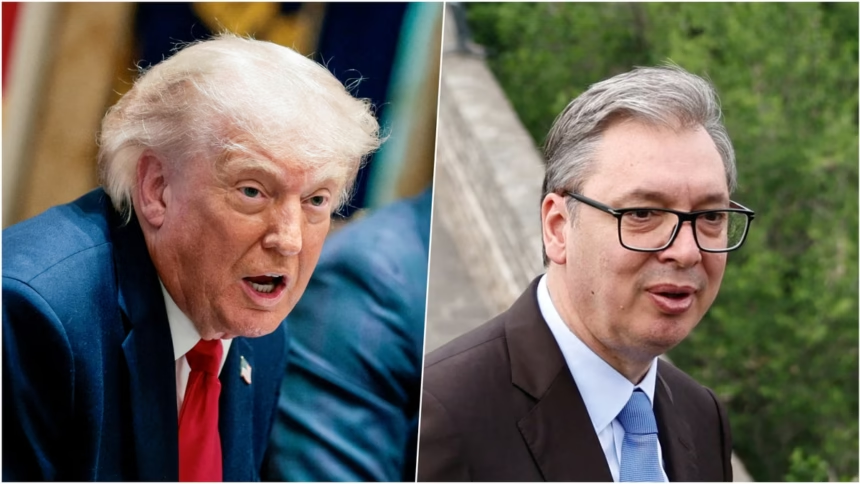
U.S. President Donald Trump has described relations between Washington and Belgrade as “very good,” while Serbian President Aleksandar Vučić has repeatedly offered similarly positive assessments. However, a strategic dialogue between the two governments and growing cooperation in energy and education contrast with bipartisan proposals in the U.S. Congress calling for sanctions against Serbia over democratic backsliding and its ties with Russia, China and Iran.
The apparent contradiction raises questions about whether relations between the two countries are genuinely at a historic high or whether the positive rhetoric reflects political and diplomatic calculations.
Speaking to N1, political analyst Dimitrije Milić of the organisation Novi Treći Put said the answer depended on the perspective, while former Serbian ambassador to the United States Ivan Vujačić rejected the claim that relations had never been better.
Strategic dialogue and cooperation agreements
During the summer, U.S. Secretary of State Marco Rubio and Serbian Foreign Minister Marko Đurić signed two memorandums in Washington covering cooperation in energy and education, formally launching a strategic dialogue between the countries.
Such dialogues are used by Washington to develop cooperation with other governments across areas including the economy, security and foreign policy.
Trump has also shared interviews with Vučić on his Truth Social platform, including appearances on conservative media outlets Breitbart and Fox News in which the Serbian president spoke positively about bilateral relations.
Vujačić, however, argued that Trump’s decision to share the interviews should not be interpreted as proof of an unusually close political relationship. He suggested that the American president’s public relations team may have influenced the decision.
N1 previously reported that the U.S. lobbying firm Valkur, hired by the Serbian government, helped arrange Vučić’s interview with Breitbart. Information in the firm’s regular filing with the U.S. Department of Justice reportedly documented its involvement. Breitbart’s Washington bureau chief, Matthew Boyle, subsequently disputed that the interview had been arranged through lobbyists, saying Trump regularly shares the outlet’s interviews.
Vujačić also pointed to Vučić’s trip to Florida, where the Serbian president met former New York mayor Rudy Giuliani but did not hold the anticipated meeting with Trump. Vučić shortened his visit because of health problems.
Another setback was the proposed redevelopment of the former Yugoslav Army General Staff headquarters in Belgrade. A company associated with Trump’s son-in-law Jared Kushner withdrew from the project following public controversy. Serbian prosecutors subsequently pursued a case concerning suspicions that documents used to remove the complex’s protected cultural heritage status had been falsified. Culture Minister Nikola Selaković was among those charged in the case, according to the report.
Vujačić said the relationship had previously deteriorated significantly and argued that the recent improvement should not be portrayed as evidence of an unprecedented partnership.
Bipartisan calls for sanctions in Congress
While the White House has emphasised cooperation, members of Congress from both major parties have raised concerns about Serbia’s democratic institutions and foreign policy.
In late August, Republican Congressman Joe Wilson and Democratic Congressman Bill Keating introduced legislation calling for measures against Serbia over what they described as serious democratic and rule-of-law backsliding, as well as cooperation with Russia, China and Iran.
The proposal included financial and visa sanctions targeting individuals considered responsible for destabilising the Western Balkans or threatening regional peace, security, stability and territorial integrity.
In early October, Republican Senator Chuck Grassley and Democratic Senator Richard Blumenthal introduced a separate bipartisan bill on Serbia in the Senate. It proposed financial and visa restrictions against individuals who obstruct international agreements considered important for regional stability. It also called for greater alignment of Serbia’s foreign policy with the European Union and NATO and for Belgrade to distance itself from Russian, Chinese and Iranian influence.
The proposals illustrate that criticism of Serbia’s government extends across party lines in Congress, although the introduction of legislation does not mean that the measures have become official U.S. policy.
Energy cooperation offers potential benefits
Milić said relations could appear particularly positive when assessed through formal diplomatic engagement and potential economic projects.
“The strategic dialogue has formally begun. Cooperation in the energy sector is taking shape through concrete projects, such as Đerdap 3 and the diversification of Serbia’s gas supplies,” he told N1.
However, he noted that ownership of Serbia’s oil company NIS remained unresolved and that uncertainty surrounding future trade was compounded by changes in the Republican administration’s tariff policy.
Milić identified energy as one of the areas where Serbia could gain the most from closer ties with Washington. Serbia remains significantly exposed to Russian influence in the gas sector, although imports from Azerbaijan have reduced its dependence compared with 2022.
Potential cooperation in advanced technology and artificial intelligence could also bring investment and strengthen Serbia’s economic links with the United States, he added.
Milić argued that U.S. interest in Serbia had increased over time as Russian and Chinese influence in the Western Balkans grew and relations between Washington and those powers deteriorated.
During Barack Obama’s presidency, Serbia largely remained outside Washington’s main focus, he said. The 2020 Washington Agreement, signed near the end of Trump’s first term, brought Serbia greater attention, while the Biden administration continued engagement through energy cooperation, the launch of the strategic dialogue and sanctions related to NIS.
The current Trump administration has continued to expand the range of issues discussed with Belgrade, Milić said, reflecting broader changes in the international environment.
Trump as a political advantage for Vučić
Vujačić offered a more sceptical interpretation of the Serbian government’s efforts to cultivate ties with Trump, describing the American president as transactional.
He argued that Vučić was seeking closer relations with Trump partly to strengthen his political position in dealings with the European Union, suggesting that the Serbian government’s public messaging often reflects a critical stance toward European and Western institutions.
Vujačić compared the strategy with Hungarian Prime Minister Viktor Orbán’s relationship with Trump, arguing that close personal or political ties with the American president do not necessarily deliver the desired benefits.
He also questioned the scale of the strategic dialogue, describing the term as overstated when applied to relations between a global power and a comparatively small country.
Vujačić cited the proposed Đerdap 3 hydropower project, which could require Serbia to borrow billions of dollars, as an example of what he views as Belgrade’s willingness to offer significant economic commitments in pursuit of more favourable treatment from Washington.
“I think the Serbian government cares much more about relations with the United States than the other way around,” he told N1. He added that Serbia was unlikely to be among Trump’s principal priorities compared with issues such as the Strait of Hormuz, the war in Ukraine and relations with China.
Different priorities in the White House and Congress
Milić said the difference between the White House’s approach and congressional criticism reflected the distinct roles of the executive and legislative branches.
The administration, he explained, generally operates according to practical diplomatic and economic considerations and may cooperate with governments despite disagreements over policy. Members of Congress have greater freedom to express their own political positions and criticism.
“Many congressional initiatives never become official state policy, although some eventually do,” Milić said, adding that it was not yet clear whether the current proposals against Serbia would advance into law.
Vujačić, meanwhile, emphasised that the lawmakers behind the two proposals came from opposing parties. Although they do not represent a congressional majority, he said their initiatives reflected concerns that Serbia’s government had crossed important democratic boundaries.
The contrast between Trump’s praise, the launch of strategic dialogue and the bipartisan legislative initiatives therefore reveals competing approaches within Washington rather than a single, uniform assessment of Belgrade.
For Serbia, the practical significance of the relationship will depend not only on presidential statements and signed memorandums, but also on whether promised energy and technology cooperation materialises, how unresolved economic issues are addressed and whether congressional pressure translates into concrete policy.